> The Democratic party platform explicitly talks about removing barriers to municipal broadband as a goal, which is the only way you are going to get competition where ISPs have a monopoly. At least in the current landscape where it's cost-prohibitive for a competitor to enter a region.
It's only "cost-prohibitive for a competitor to enter a region" because of build-out requirements which are broadly supported by Democrats. I used to live in Baltimore, where Verizon wanted to come in and compete with Comcast. The city refused to let Verizon come in and compete. Then they put out an RFP that basically sought bids for ISPs to come in and provide universal service for free. Nobody took Baltimore up on the offer.
We see this so often now I'm starting to think it's an intentional strategy.
Step 1: create conditions that prevent capitalism from solving a problem. Step 2: declare that capitalism has failed and call for government solutions.
This is a strategy we see from both sides. From the other perspective:
Step 1: Create conditions that prevent the government from solving a problem. Step 2: Declare that the public sector has failed and call for privatization.
You're claiming a "both sides" problem in a system with extraordinary power imbalances.
Businesses in a free market aren't writing laws and regulations that can put people in jail. With government's great power should come an acknowledgement that it must solve the problems it claims it can, in the way it claims it can, or back the hell off.
The problem with having an expansive public sector is that it never stops expanding and has an extremely strong tendency of becoming unequal, disconnected or or one-size-fits-all as the scope/complexity of the programs expand.
This is particularly the case when our electoral choices at many a level boil down to binary options that may not project well for individuals with values/views that are largely orthogonal to the options practically available. For example if I were pro ABCDEFG, and one candidate is Anti ABC, and the other anti EFG; Which one should I choose when taken together the value of one set over the other is subjective and not even ordinal?
One mustn't forget that the power to do great good is inherently also the power to do great harm intentionally or not.
Competition is great for consumers. The government should be allowed to compete along with the private sector. The winners of this scenario are the citizens and the people who work for these companies.
I've seen exactly this scenario play out in Santa Cruz. Comcast had a virtual monopoly. Even as recently as about 5 years ago one of the best internet packages was up to 20mbps (4mbps in reality) for $40/month.
The city announced a partnership with Cruzio for municipal broadband and virtually overnight Comcast started offering 200mbps for $50/month.
Today you can get around 400mbps for $55/month.
We should do the exact same thing with healthcare (public option).
I generally agree at a local/municipal scale but that generally doesn't scale well and is often relatively unstable if it is not operated as an mostly isolated entity given the strong conflict of interest of officials involved easily and often leads to regulating private industry out of existence.
Where do you see that being the case with broadband? There are many examples of private sector monopolies, but I've never heard of private sector broadband being regulated out of existence.
For telco stuff specifically it's more that local governments love to rentseek from the incumbents. The faustian bargain is that the telcos pony up and in exchange the government, usually local, makes it nearly impossible for new players to enter. Some of those policies might end up making it harder for them to operate but it's harder still for competitors. The same is true when hospital networks try to expand beyond state lines. The reasoning goes if I can't expand why should they?
Imagine a company whose elected board members believed that the company should abandon its current market, should be scaled back or shouldn't even exist, and they enacted policies and made hires in accordance to those beliefs. That's what's happening in the US government.
The difference is that Democrats keep succeeding in enacting strangling regulation, and Republicans keep failing to "kneecap" social programs.
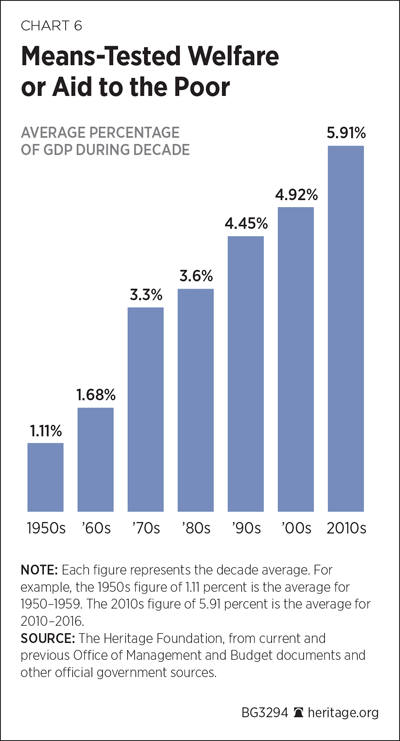
What major social program has seen funding cut since the 1970s? The percentage of the economy that goes to means-tested welfare has almost doubled from 1970 to today: https://www.heritage.org/sites/default/files/inline-images/B.... The only blip was right after the 2008 recession, but spending has mostly recovered since that time.
Now, I support welfare spending. (I'd like it better if we focused more on cash transfers to the poor, though.) But the notion that any major social program has ever been "kneecapped" is a myth.
Perhaps not a kneecapping, but Planned Parenthood recently lost a sizeable chunk of its federal funding thanks to a domestic variant of the global gag rule[1].
The 2018 omnibus budget contained a variety of funding cuts for social programs. A good example of a dramatic reduction is the 21st CCLC (a funding stream for afterschool programs) being eliminated entirely, to the tune of $1.2 billion USD[2]. That was part of a larger >10% cut to education programs as a whole, which I would consider significant.
Sure, programs get cut or funded based on various political considerations, and there might be cuts some years and growth other years. And there is a deliberate attempt to stymie provision of abortion services. That's a fair point.
> On a per-pupil basis and adjusted for inflation, public school funding increased: 24 percent from 1991-92 through 2001-02 (the last year for which such data are available); 19 percent from 1996-97 through 2001-02; and 10 percent from 1998-99 through 2001-02.
Maybe this is a nitpick, but: it can be both true that per-pupil spending goes up and that spending on social programs via the DOEd goes down.
A concrete example: the current DOEd has increased funding of both charter and private schools. We can go back and forth on whether elements of that constitute social programs, but I think the point about it not being tied to the larger funding trend stands.
That’s true in principle, but it’s not a significant factor in the aggregate. Almost all US social programs are government-administered. To your example, we are behind Western Europe in the area of school choice: https://www.edchoice.org/engage/faqs/how-does-school-choice-...
Similar stories about in other areas. In Europe it is common for private companies to operate transit systems. (Stockholm’s subway is operated by the same company that operates Hong Kong’s.) In the US, nearly every large transit system is operated by government workers on the government payroll.
Oh? Obamacare is the recent, big one that comes to mind. The crazy thing is that the "charitable" parts were part of it back in 1991, when it was considered a right-wing proposal, but the Overton window moved so far to the right that today's right wing called them socialism and kicked them out the door.
Goverment funding has been chopped for state schools, housing projects, the list goes on. The right kills social programs on a practically daily basis. Not to mention shifting the tax burden away from the upper class and towards the middle class. If your taxes have been going up over the last 30 years, it's because you aren't upper class.
And yeah, social spending has increased ever since we shipped all the jobs to China. Democrats rationalized it by promising to use the new revenue on social programs; Republicans put a stop to that straight away. The American middle class got double-teamed. Privatize the gains, socialize the losses!
I don't know about intentional, but I think it's unfortunately common. I think housing is the most egregious example. I live in a neighborhood filled with millennial parents who have their own detached homes and fairly modest jobs (mix of college/non-college). Meanwhile, my lawyer friends earning six figures feel like they can't afford homes or to start families. The difference is that they live in heavily regulated cities, and I live in an unincorporated part of a fairly rural county a few miles away from a small city. (But still in a blue state!)
I'm not a hard-right libertarian--I think healthcare probably has some examples of market failures and maybe we need something like universal catastrophic insurance. But yeah, some of these problems, like housing costs, really are self-inflicted.
I think the other approach is to shift blame or sweep under the rug problems with services that are entirely publicly run. If you have a problem with the schools or police in your blue city/state, 90% of your energy should be directed to your own state and local officials! (Instead of railing against Jeff Bezos or Donald Trump.)
To add to jjoonathan's point, I'll share an interesting observation about the Bay Area housing market:
The Bay Area has a number of little-known unincorporated enclaves that are often located within incorporated cities. Places like Devonshire (San Carlos), Emerald Hills (Redwood City), the unincorporated strip of San Carlos Ave (San Jose), Ladera or Los Trancos Woods (Portola Valley), Castro Valley and San Lorenzo (Hayward/Oakland). I've noticed that in today's hot market, houses in those areas consistently go for anything for $0-150K under asking, while houses in the nearby cities go for $150-500K over asking. A typical swing in purchase price for equivalent homes in nearly equivalent locations is about $300K (on prices of about $1.8-2.2M).
The usual real-estate confounders don't apply here because the geographic locations are so similar. The fire danger is roughly equivalent (but high): places like Devonshire and Emerald Hills are inside of 280, and right next door to equally flammable but more expensive houses in Belmont, San Carlos, and Redwood City. Commute times are basically identical, if anything a little shorter. There's less regulation for building, but not much more additional supply of land since these are constrained enclaves.
It seems like buyers are willing to pay a premium specifically to get city services and city regulation. Instead of the free market being impeded, this is the free market speaking: buyers are paying a premium to live in areas where there are more services and more regulation.
> The difference is that they live in heavily regulated cities, and I live in an unincorporated part of a fairly rural county
I can think of another difference: loads of people want to live where they do, pushing up prices, while few people want to live where you do, keeping prices reasonable.


It's only "cost-prohibitive for a competitor to enter a region" because of build-out requirements which are broadly supported by Democrats. I used to live in Baltimore, where Verizon wanted to come in and compete with Comcast. The city refused to let Verizon come in and compete. Then they put out an RFP that basically sought bids for ISPs to come in and provide universal service for free. Nobody took Baltimore up on the offer.