The problem is the proposed solutions really just entrench existing providers, specifically net neutrality policies: They legalize monopolies as long as they're "following the rules!"
_You_ _cannot_ _legislate_ _good_ _behavior_ _into_ _monopolies_. So while I appreciate the spirit of Net Neutrality rules, the solution is fundamentally flawed.
Let's say you want to open an ISP in your neighborhood. Based on their history (When Google Fiber moved into my area), Comcast will call their existing customer base and offer them services below cost but at the price of a 3year contract. This delays profitability for you as a new player into the space. Comcast can take money from one market (another state) and move the profits into subsidizing a loss to prevent players from entering the space in another market. By breaking this cash flow, you end the stagnation of consumer choice, driving innovation forward.
My water company is pretty well behaved. Sewer too. Trash pickup is without headaches although I don't know the cost. Even my power company is ok now. They had a bad part in the early 2000s when they were trying to semi-privatize and Enron was trying to horn in on the management, but once they went back to being an ordinary utility the bad behavior stopped.
I have had horrendous experienced with Waste Management on three occasions. Moving out of the neighborhood they had a city-enforced monopoly on was the only solution (granted, i moved for other reasons, but getting someone else was a delight all its own).
Similarly my previous trash company raised rates several times the year before last nearly doubling the cost, then a competitor came in at the original price and virtually everyone switched. They offered to lower us back down when we canceled the service but they were a day late and a dollar short. They still send us letters begging us to come back.
But in this case the remedy is head to your local town hall and start complaining. The "monopoly" is usually a 5ish year contract that the city sends out for bids.
I'd love the ability to head to city hall and convince local leaders to switch from Comcast to X.
This was back when I was living in a large suburb. The whole place was divided among a half-dozen or so trash companies. I might have complained, but moving was a whole lot easier than waiting 5 years to maybe get a change.
Before the monopolies were granted, people could pick their own haulers. The monopolies were granted to cut down on truck traffic- the fact that WM took iver my street was evidence enough that one complaint would not dislodge them.
You might actually have more luck with complaining about your internet service. The rural area I moved to only had DSL, and the quality was so bad the town threatened to kick the carrier out if they didnt improve. Instead, they agreed to lay fiber to the entire service area, and it was only about a year after I moved in that we got it. (Way overpriced for full gigabit, of course, but thats rural internet).
Water, sewer, trash pickup, and power have very easy to understand quality metrics, and can be easily regulated.
An internet connection is not so easy to measure. You could have a very well provisioned and maintained local loop, and poor connectivity from there. I strongly support local loop unbundling --- you can regulate the local loop in simple terms, and let competition manage the messy network interconnection bit.
For what it's worth, your suggestion is very similar to the way that electricity is sold where I live - I pay separate prices for electricity generation (where I can choose) and electricity delivery (where I cannot choose).
I'm not going to pretend to know all the pros/cons, but it is reliable and cheaper than average.
I extremely do not want the situation where the state owns and operates the communications infrastructure of the general population.
That's turnkey tyranny, censorship both ways (what you can send, what you can read). Right now it's just expensive, but you can still use a few different (overpriced and anti-competitive) providers.
If the state decides you're a threat and unplugs you, it could be months or years before you can invoke your legal rights to get reinstated.
ISPs give the US government absolutely anything they want. You have no real protection from the government because of private ownership, the only difference is now both private organizations AND the government make decisions about your internet access. You also pay more for less vs most countries with more regulated infrastructure or state owned infrastructure.
I'm happy to look at any evidence you have, but everything I have seen indicates US internet is vastly worse than more public-oriented systems, unless you own internet infrastructure.
Municipal broadband where the county PUD owns the fiber and multiple private companies provide service over them works great. Which is why you can get gigabit internet for like $50 some places and struggle to get decent internet in the suburbs.
Also Comcast is not going to tell the federal government "no" to a data request if it doesn't benifit them.
Yes, but if the state is the only game in town, you can't pop down to the next shop and buy a new SIM card, or order an install from a different provider.
Owning the infrastructure (the cell towers, fiber lines) is not the same as operating a network, the infrastructure could be public owned, while the service provider operating in data centers that connects to those public owned infrascture for a cost.
*If the state decides you're a threat and unplugs you, it could be months or years before you can invoke your legal rights to get reinstated."
You've heard of no-fly lists, right?
At least there are some protections with governments, in general. With private companies, not only do you get the risk from the government, but whatever censorship the ISP decides to subject you to as well, and you might not have a choice.
Luckily, there are some ways around some of the controls - in no small part, by doing regulation or allowing a hybrid system (government owns/maintains infrastructure, leases it to companies, for example)
There was a period of years between when the no-fly list was instituted and when there was a system of relief for people who were placed on it erroneously.
This is really just supporting my point that you do NOT want the government involved in the system at all.
You still can’t get off of the no-fly list (even if you haven’t been convicted of a crime!) if the government wants you on it and you weren’t listed by accident, “redress number” program or no.
The state currently performs suspicionless surveillance on the entire traffic graph of the USPS. Every piece of mail is weighed and imaged and sender anf recipient are placed into a database, so it is impossible to send a letter without creating a permanent record of source and destination.
You can, of course, leave off the return address, and this works fine for letter mail.
Packages, however, require ID to be dropped off. You cannot use the USPS to send packages anonymously.
The analogous version for a state-run ISP would be a blanket filter/ban on Tor/VPN usage.
I don’t think the USPS is a good example of a state-run organization for that reason. The state has already demonstrated their desire to eradicate personal privacy and anonymity.
Are you sure that having privately owned and operated communications infrastructure will actually prevent any of the things you're concerned about?
For example, AT&T rolled right over when the government wanted more access to their infrastructure after 9/11, even though it was pretty clearly illegal.
I don't think this is a monopoly problem as much as a collusion problem: multiple providers exist but many regions each have a single provider. If this is a deliberate agreement then it's extremely illegal.
Where I live there are multiple high-quality ISPs at my building, the US should find a way to encourage multiple ISPs to be present in every single neighborhood.
People who complain about "too many ugly wires" should be ignored: it's much better to have ugly cables on poles than slow internet.
Your building, you say. I can choose between at least two providers in my apartment in Brooklyn, NY.
But somebody in upstate suburbia cannot, and they are lucky if their only provider is not utterly bad.
Density is key here. Suburbia is not dense enough, and is finicky enough about digging or running wires, to make building a competing network lucrative. And the US has a ton of low-density suburban population, even in formally urban agglomerations like LA or Houston.
One solution is to live in a proper city, but proper cities are not very numerous in US, and living there is more expensive.
That's more or less how it works here in New Zealand. A private company, Chorus, has a monopoly on the network itself, and can only provide the network to other ISPs and not direct to the consumer. I kind of presume there are other regulations in place, or conditions for the $1B subsidy they got for rolling out the fibre network.
As it is, for a household to get a plan that offers download speeds of 700Mbps-900Mbps and no data caps, we're paying NZ$109, or about US$72/mo.
And there's good competition, I'm paying NZ$90 for the same speed (900/400) with no data cap. Static IP. And all the NZ prices quoted include sales tax (NZ law requires this) so the equivalent US price without sales tax would be about US$52/mo.
Agreements between the local government and the provider aren't really collusion, just government created monopolies.
As for some kind of collusion between providers, if not competing is preferable for companies, why does anyone ever compete? Verbal agreements or not. Common sense says if you undercut someone's price they will cut their price too in response. Just offer the same price, stay out of their neighborhood, etc. Don't need to wink and nod about it. Yet we see fierce competition all over the place because that strategy doesn't work. New entrants always come along and they can't make a profit by playing that game when others already have all the market share. If you only see a single provider it's either a govt-protected monopoly as I mentioned above, or a beneficial monopoly that is holding prices too low for competition to see an opportunity.
Why not? Yes, breaking up monopolies is good but that doesn't mean we can't regulate industries before the point where things get so bad that there is enough political will to break them up.
Because companies are really good at optimizing and the outcomes are usually bad behavior that is not-yet legislated. It's a cat and mouse game. Much better to have a plethora of competition so that the competitive market provides the tight feedback loop. With wireless carriers the MVNO rules mean that I can shop around and jump ship pretty easily. I just switched providers a couple of months ago.
Look at PG&E. They're badly behaved but also highly regulated.
> Natural monopolies need counterbalancing regulation. This isn't even remotely a controversial statement in economics.
Unless your argument is that the Austrian and Chicago schools of economics doesn't actually exist, this is quite wrong, since the Austrian school denies the existence of natural monopoly and argues that harmful monopoly can only exist as a product of government regulation, and the Chicago school likewise holds that absent regulation, monopoly is a transient condition, not a stable one; both favor removing regulations that they see as stabilizing harmful monopolies, rather than regulating to manage naturally-formed-and-self-stabilizing monopolies, which they don't acknowledge the existence of.
Now, I think the Chicago/Austrian positions on monopolies are wrong, but you really can't reasonably deny that this is a fundamental area of controversy.
Yes. I am entirely comfortable in saying that the economic consensus is strongly against the Austrian and Chicago perspectives. Both of these schools value prior ideology over empirical data. It's a "debate" on forums like this, but not even remotely so amongst the economists I talk to.
> Both of these schools value prior ideology over empirical data.
Austrian overtly so, Chicago less so, but, yes, its another issue that "is economics an empirical science" is also a controversial position in economics.
> but not even remotely so amongst the economists I talk to.
That's a very different claim than your original one. That last qualifier does quite a bit of work.
Yeah, it does the work of every actual credentialed economist I know has nothing but utter contempt for praxeology. As should be. As should you, if you cared enough.
The Austrian school is pretty famous for rejecting empiricism and basically saying it's their way or nothing; it may come to valid conclusions but because they reject any evidentiary evaluation of their assumptions its unfalsifiable (and therefore not a scientific way of approaching the world)
If their conclusions didn't happen to support those in power and capital in particular, they'd be just another meaningless research group.
It's not even sarcastic. The Austrian school literally starts with assumptions that basically imply their solutions, that people always act in their best interest and so on, and reject any kind of empirical test of their theory. At all. The Austrian school assumes that these bases are absolutely and completely true, and then posit that all economic truths can be derived thereof and cannot be impacted negatively or positively by empirical evidence.
Not actually the case. You are massively overestimating the impact of praxeology on Austrian economics. Austrian economics predates praxeology for 80 years.
The problem is that you are not actual arguing against austrian economics but a political movement that has hijacked the ideas and presents itself as 'the solution' that proves their political view. This is mostly driven by some conservative finance and the 'The Mises institute', that should actually be called 'The Rothbart Institute'. As they don't really represent Austrian economics as a whole, but rather a narrow minded interpretation of Mises.
If you look at the Austrians generally and those still in academia, they do not actually work that way, and they don't reject empiricism as a whole. The reject pure empiricism and pure positivism, in favor of a individual and institutional approach that is validated by data. In practice and historically Austrian economics was much closer to what we today would consider institutional economics, Law&Economics and Political Economics.
I have years ago stopped fighting since the term has been so discredited by the mob of morons on the internet. Some economists that solidly work within Austrian tradition have stopped using that term because of those bad associations.
But I'm just telling you, your argument really is just like arguing against some Burnie fam who proclaims Keynsian economics implies socialism.
No, no it's not. It's treating economics as some bastardized version of philosophy, not math. Mathematical axioms are based on the principle that you cannot imagine an alternative axiomatic system, I can easily imagine a different axiomatic system for economics, and that the axioms cannot be empirically contradicted. And I can actually justify it empirically.
You maybe right, but not the way you interpret math. Mathematical axioms are not empirical, and contradictions do arose from those axioms. Non-Euclidean geometry[0] would be a good starting point, Russell's paradox[1] is also worth entertaining. Mathematical axioms are assumptions made that works treated as truth, not the truth taken for granted.
That's exactly my point. Mathematical axioms aren't empirically testable, and mathematics accepts many different axioms.
Praxeology doesn't accept other axioms, and the axioms it accepts are empirically testable. Which is the why math is fine but Austrian economics isn't.
Also, mathematics doesn't make claims on the real world.
That's exactly the point. Non-euclidien geometry is still geometry, and axiomatic systems without the Axiom of Choice is still math.
The Austrians start with their axioms and do not accept anyone with other axioms. And unlike mathematical axioms, their axioms are actually empirically testable.
The problem is that a monopoly may naturally be disrupted in decades, while people want an improvement during their precious only lifetimes.
A temporary regulation could possibly help, but making it temporary is the hard part. And if it lingers, the inefficiencies it creates let some companies become incumbents, and, with some luck, even monopolies.
I'm more inclined to think that under a completely unregulated free market a monopoly today would instead be more likely to turn into a de-facto nation state over the course of decades. But this is purely speculation (not entirely unprompted by reading speculative fiction).
Is there any evidence that unregulated free markets actually tend towards competition, rather than consolidation?
>I'm more inclined to think that under a completely unregulated free market a monopoly today would instead be more likely to turn into a de-facto nation state over the course of decades
Based on recent experience this does appear possible, that some monopolies have gotten savvy enough to become long-running nation-state-like entities if left unregulated.
We know from the science of complex systems that one characteristic non-linear dynamic systems, like markets or national economies, is that the critical resources of the system tend to concentrate and consolidate over time.
We’ve witnessed this over the past several decades with the deregulation of the US banking industry, its subsequent concentration and consolidation.
Libertarians like to believe that such economic problems are self-correcting, that eventually such concentrations of wealth and economic power will either asymptotically collapse, or become ossified and be supplanted by something newer and innovative. Either way there’s a reset.
But I don’t think either is inevitable, in all domains. What we’ve actually observed with the banking system is that:
1) powerful monopolies/oligopolies use their resources to capture the actual government and regulators, and use those entities to shape favorable laws, and to bail out the monopolies when they collapse, preventing the reset, and
2) even if the collapse and reset occurs, it causes far more damage and misery to the rest of the economy and society than to the people responsible for causing it.
All else equal I’d rather live in a society that simply prevents those extreme cycles by making natural monopolies into well-regulated public utilities. Public utilities in the US have worked very well for a century, they’re a far more desirable economic arrangement for 99% of society.
You are making a rather large jump here. A natural monopoly in broadband services for example is very unlike to turn into a nation state.
You assume markets are inherently centralizing. Where is this assumption coming from, its actually Marxist economics. If you critic Austrian for being empirical, we should first admit that this base assumption is purely based on a school of thought that is much more un-empirical then any Austrian or other market oriented schools ever where.
This prediction was made 200+ years ago, and we have seen a trend towards ever greater number of companies. The amount of interventions by government, with things like anti-trust act were incredibly few and far between.
If there was any validity to the concept, of inherent centralization, we would have seen government having to near constantly fight monopoly.
Both in illegal and legal market we constantly see disruption of big players. The stability of the farmer own farms, rather then the inherent centralization corporate farming. The distributed production of meth, replacing the centralized supply of other drugs. The restaurant industry has existed with few regulation and no anti-trust cases for 100s of years.
I would argue the argument that all markets are inherently centralizing has been totally dis-proven by evidence. Even in the cases where Anti-Trust cases were launched, usually by the time they came anywhere near breaking up a company, the original problem had basically passed. I'm only 30 and in my lifetime I have already seen like 4 tech companies who were gone dominate the world and if Anti-Trust wasn't invoked society was doomed according to people on Hacker News.
There are natural monopoly, and markets where one player can dominate. These are more complex cases, but they are also limited in scope and unlikely to grow out of that market. In fact in general those companies usually become rather happy with just profiting from their monopoly and quickly lose the drive to go into the competitive markets.
In those cases regulation in the short term can help, but being aware of locking in the system are very real, making any kind of disruption in those markets incredibly difficult.
At the time, a broader evaluation of the concept of monopoly must realize that threw-out history, the majority of monopolies were state created. In fact, one of the kinds prime way of making mponey, was selling monopoly rights and using royal power to suppress competition. Some economists have even modeled the Soviet economy along those lines as well. This is largely still the case, the places where monopoly are most persistent, are places where it is created and sustained by regulation.
More common then strict monopoly is some small to mid sized group, getting regulation that protect them. My fav example are the like 15 families who produce cane suger in the US who have for 50 years profited from a sugar import tax. This is party the reason corn sugar is so much used in the US.
In the end, pragmatically the state should likely be aware of citizens being exploited in some natural monopoly situation, but also be aware that if it is actually a natural monopoly, even regulation can not systematically fix the problem either and can do harm in the long run.
Austrian economics doesn't actually deny the existance of natural monopoly. That is simply a wrong headed reading of Austrians by people who hate it.
If anything it says, natural monopolies exists, but some of the regulation designed to fight it, can be more harmful.
Austrians also try to not narrow down market so much, that monopolies are everywhere. Is Tom Hanks a monopoly on Tom Hanks, sure but does that matter. Is the market acting? Entertainment?
Just saying 'its a natural monopoly, therefore government need to come in with some strong handed specific regulation' is often a bad approach that can stop other mechanism from functioning. For example, locking in natural monopolies forever, even when future technologies means that monopoly would have been broken.
ISPs are NOT a natural monopoly, you can have multiple sets of wires going to every building. This is the situation in my part of Europe and my internet is pretty damn fast.
Treating ISPs as a monopoly is fundamentally wrong.
Multiple sets of wires going to every building is feasible and perhaps even reasonable when we're talking about an apartment building. But digging multiple trenches along suburban and rural roads and driveways leading to single-family homes is very wasteful. It's usually prohibitively expensive for the second company that wants to come into town, and is basically guaranteed to be a negative ROI for the third company that tries to lay fiber to customers who already have two incumbent options.
In the US, Google Fiber has had limited success entering a handful of carefully-picked markets where the incumbent options are rotting copper POTS wires vs coax that can only compete on downstream bandwidth. In some of those markets, the incumbent phone companies have replaced some of their copper with fiber, but a third residential fiber option is still unheard-of. That may not fit the strictest definition of natural monopoly, but it's pretty close: in areas where both Google Fiber and eg. AT&T fiber are competing against coax, it would not be surprising to see one of the two fiber ISPs give up. We've already seen Google give up on bundling TV service, and both Google and AT&T are very reserved about further expansions.
Also in Europe the owner of a cable to a build is required to rent it out to other providers at cost. So if DTAG builds a cable to my apartment complex, then I can later go an buy a DSL from Vodafone, despite the line begin DTAG. Since it's at cost, Vodafone has no further costs than what they would pay if they put down the line themselves, they even save some since they typically delegate support to DTAG technicians for on-site issues.
Yeah, the US had a similar concept that was changed about 15 years ago for phone circuits. Owner of the "dry pair" had to lease it out at a regulated rate, around $10 a month. At the time that was still law/policy, I had great DSL service through an independent ISP. It was far more reliable than the other options available at the time. The legal change destroyed that entire company, and left me with the typical duopoly choice for broadband since.
Obviously you can't have a competition with a monopoly in place. Regulation could help to keep prices down and to expand access in areas covered by only a single broadband provider.
It seems odd that you assume the goal of regulating a monopoly must be to encourage competition and consumer choice, ie. breaking up the monopoly, directly or indirectly. Why is enforcing reasonable prices and business practices not an allowable goal?
Before the 1980s long distance calls from AT&T landlines were very expensive. The FCC forced AT&T to allow competitors to use their infrastructure at a reasonable price. MCI and Sprint entered and the cost of long distance calls fell pretty quickly. Sadly, this may partially explain our terrible and expensive cell phone service. In many countries, the first competition to the national phone carrier were mobile services so the early mobile entrants were competing against massively inflated prices for long distance calling and quickly built high quality alternatives.
All incumbents have some advantage over a new player -- that doesn't mean monopoly.
A good example of how Comcast will be disrupted is Starlink. Though I'll concede that US Internet infrastructure seems outdated compared to the EU. So perhaps this aging infrastructure suggest monopolistic practices as does any phenomena characterized by stagnation.
Big tech is accused of being monopolistic, but there is a constant flow of new players in the field, all gaining market shares and building the Next Big Thing, while telecom providers are pretty stagnant.
I'm curious why cities don't directly lay down the infrastructure work for broadband access. In some cases that might raise property value enough that the town could make it's money back in very little time.
There are a lot of municipalities doing exactly what you say and making the money back fast. But a lot of states have blocked doing this, and the incumbents fight like crazy to turn people against the idea. My favorite way of implementing it is open access. The city installs and owns the infrastructure and anyone can come be an ISP on it. You get great competition. It's basically the same as how it works with the community owning the roads and you pick who you want to service your house (FedEx, UPS, yourself, DoorDash, the local roofing guy, etc.)
The other thing that would be worthwhile is local loop unbundling, which is basically open access but with existing providers having to open their infrastructure.
I highly recommend muninetworks.org and their podcast if you want to learn more about municipal broadband.
> I'm curious why cities don't directly lay down the infrastructure work for broadband access.
Wondering the same thing here (Switzerland), but I might not understand the context: decoupling the "cable" from the "provider" is not common in the US, or there are some other complexities that I don't understand?
In my case the company "Swisscom" opened half of the sidewalk, connected my apartment building to their FTTH infrastructure, then sent me a ton of flyers etc.. to advertise their Internet, but I still decided to use a tiny provider located 100km away (being small, high customer focus etc...) => works since 7 months perfectly, latency is good (e.g. 2-8ms to ping 8.8.8.8), etc... .
My parents had basically nothing (half-broken copper wire), then on a random day the city's electricity&water&gas company team suddenly turned up, installed the FTTH cable (old house => turned out to be super-complicated to push that tiny cable through the house's structure => took them 4hrs), then they left, that's it => me and my parents then had multiple discussions about providers and they finally chose "Sunrise" (one of the major ones in Switzerland) and everything so far has been perfect.
As far as I understand how things work here, the company that provides the cable earns money paid by the providers that use that cable, which in turn earn money paid by their customers => everybody earns money, everybody is happy.
For very small communities (e.g. the one where my parents live - ~800 inhabitants), the town/village might have to directly finance a part of the costs needed to lay down the cables (which in turn are covered by common taxes), but that in turn makes the small community more desirable by whoever takes it into consideration when moving.
Many municipalities expressly made contracts with cable TV networks to wire their towns / neighborhoods in exchange for a monopoly in cable access. Else the cable company did not have enough incentive (or pretended to) to lay the cable at all.
So the cable company owned the only copper capable of broadband internet, and also the underground channels to lay fiber in. They naturally upgraded their hub spots to allow Internet traffic, and laying the last mile all over again is prohibitively expensive, or even administratively prohibited, in a lot of places.
There is, of course, phone infrastructure! But Bell was a textbook monopoly, and pieces if it retained the infrastructure after its split. So in some places they can profitably reuse the copper they have to also provide Internet service, and sometimes you can even get fiber from them in newer houses which were wired with fiber backbone for the phone service anyway. In some areas the fixed-line copper is not good enough, and running fiber is too expensive because of low housing density.
In large proper cities, of course, the situation is much better, because infrastructure cost per reached customer is much lower.
> I might not understand the context: decoupling the "cable" from the "provider" is not common in the US, or there are some other complexities that I don't understand?
So the US context in a nutshell; in most places, the provider of the cable is the provider of the service.
In a bit more detail. Up until 1982, almost all telephone service was provided by AT&T (also known as the Bell System or just "The Phone Company"); at that point, it was split up through anti-trust into regional local phone companies (the baby Bells, ex Pacific Bell in California, Bell South in the south), and a long distance phone company (AT&T), and it became possible to choose a long distance carrier, if you wanted to make long distance calls. The local phone companies were not permitted to provide this service, although AT&T may have been allowed to be a default choice. This unleashed real competition in long distance service, it was now fairly easy to switch, and as easy to dial, and there were several companies ready to go, because they had been offering less usable services already (dial a local number, get a second dial tone and dial the actual destination, etc); prices dropped, quality improved, etc, etc.
In 1996, we got a Telecommunications Act which among other things, required the incumbent local telephone services to lease access to their lines at cost based rates. Under these terms, if there was sufficient space in the central office, a competitive local carrier could install equipment and provide local (and long distance) calling and DSL.
However, the regulator (FCC) said this only applied to telephone service and not to "new" services like phone and internet via cable TV lines.
Additionally, DSL length restrictions meant many customers weren't close enough to the Central Offices to get good service, and phone companies began building out remote terminals to house the equipment closer to the customers. But there's no space in a remote terminal for competitive carrier equipment, so that wasn't necessarily required to be available either.
Finally, courts ruled that it wasn't fair to impose leased access requirements on telephone companies but not cable companies, and the regulator declared the market competitive because consumers could chose from their telephone company, their cable company, internet over power lines (which I don't think every actually happened!), or wireless, so line sharing wasn't important.
An additional wrinkle is that although the leased access prices were regulated, and supposed to be based on cost, incumbent carriers would regularly price retail accounts below the leased access prices, making competition unfair.
There are a few open access networks that were explicitly built out for this, but it's pretty rare, or it comes with big caveats: I can get on my municipal fiber network where I live, but I'd have to pay all the construction costs to get the network extended; if I organize a group, we can split the costs, but interest is low, I'd rather be able to do it, but get partially reimbursed if someone else connects up on the line I extended (within a reasonable time).
TL;DR: we almost had it, but it was a bit broken, and then it was taken away.
> I'm curious why cities don't directly lay down the infrastructure work for broadband access.
In a lot of states there is legislation banning them from doing just that.
Plus-- where are all the videos demoing what it's like having a fiber connection, to rouse all the people who live in internet deserts? For fuck's sake, the article references kids lurking around Taco Bell "scrounging for internet."
If you are a technologist with a fiber connection, please take five minutes away from overclocking your company's attention-sucking machine to see what it's like working toward a goal that is 100% non-creepy.
I found this comment deep in an unrelated thread [0] a couple months ago. It describes someone who created his own ISP for his neighborhood using fiber and links to a good video [1] about it. It's worth using youtube-dl to archive it.
There may be a constant flow of new players, but much of the time when they start to show a certain amount of success then one of the big players simply buys them up.
You phrase it as if these are hostile takeovers. Having been a founder, I can state that most of my peers wanted acquisitions. It was a way to finance the vision and growth.
Would YouTube, Instagram, or dozens of other companies have been able to get where they are w/o the support of their acquirers? Just think of the burn alone and the required investment is a scary figure.
The situation isn't comparable to social media unicorns courting acquisition at all.
Comcast and the other big incumbents have one very clear overt objective: own the customer base for the foreseeable future. If you're a small independent ISP and try to go up against them, as soon as you're on their radar you can expect a pretty ruthless attack. The most mild form of this is Comcast's sales team is willing to offer something closer to fair pricing to condo properties if it involves ~5 years lockin vs a new competitor. A friend owns a business in this space and has watched a couple competitors that were growing fast locally suddenly find their entire customer base gone within weeks via this. Less fortunate people find themselves facing a legal challenge at the city or state level.
And that's not even getting into what happens if your small ISP competitor gets going well enough to start talking to the city about renting space on utility poles or doing some trenching.
These mega ISPs aren't interested in acquiring competition for the last mile. They want to pre-empt competition existing entirely, and they can and will use every single tool available to them in doing so.
> Would YouTube, Instagram, or dozens of other companies have been able to get where they are w/o the support of their acquirers?
Yes if they got access to capital, which they could have gotten easily. You forget that Google bought Youtube because google video wasn't gaining traction and youtube had the "network effect". The same goes for instagram and facebook. It's all "whatif" but youtube and instagram most definitely would have been major independent players by themselves.
Facebook, Netflix, Google, Amazon, etc were able to grow without being acquired. Remember that page/brin even tried to sell Google to Yahoo. Google did alright even though they weren't bought out.
Youtube and Instagram had no real peers like google did ( altavista, excite, etc ) and they both were able to create the network effect before they got bought out. I think google and facebook really got lucky snapping up these companies. Not just in financial benefits but look at the cultural impact these companies have on the world.
I understand your pain on this because i've been there. At the same time, deep down, I think many of us have also learned the truth:
If there is some startup providing some ridiculously awesome service and strangly isnt charging:
1. It will charge in the future, and even that charge may not be sufficient to cover costs (see: Quantopian recently, apparently could not find a price point which kept users and also kept the service)
2. It may get acquired, to finance long-term profitability (see: YouTube, WhatsApp, Instagram)
3. You may be giving up more than you thought you were (e.g., privacy) (see: like half the social media startups)
4. It may get acquihired, and often the product is sunset (see: Slide, Parse)
5. It may shut down (see: like 95% of your friends startups)
As a former founder, I can say most startups are just one funding round away from case 5 (bankruptcy) -- see MapR. In which case, sometimes you accept case 4 (acquihire) as a consolation prize. Many of us want to be the next FAANG, but reality strikes that obviously not all 100,000 startups out there will become a fang. Often, you teeter in case 1 (barely making it), and if that happens too long, you might go with option 2 (strategic acquisition.)
There are a lot of problems as a founder. Not all of them are actually about tech. I'll list some problems:
1. You are constantly questioning yourself -- is life just about eating ramen noodles and working? Did I really study and get top grades for 20yrs only to barely life? Mabye I can sell out. This should not be a problem post Series A, but is def an early stage issue.
2. You have liabilities - student loans, healthcare, rent, etc. Sure, you can couch surf, but should that be expected of people?
3. After marketing and ads especially, you often dont make as much as you think.
Sometimes you make a limited time bet, and if things dont catch, you move on.
No, I simply said they get bought up. Any negative inference is your own. Feel free to suggest what you believe to be a more neutral term for being purchased by another company.
There's arguably been a few instances of "no one ever got fired for picking IBM" syndrome in neighborhoods I have lived in that considered it.
When a local authority run by people with little understanding of the technology is presented with a local infrastructure bid from a not so well known group vs a glossy Comcast/AT&T/<big telco> bid etc...
I absolutely agree though. It's an antitrust problem that has caused me genuine huge cost increases in reality (Comcast mandatory 1TB data cap in Comcast only neighborhoods. not sure if this nonsense still going on), not just hypothetically.
There are ways to expose the existing networks to competition too. There are examples out there of using careful legislation to force a big monopoly player to share cable space and so on, allowing other vendors to compete on price.
Big tech has big profit margins. Big telecom services doesn't.
Competitors don't enter the industry because there's little money to be made. The only way you make money by starting an independent ISP right now is by serving some niche clientele e.g. serving wireless internet to events at locations without enough broadband access.
I don't think competitors are avoiding telecom due to low margins. I guess you could say the high amount of start-up capital AND high regulatory hurdles AND the low margins (meaning your payback takes longer) cause it to be undesirable...then... yeah margins are (part of) the issue
> high amount of start-up capital AND high regulatory hurdles AND the low margins
Not independent variables. The large wired broadband ISPs already enjoy economies of scale (access to capital, army of lawyers, etc.) and operate at slim margins. An independent ISP would need to reach the same size just to get the same near-zero margins.
That being said, there is a market for independent ISPs, but they tend to serve specialty customers where margins are much higher.
I’ve heard of communities doing this very thing, or creating city-owned ISPs, and then getting shut down as illegal due to “unfair competition” (the argument being that the government has unfair advantages vs a private company)
Brazil tried it, we had a state company that had a monopoly of telecom, we broke it up intentionally in many tiny parts and sold them.
Results were basically this:
1. A bunch ended eventually merging, often with help of blatant corruption (for example one such merger was first denied, then approved again after the son of the president "sold" to a telecom company, his game company for 30 million, a game company that never made any games, and the son of the president before that was a zoo caretaker and didn't knew how to code).
2. Some are going bankrupt, with parts they bought being unprofitable, and will eventually get merged into the others.
3. A LOT of international 007-style spy shit happened because of this... We had our version of CIA spying on our own president, owner of a bank spied upon (seemly with good reason), Italy and Brazil spying on each other, agents getting arrested, agents disappearing, people bending backwards to release criminals and suspected criminals to avoid diplomatic incidents, people that disappeared or died, etc...
To be honest Telecom looks like the sort of thing that even touching with a mile-long pole you will still get shit splattered on you, and if you try a shorter pole it will be nuclear shit.
I think telecom is like power, the only way it can be split is by creating horizontal markets, emphasis on plural, and preferably along some natural lines to the fictional overhead such as generation/distribution in the case of electrical markets.
For communications I think the way to do it might be to create 3-4 levels of responsibilities and say that no single player can operate in more than a few levels at once and must offer their services via live public auction or standard public wholesale pricing.
For wireless the way I'd split is is:
1. Location/site management, aka who owns/manages the poles.
2. Operating the actual Networking/Peering equipment, networking to the site with permission of #1.
3. Consumer/retail such as MVNO; direct-use in the case of large businesses, or value-add aggregation/resale for intermediates.
For wired the way I'd split is is:
1. Global networking/peering.
2. Regional networking/peering.
2. Last-mile equipment/rights, servicing.
3. Consumer/retail, value-add etc.
The goal here being to reduce the barrier to entry for small players via horizontalization which increases competition but not draw too many hard lines so that players have some flexibility in organization and so that players in one level have the opportunity of punching through to an adjacent or skip level if it is being overpriced.
In NZ we have 2 levels, wholesale and retail providers. By law you cannot be both. The price paid by retail providers to wholesale providers is currently set by the commerce commission because the infrastructure being built and managed by the wholesale providers was heavily subsidised by the govt. The (4) wholesale providers are effectively regional monopolies but importantly cannot set their prices, and the retail providers compete on value-add services and price for which there is fairly healthy competition.
I think the key is to not necessarily have state-run ISPs completely OR private-run ISPs completely. Something like the courier/delivery market where there's access to multiple providers is key.
Any kind of local monopoly is bad.
The other elephant in the room is the right-of-way that's granted to these telecom companies over private and public land. In exchange for what?
This is such a weird thing. After spending time in SE Asia, where bandwidth is cheap and plentiful (in the cities), it's painful coming back to Europe (and Australia). I'm in Berlin atm, and the wifi is shit, bandwidth is expensive and unreliable. And the phone plans suck. I was in Perth (Australia) before that, and access there is terrible.
In Cambodia, 120Gb (per week) of download cost me US$1 (per week) over good-quality 4G connections anywhere in the city (but almost nothing outside the cities). In Berlin, it's 40 euros a month for 5Gb, and coverage is a bit patchy, and very patchy if I go a few Km's out of the city.
In Bali, a $5 SIM card got me a month of effectively-unlimited download over decent connections. Nepal, Malaysia, all good. Phillipines was tricky to get decent coverage, but when it was there it was cheap.
Cafes in SE Asia offer free wifi with a coffee. Berlin nope.
I get the price differences are a function of relative GDP. But the performance differences should be the other way around. Tech should work better in developed countries, not worse.
I understand there are some specifics going on in Germany. While I've never quite understood, I've seen many German posters call out a national broadband backbone based on Copper as the root cause.
I don't know if this is true, but I am in Ireland and know that also the UK did a rollout of a Fibre backbone network, and in both there's widespread availability of 1GB+ consumer connections.
I think what's happened is in many or some European countries there was a rush to increase Broadband adoption and speeds, where being the first mover left them with now outdated backbone infrastructure. Those who moved later, more gradually, or chose a more future proof backbone network benefited.
The sunk cost and possibly inflexibility of the network to upgrades holds back the push for better speeds. If the service is good enough, the push from consumers for more is lessened.
> I think what's happened is in many or some European countries there was a rush to increase Broadband adoption and speeds, where being the first mover left them with now outdated backbone infrastructure.
If you are referring to the copper network built in the 80s under Kohl, that is not what happened. Some call it "conflict of interest", some blatant corruption.
Don't confuse the internet situation in Germany for the internet situation in the whole of Europe. Some countries have cheap data, others are unreasonably expensive. European internet infrastructure isn't as homogeneous as people seem to think.
Here in the Netherlands, you've got national coverage with unlimited data for €25 per month (practically unlimited, not theoretically unlimited, of couse, because fair use policies exist everywhere).
One country to the south is Belgium, where even the landlines have data caps, something that would be unthinkable here.
There's some connection between GDP/purchasing power and the price of data, but there's much more going on. Things like nationalised internet connections, government investment in public internet infrastructure and geography are more important than how much money someone in a certain country makes on average.
In Cambodia, your 4G is subsidized by the low cost of living. The household income per capita in Cambodia is ~$1,400. Also infrastructure in SE Asia doesn't seem to regulated, seeing as there are cables everywhere, which also cuts costs.
You're absolutely right, not sure why you're being downvoted. As I said, I get that the cost is a function of GDP, so the cheapness is kinda expected. Though I'm doubtful that the driving force behind broadband costs is labour, so I'm not sure why the costs are a function of GDP. Even with the ability to string cable everywhere at will.
But I still expect that the tech would work better in a developed country.
Maybe all those NIMBYs objecting to mobile towers near schools are the problem.
Why is it so hard for people to arrive at the conclusion that companies increase the price of products and services up to where the customers can handle it? The primary motivation for companies is profit. Broadband and mobile data prices are high because customers can afford to pay for them and they do.
In fact, I think your comment is actually disingenuous and you've not researched the market properly if you're paying that much and not receiving a phone included.
It is odd that Starlink isn’t mentioned in the article. Starlink has impressive speed and latency and the potential to compete to some degree in every market in the US. Twitter angst aside (some of which is fair but much seems to be either dishonest or ignorant, even by those who should definitely know better), SpaceX has also done a remarkably good job of addressing the light pollution problem such that the satellites are invisible to the naked eye once in operational orbit (mitigating impact on ground astronomy is something SpaceX continues to work with astronomers on). They’ve done so well, this should probably become industry regulation. And by choosing a lower (self-clearing) orbit, they’ve mitigated a lot of the concerns about space debris as well. I think their approach to these problems shows it is scalable (although IMHO we should actually codify some of these mitigation’s instead of just relying on good faith).
And thankfully, competitors exist. OneWeb has exited bankruptcy and is starting to launch again. Project Kuiper also shows promise.
I think people are still sleeping on just how big of a deal Starlink (etc) is going to be.
starlink cannot compete in densely populated area because the sats have comparatively (to dsl, fiber, etc.) limited total bandwidth to spare, just like any other shared medium. musk himself was very open about this. starlink is a game changer where the last mile is prohibitively expensive i.e. sparse/rural areas a few dozen miles away from population centers.
Building in dense urban areas carries its own set of problems akin to how pushing changes to a live product can be more difficult than hacking one together from scratch.
It requires aligning many stakeholders who often have conflicting interests e.g. all the building owners on the same block.
Any idea how suburbs fit into that? The last mile isn't prohibitively expensive, but enough that you don't get any kind of competition, either, and the space isn't extremely crowded.
By the time Starlink goes wide it probably won't be any cheaper than I'm currently paying, but what I am paying is quite absurd given that it's not a network of satellites. It's just a fiber optic cable that was long since amortized to zero.
It depends completely on how many of your neighbors have the same idea in a few dozen mile radius, and perhaps if you have a tree blocking a large part of the sky nearby.
Starlink can, indeed, compete to a degree in more densely populated areas, as I said. (Especially DSL.)
> SpaceX CEO Elon Musk has touted Starlink’s reach, saying it could bring 5G-like service to billions around the world while also handling up to 10 percent of the internet traffic in more congested regions “where people are stuck with Time Warner or Comcast.”
https://www.cnbc.com/2018/02/17/spacex-testing-its-own-satel...
I’m curious what happens with rural terrestrial broadband. Does it dry up and die or do the telecoms try to compete at a relatively high cost per customer. Many don’t have dial tone and satellite TV bundles aren’t competitive so they will likely lose the customer completely and are left with an asset that makes no money.
They might open the local loop back up to at least get rent?
Yep, got DSL at my current location in 2008 and they haven't upgraded anything since then. Very minor bump in peak bw they would configure, I'm at 15M/768k and that's as high as it goes. Network is garbage though and lots of time it's saturated upstream. $30K to run fiber to the DSLAM...if it was a fiber fed box I could probably get enough neighbors on board to swing it...but no.
1.5Mb/688Kb. No change in ten years. Also, I get dropped and reconnected every couple of days to a DSLAM channel running at 20Kb (!) down and have to reboot the modem to get back to 1.5Mb.
But if it does, how do we stop it becoming a monopoly? We don't need and can't have multiple rival fleets of satellites up there. But if it's just Starlink then how do we stop it charging more and more for less and less because no-one else is threatening it?
If it works, should the UN step in and take over the network as a service to all of humanity?
We do need and can have multiple fleets up there. OneWeb has already launched a bunch of satellites, and there is enough room up there for several more, particularly as operators get better at safely operating them.
I would agree, but I've seen the mess that e-scooter organisations have made of this. The city is littered with e-scooters whose name changes every few months. If the business plan doesn't work out, who cleans up the satellites?
The satellites have to have ability to do a commanded deorbit. Additionally, at the altitudes Starlink operates at, if there’s a problem with the commanded deorbit, the satellites will naturally deorbit in a reasonable time.
EDIT:OneWeb operates at higher altitudes where if there's a failure, the satellite will stay there for hundreds of years, but to try to mitigate that a bit, they added a grappling fixture/fiducial to try to make it easier for a robotic deorbiting craft to capture it.
> The city is littered with e-scooters whose name changes every few months.
You claim to be against monopolies but are unwilling to tolerate even the slight inconvenience of seeing scooters parked around? I personally love them for their amazing convenience and they're also incredibly compact relative to cars or even bikes.
> If the business plan doesn't work out, who cleans up the satellites?
Cleaning up is essentially free as long as the satellites are still operational: just command them to deorbit. Orbits are low enough that the fuel required to deorbit is comparable to a few months of station-keeping.
If I were to pick a second place it would be IEEE. I don't think it would be a good idea to hand it to W3C, as this is at a layer+ lower than they would typically operate.
In some of the newer neighborhood around my place, the telecom providers pay a fee to the neighborhood developer to make them the only sole provider. So in these new neighborhoods there is only one option. I don't know if DOJ can do anything about it or how they can fix it.
It's true. I'll never stop being amazed at how in Helsinki 10 years ago I had a 500/500Mbps connection for $29/mo and in Seattle I have a 200/10Mbps connection for $59/mo.
I won't even get to mobile plans since at least there it's somewhat plausible that I must subside the rural cellphone towers since it's a huge (in area) network.
And for the most part, it doesn't matter how much money you have to spend on it. If I were inclined to offer twice as much for double the bandwidth, that's just not an option. (Not that I feel like I'm getting the bandwidth I pay for in the first place...)
The worst is the highly one directional connections too. Sure I have a gig down. I have 25mbps up though. The upload is the same for every package from 300mbps down and above. I'd happily have less download for more upload.
That's because they don't actually have capacity. The internet coming via coaxial cables is sharing the road with TV service. TV service earns Comcast/Spectrum/Cox/etc more money than internet service, so they don't necessarily want people to consume via internet yet (at least not until they own the media companies like Comcast).
So they probably only have a tiny amount of bandwidth available for an entire neighborhood, and then they sell you 100s of Mb in download, except that if you read the fine print, it's only burst speeds, so it's not like you get 300Mbps sustained download bandwidth. It's just a temporary boost while they take it from others in the neighborhood. And the upload, who knows how little is allocated for that, they don't even bother advertising upload bandwidth.
20 years ago maybe. Today Comcast has indeed migrated to IPTV and has bought out those media companies. You remember NBC and Universal are now owned by Comcast, right? Do you remember Comcast before it had Xfinity? I do.
>It's true. I'll never stop being amazed at how in Helsinki 10 years ago I had a 500/500Mbps connection for $29/mo and in Seattle I have a 200/10Mbps connection for $59/mo.
There isn't sufficient voter interest to force politicians to go after the existing cable company monopolies and overturn laws preventing government owned fiber networks. And there isn't sufficient voter interest in spending taxpayer funds to build out government owned fiber networks.
A large number of buildings in Seattle still have Comcast contracts such that Comcast is the only provider allowed. I find it strange that my hometown of Rochester has better better Fiber options than the tech hub that is Seattle.
In Finland I think I rent in some grandfathered building. 9,95€ a month for 100Mbs VDSL... And this same price has probably being here for much longer than 3 years I have lived... And these prices have been around for long long time.
There are at least 5 ISPs that offer gigabit service in Seattle. Wave is as low as $50. Atlas is $59. Century link is $65 as a promotional period. Google Fiber is $70, Comcast is $100+.
Not all in the same place. WaveG and Atlas and Google (WebPass, not Google Fiber) buildings do not overlap. Nor do WaveCopper-not-WaveG and Comcast except for a small part of Beacon Hill and Lower Queen Anne.
And CenturyLink does not offer fiber-to-the-home, or fiber-to-the-node-with-gigabit (and FTTN upload is limited to a paltry 10Mbps) in about 35% of the city, including places like Ballard, most of the Central District, Hillman City, or Crown Hill.
Condo Internet and the other two are available in very limited apartment buildings.
Century link is the only one that provide real Gigabit service to homes outside those apartment buildings. Comcast? Well you can enjoy the speed for 5 hours before hitting the data cap.
> Comcast has spent more than $10 million on lobbying in Washington this year
One of the remarkable things about our political system is how little money (relatively) it takes to lock in a multi-billion dollar advantage. In terms of benefits per dollar spent, lobbying is one of the most profitable investments an established company can make.
Want to shut out new competition? $100k
Prevent municipal broadband? $10m
Get affordable access to a low-cost corridor for your facilities/ network? $20m
Seriously, I feel like I say it every time it comes up: WHY aren't people taking action against ISP monopolies?
It seems like such a cut-and-dried political issue: they're utilities and they overcharge you whether you're a Republican or Democrat. And taking action doesn't require new antitrust concepts, because it's just your garden-variety utility. It's the same established principles as electric or natural gas.
Yet bizarrely this doesn't show up as an issue on Republican or Democrat platforms. Going after Google and Amazon and Facebook's free products is the sexy new issue, but the fact that we're all overpaying hundreds of dollars a year for broadband is just massively ignored.
And I'm not talking about politicians being bought. It baffles me why voters aren't writing letters to their city councils, their mayors, their state reps, their governors. If voters actually care, politicians do respond.
It would seriously be so easy to change if the voting population actually did care about it. But, inexplicably, we just pay the fees and deal with the crappy customer service and complain, but it never seems to occur to anybody to actually organize local political action against it.
It's only baffling if you didn't bother to read the party platforms. The Democratic party platform explicitly talks about removing barriers to municipal broadband as a goal, which is the only way you are going to get competition where ISPs have a monopoly. At least in the current landscape where it's cost-prohibitive for a competitor to enter a region.
Also (emphasis mine),
> Democrats will restore the Federal Communications Commission's (FCC) clear authority to take strong enforcement action against broadband providers who violate net neutrality principles through blocking, throttling, paid prioritization, or other measures that create artificial scarcity and raise consumer prices for this vital service.
Regardless of anyone's feelings broadband is not categorized as a utility. You may want it classified as such. Then ask yourself which party is likely to move in that direction.
> The Democratic party platform explicitly talks about removing barriers to municipal broadband as a goal, which is the only way you are going to get competition where ISPs have a monopoly. At least in the current landscape where it's cost-prohibitive for a competitor to enter a region.
It's only "cost-prohibitive for a competitor to enter a region" because of build-out requirements which are broadly supported by Democrats. I used to live in Baltimore, where Verizon wanted to come in and compete with Comcast. The city refused to let Verizon come in and compete. Then they put out an RFP that basically sought bids for ISPs to come in and provide universal service for free. Nobody took Baltimore up on the offer.
We see this so often now I'm starting to think it's an intentional strategy.
Step 1: create conditions that prevent capitalism from solving a problem. Step 2: declare that capitalism has failed and call for government solutions.
This is a strategy we see from both sides. From the other perspective:
Step 1: Create conditions that prevent the government from solving a problem. Step 2: Declare that the public sector has failed and call for privatization.
You're claiming a "both sides" problem in a system with extraordinary power imbalances.
Businesses in a free market aren't writing laws and regulations that can put people in jail. With government's great power should come an acknowledgement that it must solve the problems it claims it can, in the way it claims it can, or back the hell off.
The problem with having an expansive public sector is that it never stops expanding and has an extremely strong tendency of becoming unequal, disconnected or or one-size-fits-all as the scope/complexity of the programs expand.
This is particularly the case when our electoral choices at many a level boil down to binary options that may not project well for individuals with values/views that are largely orthogonal to the options practically available. For example if I were pro ABCDEFG, and one candidate is Anti ABC, and the other anti EFG; Which one should I choose when taken together the value of one set over the other is subjective and not even ordinal?
One mustn't forget that the power to do great good is inherently also the power to do great harm intentionally or not.
Competition is great for consumers. The government should be allowed to compete along with the private sector. The winners of this scenario are the citizens and the people who work for these companies.
I've seen exactly this scenario play out in Santa Cruz. Comcast had a virtual monopoly. Even as recently as about 5 years ago one of the best internet packages was up to 20mbps (4mbps in reality) for $40/month.
The city announced a partnership with Cruzio for municipal broadband and virtually overnight Comcast started offering 200mbps for $50/month.
Today you can get around 400mbps for $55/month.
We should do the exact same thing with healthcare (public option).
I generally agree at a local/municipal scale but that generally doesn't scale well and is often relatively unstable if it is not operated as an mostly isolated entity given the strong conflict of interest of officials involved easily and often leads to regulating private industry out of existence.
Where do you see that being the case with broadband? There are many examples of private sector monopolies, but I've never heard of private sector broadband being regulated out of existence.
For telco stuff specifically it's more that local governments love to rentseek from the incumbents. The faustian bargain is that the telcos pony up and in exchange the government, usually local, makes it nearly impossible for new players to enter. Some of those policies might end up making it harder for them to operate but it's harder still for competitors. The same is true when hospital networks try to expand beyond state lines. The reasoning goes if I can't expand why should they?
Imagine a company whose elected board members believed that the company should abandon its current market, should be scaled back or shouldn't even exist, and they enacted policies and made hires in accordance to those beliefs. That's what's happening in the US government.
The difference is that Democrats keep succeeding in enacting strangling regulation, and Republicans keep failing to "kneecap" social programs.
What major social program has seen funding cut since the 1970s? The percentage of the economy that goes to means-tested welfare has almost doubled from 1970 to today: https://www.heritage.org/sites/default/files/inline-images/B.... The only blip was right after the 2008 recession, but spending has mostly recovered since that time.
Now, I support welfare spending. (I'd like it better if we focused more on cash transfers to the poor, though.) But the notion that any major social program has ever been "kneecapped" is a myth.
Perhaps not a kneecapping, but Planned Parenthood recently lost a sizeable chunk of its federal funding thanks to a domestic variant of the global gag rule[1].
The 2018 omnibus budget contained a variety of funding cuts for social programs. A good example of a dramatic reduction is the 21st CCLC (a funding stream for afterschool programs) being eliminated entirely, to the tune of $1.2 billion USD[2]. That was part of a larger >10% cut to education programs as a whole, which I would consider significant.
Sure, programs get cut or funded based on various political considerations, and there might be cuts some years and growth other years. And there is a deliberate attempt to stymie provision of abortion services. That's a fair point.
> On a per-pupil basis and adjusted for inflation, public school funding increased: 24 percent from 1991-92 through 2001-02 (the last year for which such data are available); 19 percent from 1996-97 through 2001-02; and 10 percent from 1998-99 through 2001-02.
Maybe this is a nitpick, but: it can be both true that per-pupil spending goes up and that spending on social programs via the DOEd goes down.
A concrete example: the current DOEd has increased funding of both charter and private schools. We can go back and forth on whether elements of that constitute social programs, but I think the point about it not being tied to the larger funding trend stands.
That’s true in principle, but it’s not a significant factor in the aggregate. Almost all US social programs are government-administered. To your example, we are behind Western Europe in the area of school choice: https://www.edchoice.org/engage/faqs/how-does-school-choice-...
Similar stories about in other areas. In Europe it is common for private companies to operate transit systems. (Stockholm’s subway is operated by the same company that operates Hong Kong’s.) In the US, nearly every large transit system is operated by government workers on the government payroll.
Oh? Obamacare is the recent, big one that comes to mind. The crazy thing is that the "charitable" parts were part of it back in 1991, when it was considered a right-wing proposal, but the Overton window moved so far to the right that today's right wing called them socialism and kicked them out the door.
Goverment funding has been chopped for state schools, housing projects, the list goes on. The right kills social programs on a practically daily basis. Not to mention shifting the tax burden away from the upper class and towards the middle class. If your taxes have been going up over the last 30 years, it's because you aren't upper class.
And yeah, social spending has increased ever since we shipped all the jobs to China. Democrats rationalized it by promising to use the new revenue on social programs; Republicans put a stop to that straight away. The American middle class got double-teamed. Privatize the gains, socialize the losses!
I don't know about intentional, but I think it's unfortunately common. I think housing is the most egregious example. I live in a neighborhood filled with millennial parents who have their own detached homes and fairly modest jobs (mix of college/non-college). Meanwhile, my lawyer friends earning six figures feel like they can't afford homes or to start families. The difference is that they live in heavily regulated cities, and I live in an unincorporated part of a fairly rural county a few miles away from a small city. (But still in a blue state!)
I'm not a hard-right libertarian--I think healthcare probably has some examples of market failures and maybe we need something like universal catastrophic insurance. But yeah, some of these problems, like housing costs, really are self-inflicted.
I think the other approach is to shift blame or sweep under the rug problems with services that are entirely publicly run. If you have a problem with the schools or police in your blue city/state, 90% of your energy should be directed to your own state and local officials! (Instead of railing against Jeff Bezos or Donald Trump.)
To add to jjoonathan's point, I'll share an interesting observation about the Bay Area housing market:
The Bay Area has a number of little-known unincorporated enclaves that are often located within incorporated cities. Places like Devonshire (San Carlos), Emerald Hills (Redwood City), the unincorporated strip of San Carlos Ave (San Jose), Ladera or Los Trancos Woods (Portola Valley), Castro Valley and San Lorenzo (Hayward/Oakland). I've noticed that in today's hot market, houses in those areas consistently go for anything for $0-150K under asking, while houses in the nearby cities go for $150-500K over asking. A typical swing in purchase price for equivalent homes in nearly equivalent locations is about $300K (on prices of about $1.8-2.2M).
The usual real-estate confounders don't apply here because the geographic locations are so similar. The fire danger is roughly equivalent (but high): places like Devonshire and Emerald Hills are inside of 280, and right next door to equally flammable but more expensive houses in Belmont, San Carlos, and Redwood City. Commute times are basically identical, if anything a little shorter. There's less regulation for building, but not much more additional supply of land since these are constrained enclaves.
It seems like buyers are willing to pay a premium specifically to get city services and city regulation. Instead of the free market being impeded, this is the free market speaking: buyers are paying a premium to live in areas where there are more services and more regulation.
> The difference is that they live in heavily regulated cities, and I live in an unincorporated part of a fairly rural county
I can think of another difference: loads of people want to live where they do, pushing up prices, while few people want to live where you do, keeping prices reasonable.
> The Democratic party platform explicitly talks about removing barriers to municipal broadband as a goal
Since the cities are generally under solid Democratic control (there's not a single Republican in elective office in Seattle, for example), there's something else going on.
A bunch of state governments have either outright banned municipal ISPs or have introduced regulatory barriers to "protect" incumbents from "unfair" competition.
I don't think this is a Dem versus Rep thing. Local corruption issues like this usually end up boiling down to following the money. Many municipal broadband projects end up being scrapped after lobbyists $$ get involved regardless of who is running the show.
It's less that lobbyists are involved but that "why go through the effort of setting up municipal broadband when we (AT&T/Spectrum) are more than happy to work with you and come to an agreement about serving your area."
I'm not confident that municipal broadband will ever really take off in the US but I think local loop unbundling might have a chance since I'm sure companies are more than happy to unload all the expensive construction work to the local gov't.
Company X: "We'd like to meet with you to discuss how we can service your community better than municipal broadband. Our representative is going to be in Hawaii for the next 3 weeks and we'd be more than willing to fly you and your family out to meet with him. Of course it's inconvenient for you to travel so we'd provide for hotel and airfare."
>It's less that lobbyists are involved but that "why go through the effort of setting up municipal broadband when we (AT&T/Spectrum) are more than happy to work with you and come to an agreement about serving your area."
Actually, It's all about the lobbyists and industry groups, often with model legislation from ALEC[0][1][2] that have blocked municipal broadband in 22 states[3] (down from 25 a few years ago):
"Over the past year, several promising developments have been made on the municipal broadband front.
Two states were successful in repealing their municipal broadband bans, bringing our tally down to 22 states from 25 states identified in our 2019 report. Those law changes are significant, and may portend similar measures being considered across states in the coming years.
This report is the latest in our annual series looking into the state of municipal broadband in America, and provides a state-by-state breakdown of the various roadblocks and restrictions used to prevent their establishment. This year, we’ve also compared access to low-price broadband in states that have no municipal restrictions versus those that do, and we’ve found that the former have lower internet prices on average.
State legislatures around the country considered a wave of broadband-focused bills in 2019. That signals not only the importance of addressing broadband access gaps for state lawmakers, but also a growing acknowledgment among state and local governments that they have a larger role to play in ensuring all residents have access to the high-speed internet."
>I'm not confident that municipal broadband will ever really take off in the US but I think local loop unbundling might have a chance since I'm sure companies are more than happy to unload all the expensive construction work to the local gov't.
I'd tend to agree, as long as state and local government officials continue to be bought (and critically, stay bought) by industry groups.
That's not to say that municipal broadband is the solution for every county/city/town. Rather, it's a solution that, under the right circumstances, can improve the livability, access to commercial opportunities, higher-paid residents and a raft of other positive outcomes.
These are local and state issues that aren't well suited to regulation/lawmaking from the Federal government, and should be addressed in that fashion. A good place to start would be to reverse the anti-competitive laws in place in 22 states that limit the ability of local governments to implement municipal broadband.
I'd say that if the big ISP's don't want it, it's probably a good thing to do.
Realize that the person you are replying to has worked as an attorney precisely for telecom "industry associations" when you're processing his perspective...
> which is the only way you are going to get competition where ISPs have a monopoly
Would it not be possible to make it illegal to provide internet access and to own the infrastructure at the same time?
Where I'm from, there are two national phone networks, owned by the two biggest phone plan providers. They also rent out their network infrastructure to smaller companies, which effectively means they control the price of phone plans. As a result, phone plans are comparatively very expensive where I'm from. It seems like separating the infrastructure from the phone plan providing would make the market more competitive, leading to lower prices.
> removing barriers to municipal broadband as a goal, which is the only way you are going to get competition
Municipal broadband is the only way you’ll get competition? A “public option” seems to invite the very opposite of competition. Less regulation is how you increase competition — by allowing more new entrants into a market, you necessarily increase competition.
Municipalities should own the wire, not the service flowing through the wire. Making capital expenditures less expensive would encourage more service providers.
Municipal broadband has been stopped predominantly by long term exclusivity contracts that were locked in by local politicians in the past.
How would another option decrease competition? In what world does that make sense? This isn't without precedent. In markets where there are municipal broadband or increased competition in general, companies like AT&T immediately up their speeds, cut their prices, cut their contract lengths, etc.
> Democrats will restore the Federal Communications Commission's (FCC) clear authority to take strong enforcement action against broadband providers who violate net neutrality principles
This seems antithetical to their newfound views on how corporations like Twitter should be able to block political news on their platforms. I don't see how it's dramatically different for Twitter (or Facebook or Google) deciding to block the New York Post than it is for Comcast to do so.
It's not obvious to me right now which is the party for a free and open internet.
> I don't see how it's dramatically different for Twitter (or Facebook or Google) deciding to block the New York Post than it is for Comcast to do so.
If Comcast decides to block the New York Post, you can't see it at all until you change your Internet provider. That may involve breaking a contract, and will certainly cost you time and money. And that's if you have a choice at all - large swathes of the country have only one ISP. Many apartment buildings only have hookups for one provider.
If TwitFaceGoog don't show NYP links you're free to type in their domain name in your web browser and go to the site directly.
Suggesting there's no difference between the two is dishonest.
If you use a Comcast email address -- is it ok for them to scan emails you send to your friends, and quietly delete them if they contain links to newspapers they don't approve of?
This would be illegal under net neutrality, and is identical to what Twitter and Facebook are doing regularly.
> is it ok for them to scan emails you send to your friends,
They're probably already doing this, at the very least to scan for viruses and filter scammy emails.
> quietly delete them if they contain links...they don't approve of?
That's what a spam filter does.
> This would be illegal under net neutrality
a) ISPs aren't subject to net neutrality. They were, but now they aren't. Guess who voted to make it that way?
b) It would be a dick move and would cost the ISP a lot of business. Email is 1:1 and you (presumably) consented to receive email from your friends. But it isn't illegal afaik. Can you cite the relevant law you think makes this action illegal?
> is identical to what Twitter and Facebook are doing regularly.
Maybe, maybe not. It's not illegal. Considering that an ISP operates at the network layer and social networks operate at the application layer, such comparisons are meaningless. ISPs perform plenty of network-layer moderation that you never see and might never find out about.
Your comment is content-free and breaks the HN guideline to assume good faith.
I’d like to hear why you think it is terrible when Comcast bans a website but fine when Google/Facebook/Twitter do it. Both groups have monopolistic power. And, if anything, the ISPs are much less powerful and less important than the big tech companies. If anything they should be held to a higher standard.
> Your comment is content-free and breaks the HN guideline to assume good faith.
Nah.
> I’d like to hear why you think it is terrible when Comcast bans a website but fine when Google/Facebook/Twitter do it.
In many areas of the country, there is only one ISP available. In my area, there's two, but one only offers very slow DSL; there is a de facto monopoly on meaningful internet service.
This is not the case for social media.
> Both groups have monopolistic power.
That you had to say "Google/Facebook/Twitter" and not just one of them clearly indicates that they do not.
> The major takeaway of this report, which provides policymakers in D.C. and the states a wide-ranging view of available data to see trends in the Internet, is that competition for broadband only looks good at slow speeds while a vast majority of Americans (EFF estimates at least 68 million) are facing monopoly or no access to high-speed broadband.
> Instead, in a handful of markets we have reviewed, we find that the average price consumers pay ranges from 200% to 400% above competitive rates and that cable prices are established surgical precision in order to extract monopoly rents. For example, I myself would have to pay $159.95 for a gigabit service whereas my coworkers would pay $40 for a superior product.
It's only a monopoly when you're narrowly focused not on internet access, but on fiber specifically.
My goodness you folks will bend over backwards to defend the world's largest corporations censoring journalists. It shows just how illiberal the Democratic Party has become. It's very lonely right now for those of us that believe in freedom of speech as an ideal worth standing up for.
Title: "50 million US homes have only one 25Mbps Internet provider or none at all"
Article:
> The household analysis found a slightly better, but still troubling, situation, with nearly half of the 118 million US households lacking any wired Internet choice at the FCC's broadband standard of 25Mbps.
My phone is about to die, but last time I checked FCC's data on ISPs in my area it was quite inaccurate, showing more and faster options than are actually available. Also it included several geo satellite options, which hardly qualify as options.
It's a good question, but I think one of the issues is that physical networks are a natural monopoly in the same way as most public utilities, so it's not just about enabling more competition but about establishing a regulatory framework around that competition, much like exists with airports and railways. OR, alternatively, changing to a public sector provision model like plumbing or roads.
What actually bothers me the most is the rules that (in most places) prohibit cities and towns from offering new municipal broadband service as a competitive offering. This used to be more common in smaller towns that had not been able to get good commercial service, and it adds valuable options and competition, but my understanding is that it's extremely hard for cities who don't already have municipal broadband to start offering it now.
And worked pretty well[0] for the seven or so glorious years we had it in the United States before the Bush FCC ended it.
0 - Yes, I know, it wasn't perfect or even "great" most of the time but that was largely because the incumbent carriers dragging their feet on doing literally anything and the FCC not enforcing the competition rules. And when, largely out of spite, the copper-based incumbents simply didn't do anything to upgrade their networks while the not-at-all-regulated cable companies blew past them in speed and reliability, people switched in droves which gave the incumbent phone companies even more reason to throw up their hands and say "not worth it."
>physical networks are a natural monopoly in the same way as most public utilities
But ISPs are not, generally speaking, a monopoly. There's usually at least two wired options and they compete with cellular and satellite options. Profit margins generally reflect this. The large ISPs are around the average for the S&P 500.
Per https://www.fcc.gov/internet-access-services-reports approximately only about 25% of census blocks have two or more providers for wired internet. Often within a census block most households will only have one option.
That is true, and you can look at the data in different ways. But still most households don't have at least two different high speed internet providers.
Yeah, if 1 household has an option greater than what, 5mbps, that whole census block is considered as having options...
For my home, 2.5mi from the Capital Building in Washington State, I'm offered four wired broadband providers: 1. Comcast, "advertised 100mbps to 1gbps" (true enough, although you can only get 150mbps, so I'm not sure if that's bracketing) 2. CenturyLink, "25-50mbps" (CenturyLink's own website says "Our systems indicate that our High Speed Internet is not currently available at your service address." I tried several other streets in the area that indicated that none of them had availability either.) 3. Platinum Equity LLC, "10-25mbps" (err, Platinum Equity is an investment firm - oh, one of their portfolio offers "T1 and Bonded T1" lines to businesses and after further investigation would offer me 192K SDSL as a residential offering) 4. Integra Telecom Holdings, "3-6mbps" (a Vancouver telco that does business fiber). So there's one - Olympia, WA.
Low latency, low packet loss, high upload and download bandwidth, unmetered internet service is certainly a monopoly. None of this is possible with wireless. You're lucky if you live in a place with symmetric gigabit fiber service. There's only one provider. And quite frankly, there's no need to string multiple fibers to every house.
Everyone else has a subpar coaxial connection from Comcast/Cox/Spectrum.
If you segment any market enough eventually you end up with a monopoly. And your segment is unreasonable. Very very few people need symmetric gigabit fiber. Using that as the criteria is like saying Lamborghini has a monopoly on cars because they're the only one that makes one that goes 200 mph.
If you're laying fiber, it costs next to nothing to make it gigabit versus 10Mbit.
The issue is that fiber internet itself is a much better product than non fiber internet. And tell the people who have kids and are also working from home that they can't stream video because an HD video stream is 3Mbps+ and 4 people in a house streaming at the same time at high quality is basically impossible.
Some people also have security cameras streaming upload too. The applications for increased bandwidth are numerous. Remote doctor visits can use high quality video, you can stream things from your home NAS, backups are quicker.
Just a decade ago, SMS messages in the US cost 10 to 25 cents per SMS. You also got charged for spam SMS. Prices were completely disjointed from the reality of underlying costs (zero for the telcos). My college CS professor gave senate testimony on this: https://www.judiciary.senate.gov/imo/media/doc/keshav_testim...
(side rant: in the following ten years, the tech giants sweeped in, competed, provided a better service, with better cross-platform support, for zero dollar immediate cost to the end customer -- gained a massive following (think whatsapp), and are now vilified for their "monopoly" and the "harm" it has caused.)
My read of this situation is:
- Real monopolies (esp Telco) have entrenched lobbying bases
- Tech has done a poor job at lobbying, possibly due to idealism that logic wins even though thats now how things work in the US
- Tech has disrupted so much that they now have multiple industries as enemies
- Tech is concentrated enough geographically that there is some jealousy against this sector "over there" raking in too much money, even if they have provided an amazing service
Only baffling because you dont fully comprehend how much communication monopolies control they playing field by financing both political parties. Not behind my computer, but look up the legal bribery that has prevented municipal broadband in the US. I worked for Cox when this was a thing back in the early 2000s. There is no amount of money they would not spend to subvert competition.
It’s only baffling if you believe the system works. It is entirely unsurprising if you believe that those monopolies are too rich and powerful to be attacked by politicians.
So the question becomes then why people believe so much this - "that those monopolies are too rich and powerful to be attacked by politicians" - to not act, while they, the same people, don't seem to have similar beliefs in other issues.
Usually because it's also in the interests of a powerful group who piggybacks off popular support for an issue for their own purposes.
Net neutrality was a good example of this - still good despite not being the most important issue du jour. Received attention because it's coincidentally in the interests of Google et al.
This is the result of government corruption. For example: the government paid ISPs $400 billion dollars (!) to create a nationwide fiber network, and the ISPs pocketed the money and didn't do it. No investigation into what happened or anything. The money is just gone. Clearly corruption is the only explanation. Politicians have been bought.
Why voters don't know/care is another issue, but it might have something to do with the fact that the news media has also been bought.
It’s really down to the simple fact that most people aren’t aware. And those that are feel powerless to do anything about it; “It’s been this way for so long, it’s part of how life is now.” (see also: the NSA spying complex) Not to mention that ISP monopolies aren’t near the top of people’s “policy priority list”(TM) (contrast with, say, abortion), so even if a politician were to campaign to fix the problem, most people wouldn’t care. And because of that, most candidates don’t campaign that much about ISPs because it’s (essentially) a waste of ad money.
Take Ron Wyden (D-OR) for example. He’s been talking about the problems of “Big Tech,”[a] the NSA, etc. for years, but no one outside tech or his state have even heard of him.
[a]: Those aren’t “scare quotes.” They’re because there isn’t really a good word for it. FAANG seems too restrictive compared to how many companies are actually part of the problem.
I'd guess because the media is controlled by some of the same people who want us to remain unaware. They block information from reaching the media, and flood media with sensationalist stories to prevent attention from settling on issues that matter.
Even stipulating that your comment had some kind of probative value, the cost to the community of people routinely pulling this shit far outstrips that value; accusations of bad-faith commenting are one of the most corrosive forces on message boards. Demanding users not make those accusations is one of the things HN gets uniquely right.
It wasn't in taxes or tax breaks, but the ISPs were given exemption to regulation on prices in exchange for deploying a fiber network they never deployed. This basically happened twice, which is why I talk about 400 billion when the link you gave only talks about the first 200.
BTW the logic in your link doesn't make sense. The $200 billion number is "based on taking what ISP profits would have been had they been regulated as a utility", yes, but the only reason we didn't regulate them as a utility is they promised us the fiber networks!
Is there a way to have a discussion where we use words according to their ordinary meaning? You said "the government paid ISPs $400 billion dollars." As you acknowledge, money didn't change hands. So nothing was "paid" right?
The government deregulated prices in 1996 for the same reason we deregulated airline fares, truck tariffs, etc. The government wanted to get out of the business of price control. And it didn't just happen in the U.S., it happened all over the world.
Fiber was presented as a benefit that would result from increased capital investment following deregulation. And that happened to an extent--wireline capital expenditure almost doubled from 1996-2001. But after 2000, capital started moving to the fast-growing industry of cellular wireless, where the returns were better. So yeah, we didn't get as much investment in fiber as we expected. But we got huge investments in cellular. That's how free markets work--the government can't predict or direct where capital goes.
The 1996 telecom deregulation wasn't a bargain, where ISPs were allowed to raise prices in exchange for a "promise" to build fiber. It was a deregulation of the industry. It's fair to complain that maybe the benefits of deregulation were oversold. (I can also claim that projections about premiums reductions under Obamacare have been oversold!) I think the 1996 deregulation should have been paired with a preemption of state-and-local broadband construction regulation. (American municipalities regulate in a way that makes it expensive to build infrastructure, whether you're talking about broadband or subway tunnels.) In particular, the nearly universal requirement to agree to service an entire city in exchange for permission to service any part of a city vastly limits the competition that could have been enabled by deregulation.
Its fair to have a debate about the ultimate outcomes of the 1996 deregulation. But its deceitful to act like it was a planned government fiber-construction project where ISPs just "pocketed the money" and didn't build the infrastructure.
"I've been tracking the telco deployments of fiber optics since 1991 when they were announced as something called the Information Superhighway. The plan was to have America be the first fiber optic country -- and each phone company went to their state commissions and legislatures and got tax breaks and rate increases to fund these 'utility' network upgrades that were supposed to replace the existing copper wires with fiber optics -- starting in 1992. And it was all a con. As a former senior telecom analyst (and the telcos my clients) i realized that they had submitted fraudulent cost models, and fabricated the deployment plans. The first book, 1998, laid out some of the history "The Unauthorized Bio" with foreword by Dr. Bob Metcalfe (co-inventor of Ethernet networking). I then released "$200 Billion Broadband Scandal" in 2005, which gave the details as by then more than 1/2 of America should have been completed -- but wasn't. And the mergers to make the companies larger were also supposed to bring broadband-- but didn't. I updated the book in 2015 "The Book of Broken Promises $400 Billion broadband Scandal and Free the Net", but realized that there were other scams along side this -- like manipulating the accounting."
Since Bruce Kushnick is one of the originators of this "$200 Billion Broadband Scandal" claim, I'm not sure what simply quoting him does for this discussion. We all agree that there are people making this claim; what seems dubious is that the claim is valid.
You might want to read one of the trilogy of books we wrote on the subject, the first published in 1998, the latest published in 2015, or the collection of research reports we published as New Networks and now the IRREGULATORS, our consortium of lawyers, forensic auditors and other analysts,
the last book,
http://irregulators.org/wp-content/uploads/2017/05/BookofBro...
and our library of research
http://irregulators.org/our-work-reports-filings/
Moreover, the books and research not only use the expertise of our gang (or which some of us have been working together for a few decades) but, we quote primary research, such as annual reports, state and federal filings by AT&T et al, etc, much of which are hidden in plain sight, such as the Verizon NY 2019 Annual Report, which is the financial report of the primary telecommunications state-based public utility-- and ironically most reading this don't even know that there are still state public utilities left.
http://irregulators.org/wp-content/uploads/2020/06/Verizonny...
The $200 billion broadband scandal was published in 2005 and that was based on examining the state-based commitments for fiber upgrades and the changes in state laws that gave the companies billions per state to do the upgraded-- i.e., rate increases and tax breaks.
The most recent work uncovered that the accounting has been manipulated in the utilities and caused the networks to appear unprofitable --- and we're preparing to take legal actions in multiple states-- it's about $20 billion annually in the US. https://bit.ly/3mQUWgf
As a former senior telecom analyst to the telcos 1982-1994--we knew were the skeletons were buried...so, we didn't just 'wing it', and the books detail our claims. So while others may follow in our footsteps... we've been at this for decades with actual documentation to substantiate our work. to see the latest, I post at medium.
See Rayiner's link upthread, to a thread several years ago that quotes your analysis directly and, to my mind, pretty convincingly refutes it.
My point on this thread is simply to remind people that we already knew going into the discussion that you believe there was a $200 billion broadband scandal. Since the point of the thread itself is to debate whether that's true, simply restating your premise doesn't move the discussion forward.
What would be neat is if you could click through Rayiner's thread, read it, and then rebut that.
>The ISP's never got "$200 billion" in the 1990's. That's a total made up number, based on taking what ISP profits would >have been had they been regulated as a utility, and calling everything over that "money given to ISPs."
>The premise of deregulation was that it would lead to increased infrastructure spending. And it has: the late 1990's and >the 2000's saw massive investment into cable and wireless. People assumed at the time the money would go into fiber, but >demand exploded in wireless so investment went there instead.
let's start with this-- The reference to ISPs. In the 1990's, the largest group of Internet service providers was not the incumbent phone companies, but entrepreneurs-- by 2001 there were 9335 independent ISPs and they handled the majority of the traffic-- it was only after 2004-2005, when the FCC killed the right of competitors to use the copper wires for line sharing did this definition change-- and what is now AT&T (then SBC) stole the business from the ISP.
Second, I never said anything about ISPs -- as, well, I was a research analyst for the competitors-- the ISP associations, like the Texas ISP association, TISPA, or CISPA, or the Competitor associations like ALTS or Comptel. And we filed to protect the ISPs from the harms caused by those who controlled the wires. We filed at the FCC, we were working with Congressmen Nadler to create the "Broadband Bill of Rights" and created a small ISP summit with the Small Business Administration -- Read our impact study.
Let me address this quote--its hard to know where to start. In 1991, when the info highway was proposed by the Clinton-Gore ticket, the telephone companies were still state utilities, controlled by holding companies. They were regulated, and the profits were regulated. They received alternative regulations in almost every state from 1992-1995. -- i.e., PA, CA, IA, OH, NY, NJ, KY, TN-- all had primary state-based public utilities and all had state laws changed.
And the investments were supposed to replace the existing copper wire with fiber. And laws were changed to pay for these fiber build outs. And phone rates went up, and profits went up, but virtually nothing was built; and there were others besides us tracking the amount of money collected for these utility networks. They were NOT free market companies but utilities, like water, gas, electric or roads---
So, Pacific bell (CA) claimed it would spend $16 billion and have 5.5 million households done by 2000
All of Verizon NJ. 100% was to be done by 2010-- with fiber capable of 45 mbps in both directions, starting in 1996,
All of CT was to be done by SNET, and spend 4.4 billion -- completed by 2007.
And cable? Wireless? They were and separate subsidiaries and it is illegal to subsidize these other lines of business out of the state utility budgets--it is known as 'cross-subsidies'.
Since I was actually a consultant to the companies when all of this was going down... I had a front row seat.
Think of this as a highway plan-- you pay a contractor to build a highway and they charge the state billions, which in turn turns into additional taxes... here, the local rates and other charges were applied to customer bills as prices should have went down when there were staff cuts.
Where did the money go? As documented, they lost over $16 billion as a group overseas, and they wanted to go into the long distance market-- which was separate, but was very profitable
So, according to this, the companies were ISPS and not utilities, wrong. They were allowed to cross-subsidize all lines of business-- wrong, and there were no commitments to build out the fiber as part of these utilities-- wrong.
And might as well finish this:
1) That the internet and mobile booms are unrelated to deregulation and should not be factored into the analysis. Of course, that's ludicrous.
2) providers of the infrastructure underlying those boom industries to depreciate infrastructure and invest in new infrastructure faster than before?
The book is about the wired infrastructure of the state utilities -- a fact that the commentor appears to not understand, and the 'deregulation' that was granted was based on the utilities who control the wired infrastucture to not lie to the public and not charge them for other lines of business that are supposed to be paid for by INVESTORS, not the utility customers.
Ironically, most of the wireless networks were subsidized, which shouldn't have occurred because, well, starting in 2010, the telcos started to divert the funding to wireless -- not legal in most states, to fund wireless, instead of upgrading the cities and rural areas. -- See, utilities are based on serving the territory they cover... So, Verizon and AT&T took billions and moved them to these other lines of business but then left the copper to deteriorate and not upgraded to fiber..
And that is 'ludicrous that the critic doesn't understand telecommunications laws, or even examined the details of the financials for the state utilities -- or the consequences that occurred.
The internet occurred because we, and others, spent years get the Telecom Act passed so that the small ISPs could do what they did.
2) That 1970's-style rate-regulation doesn't have an adverse impact on capital investment.
More crap. the investment under this "1970's" regulation, not referred to as "Title II", and the manipulation of the accounting was used to allow the companies' other lines of business to cross-subsidize and not build out the states with fiber and not even maintain the networks, especially in rural areas.
We wrote an entire report on the current Verizon NY 2019 Annual Report financials and cross-subsidies
I'll be glad to answer questions-- but it's not 200 billion... counting the cross-subsidies we uncovered over the last decade, it's over 1.1 trillion; The overcharging from changes in state laws which were based on commitmenets not met since 1993 is eclipsed by the massive cross-subsidy scheme underway playing out, today in the state utilities -- and yes, PA, CO, CA, NY, MA, all have primary state public utilities... like AT&T California or Verizon MA
Thank you for this comment. You haven't sold me, but I'm sure you've sold other people reading this thread. I read your two cites as well. I have two small points in response.
First: I ran tech operations (as employee #2) at what became Chicago's most popular independent ISP, in the mid-to-late 1990s, and had a similar "front row seat" to that sector. And I'll say right now that the claim that "deregulation killed the independent ISP" does not at all ring true. Economies of scale is part of it, but so was consolidated billing, coax Internet, "triple play" packages, and wireless. Also, the market just consolidated; even among the indie ISPs, by the end of the 90s, everyone was doing roll-ups.
Further, while I loved my time in independent ISPs, I'm confident that as a consumer, I'm far better served by AT&T than I was by any independent ISP I've used. My service is faster, more reliable, less expensive, and simpler than it was in the '90s in Chicago and San Francisco, or the early 2000s in Ann Arbor. Honestly: even Comcast did a better job than most of the indie ISPs I used.
Second, while the additional detail you've provided here is interesting, you really haven't engaged Rayiner's central argument, which is that however many billions of dollars you're saying telcos were "given" to build fiber, you're just counting dollars in their prices that you think are unreasonable. Which is not what people people on HN typically mean when they cite this "200 billion dollar scandal".
> >"deregulation killed the independent ISP" does not at all ring true. Economies of scale is part of it, but so >was consolidated billing, coax Internet, "triple play" packages, and wireless. Also, the market just >consolidated; even among the indie ISPs, by the end of the 90s, everyone was doing roll-ups.
We were the survey firm and did the analysis for multiple ISP associations, and we worked with the indie ISPs and CLECs, as well as with Small Business Administration's Office of Adovcacy. In the 1990's, at least, there was no triple play. the cable companies had not offered voice, or even broadband with any seriousness. AT&T was an indie and started bundling local and long distance, and wireless wasn't even on the radar as a broadband service.
And we filed complaints with the FCC, AG and state commissions because about 40% of the orders placed by an independent didn't go through -- harming the ISP but also pissing off their customers
https://newnetworks.com/baadslscrewisp.htm
And in 2001, we wrote an impact study, quoted by SBA about the lack of FCC enforcement, and the fact that the wired companies were stealing the ISP customers, that the orders weren't going through, that it took weeks to get orders, that there was preferential (illegal) treatment of the companies' own ISP,
(these links still work....) And how bad was it for those seeking justice from the regulators? Dave Robertson, the head of the Texas ISP Association, recounted his recent meeting with Chairman Powell and senior staffers at the FCC Enforcement Bureau.
"The meeting was Tuesday May 8th. In a nutshell, all the "bad acts" submitted to them to date have resulted in exactly "ZERO" dollars in fines, and little delay in their 271 approvals for the Bells to jump into the long distance market. We asked for something blatant as handwriting on a wall as to the future of the complaint process as we are approaching it. We got it. WE SHOULD EXPECT NOTHING FROM THE INFORMAL COMPLAINT PROCESS. We should expect nothing from any complaints we have submitted to date.
"A couple of weeks ago we met with a senior person in the ENFORCEMENT BUREAU. After a one-hour meeting and receiving some heartfelt empathy for the plight of ISPs and the consumers who are being victimized by the illegal, anti-competitive behavior, I suggested that our best move might be to just jump out a window. He suggested we might want to consider throwing a chair out of the window first, so we wouldn't get cut on the glass as we jumped."
So, yeah, wireless and the triple play? -- had the networks been open, would the independent ISPs used the networks to offer these other services? AT&T and MCI at the time were large enough, as was AOL and other ISPs like Earthlink could have, probably would have.
I agree there was consolidation -- but, when the FCC got rid of line sharing and refused to address the litany of charges against the telcos who controlled the wires, -- but worse, the companies lied about deployments and took the money --didn't upgrade their networks to fiber as paid for by local phone customers --- we were put on a path where those who control the wires killed off most of the competition.
>Second, while the additional detail you've provided here is interesting, you really haven't engaged Rayiner's >central argument, which is that however many billions of dollars you're saying telcos were "given" to build >fiber, you're just counting dollars in their prices that you think are unreasonable. Which is not what people >people on HN typically mean when they cite this "200 billion dollar scandal".
Arrgh. While we did track price increases, which shouldn’t have happened as they were based on supposedly using the extra cash to upgrade their aging copper infrastructure --- we didn’t use price increases for our overall calculations
We examined multiple states' plans as well as the data that the FCC collected, as well as other groups that since stopped including NARUC, BEllCORE, and state and federal filings by the companies.
but-- I'll play... The incumbent utilities are regulated, because they control critical infrastructure, get use of the rights of way, and had requirements to deploy fiber--based on their own filings and commitments made.
READ THESE: we quoted other analysts Here’s testimony by ETI about Verizon PA fiber plans and monies collected – (ironically funded by AT&T against Verizon,-- before the networks were closed and AT&T and MCI were put up for sale and AT&T was taken over by SBC http://www.teletruth.org/docs/LLS%20PA%20Senate%20Testimony%...
This is a scathing review of the first 5 years of the Verizon NJ ( Bell Atlantic – 1997) by the New Jersey consumer advocate.
https://web.archive.org/web/20160429003841/http://www.rpa.st...
It’s clear no one has read the original source materials – We covered a) depreciation, b) return on equity, c) dividends paid d) extraneus deductions charged to the state, e) growth in lines, minutes, revenues, expenses, corporate operations expenses, marketing, employees, etc –
So, as a group the telcos took $25 billion in tax deductions when they claimed that they were replacing the copper… didn’t do it. The state freed their profits so nationwide it went from 12-14% Return on Equity to 29% on average—but they were still monopolies and no direct wireline or wireless competition. And again, this was supposed to be used for fiber.
The overcharging, then was comparing the commitments against the excess billions the companies-state utilities- got from the changes in state laws was supposed to be used for construction, not buying companies overseas.
And when $200 billion was written, no telco had done the work but all got billions. FiOS and U-Verse were announced in 2004 specifically to close the networks—claiming it was harming investments – when, we, the people, were the investors, which the FCC, etc never recognized.
This is a classic example of what happens when you have concentrated benefits and diffuse costs. Everyone pays a little bit more because of the way broadband is treated, but broadband companies make a LOT because of it.
It simply doesn't reach a high enough priority for people to really push for reform, but it is high enough priority to broadband companies that they fight tooth and nail.
Only so many issues can be discussed at once in the commons and politicians are mostly going to react to those.
So BLM, Facebook, Twitter, the Election, Trump etc. are sucking up all the air and that's that.
There are other ugly factors: CNN is owned by AT&T. So do you think CNN is going to help 'fan the flames' of the movement? I don't think so.
'Anti Trust' is also a complicated word, almost a little to complicated for MSM cable news. It's possible for watchers to understand 'Privacy and Facebook' but it's a struggle to get the plebes to try to think about such an abstraction as 'anti trust'.
Those entities spend a fortune lobbying both sides of congress.
Without some popular focus and the press latching onto it like they did BLM, it's going to be hard to get some kind of movement going there.
Even politicians that 'care' about the issue are going to want to 'pick their battles' and it might not be a while before someone starts knocking on that door.
ISPs are "natural monopolies" like water or electrical companies, especially in areas with low density. This means that even a level playing field was not enough, because small competitors can't afford the cost of building their own infrastructure (nor would we want them to lay redundant cables). Measures like Net Neutrality are ways of keeping the natural monopolies from abusing their position to gain advantage in other markets.
Here Biden clearly seems to be for net neutrality while Trump is, obviously, against it. So it's not as if this issue is not visible to both candidates. It's just never spoken about in terms of "monopoly" because there's no clear way to eliminate natural monopoly without a ton of regulation (e.g. sharing the last mile) or outright public takeover of the last mile infrastructure.
Because Net Neutrality was the angle that brings more money their way.
Net Neutrality assumes the monopoly will stay, that no alternatives are available, and that top-down control is the best bet.
If you focus on the monopoly instead, different ISPs could offer different advantages based on the consumer's requirements: gaming, video consumption, media upload, basic light browsing - you could tailor engineering costs to meet the needs of consumers, instead of one-size-fits-all baggage.
Net neutrality doesn't forbid you from offering+building low latency services (needed by gaming), or from offering+building symmetric internet connections (useful for media upload). "Basic browsing" can be implemented by just giving users a low bandwidth or weekly traffic quotas.
Also, most of the difference in these services lies in the backbone, but that's not where most of the cost lies. The main cost is digging the last mile. Generally, having multiple ISPs put cables to your porch will n-fold their cost. Who's gonna pay for that in the end? You, the customer. It's best to have one ISP lay fiber cabling to your home and then have them rent it out to others, on terms set up by regulators in advance. Maybe that last mile ISP could even be publicly owned.
Offering consumer-controlled latency prioritization doesn't violate net neutrality. Giving that control exclusively to the ISP, or to third parties who pay the ISP, does.
Because america is so anti-socialist. No, seriously. And it's the same reason why PG&E does such a shit job of maintaining their infrastructure, too.
Letting anyone tear up the street to run their own wires whenever they want isn't feasible. From a competitor perspective,that's super expensive and a massive capital investment, so any preexisting competitor with a large enough warchest could just lower their competing prices to drive the new competitor out of business. But from a municipal or society perspective, cable right of ways/culverts are already a constrained resource, and installation disrupts traffic and residents. So basically that last mile infrastructure is a great example of a natural monopoly.
If it wasn't such a natural monopoly, a market could be a great solution for increasing ISP quality, but since it is a natural monopoly, market based solutions fall flat due to lack of competition.
This is where the socialism bit comes in. If america were less anti-socialist, it would treat the last mile of wires like it treats public roads. It doesn't solve the natural monopoly issue, but it does solve the issue that ISP users have no means by which to get the ISP to improve service. Unlike, a private ISP whose only constituents are the shareholders, a governments constituents are the people being governed, so if they want a better ISP, they can vote for improving it through bonds or taxes or however they want to finance it. But that's socialist and america hates socialism, so instead state governments pass anti-municipal-ISP laws and/or municipal governments grant multi-decade-exclusive service contracts in exchange for the ISP deigning to maintain the infrastructure or promising to marginally improve it (but of course at a rate that never threatens their quarterly numbers).
yes, and .. there was a time long ago in California when PG&E had a clear, engineering oriented management culture. In fact, great infrastructure was built and ran very reliably, for decades. But the times changed. There were relatively fewer 'grand challenge' engineering efforts, and far more day-to-day infrastructure and labor management, accounting and banking. Oh, lots of cash accumulation and cash flow control, too.
A new set of PG&E leadership settled in -- bean counters and control-focused policy. The old engineers, for good reason, considered their "job well done" and went to play golf or whatever. The new management hid money, played hardball with sub-sub-contractors, and told old people on pensions to pay up, as business people tend to do..
source: attorney from the time of the Enron price crisis in California
I'm not sure exactly what the legal framework is around it, but Canada's monopoly network operators (Rogers for coax, Bell for copper) are I believe required to sell bulk bandwidth to MVNO-style carriers. I've been a long-time TekSavvy customer, and certainly I get way better pricing from them than I would buying equivalent service directly from Rogers. And for what it's worth, when I tracert out of my house, the very first hop (9ms away) is a TekSavvy IP address which geolocates to a point in my neighbourhood, so it's not like I'm going through a ton of Rogers infrastructure to get to them (unless it's all transparent and extremely low latency).
There isn't much of a difference on the service side either; the trucks which come around here are all third party fulfillment firms regardless of who your ISP is (and they have super-bland, forgettable names like "Dependable HomeTech")
There used to be something similar around telephone lines in the US, where bell had to let competitors use the lines at cost or something similar, but that way tends to lie madness because of fights over what the actual cost of maintenance of the infra is and how much of that cost should be borne by the actual owner and how much they can charge middlemen carriers (for lack of better term).
It's extra sad because it didn't have to be this way for internet, but the US chose to privatise public internet infra back under clinton and then double and tripled down under bush. Meanwhile, it still maintains at least 1 set of infra for itself (I don't know if siprnet and jwics use separate cables).
I don't think it necessarily has to be madness, but you do need a competent and appropriately-separate regulating body overseeing the system and setting prices/rules that are fair to all the participants.
In Canada, that body is the CRTC. I think they largely do a good job, though some of it ends up in the courts, and TekSavvy happily engages customers by bumping monthly rates up or down in response to the rule changes, and encouraging us to write our elected representatives if we like or dislike it. Examples:
It doesn't have to be no, but having it incentivizes both sides to spend time and money on capturing the regulatory authority to tip the scales in their favor, and american companies are really great at regulatory capture.
Maybe because the actual antipathy towards Facebook and Google is about their role in discourse and electioneering; antitrust is just a weapon that happens to be nearby.
> And I'm not talking about politicians being bought. It baffles me why voters aren't writing letters to their city councils, their mayors, their state reps, their governors. If voters actually care, politicians do respond.
Concentrated benefits, disparate costs. Paying $20/month too much for internet is a pain in the ass, but it's a pretty minor issue for most people compared to (say) healthcare.
K-Street runs congress, despite whatever their party platform talking points are. Non-representation in a captured legislative entrenched by things like gerrymandering maintain the status quo.
>at the same time I don't want a single government ISP controlling everything controlled by bureaucracy.
Firstly, most municipal broadband networks, either built or proposed, absolutely do not include ISP services.
Rather, they provide last-mile/Fiber-to-the-premises infrastructure that comes back to an interconnection point where multiple ISPs can provide Internet access services to customers.
This actually increases competition, because ISPs don't need to pull cable to every single customer in order to provide service. They just need the appropriate back-haul capacity to service those customers who sign on with them.
This allows for more competition on price, features and customer service, not a "single government ISP."
Australia has also had more expensive internet than many countries including the US. This is because they had a huge telecom monopoly that locked down the market for decades.
Just because the same problem has happened in other places doesn't mean it isn't a problem.
watching them flip positions in realtime was quite interesting too. neither group cares because of what you say, and money, but mostly money. i became 100% convinced neither side really cared other than how much ended up as campaign contributions. all of the large cities at this point should have amazing internet. instead many dont or only small pockets of it. one side tells me how too many of them would make our roads a potmarked hellscape. the other tells me how they are being downtroden upon and throttled yet find new and inventive ways to spy on me. I am beginning to think it is time to declare shenanigans.
> WHY aren't people taking action against ISP monopolies?
Mainly because ISPs are not engaging in viewpoint discrimination. They don’t care what political viewpoint you have, as long as you pay them money, they will let you post it on the internet. In addition, most people have become used to the prices and expending a bunch of political energy to save $30/month isn’t worth it to a lot of people.
Now the feeling of being censored, on the other hand, generates a visceral reaction, and people can be convinced to expend a lot of political capital for that.
One could argue that ISPs participated in the fight against peer-to-peer technologies, the hindrance of which allowed social media and other communication technologies to centralize.
I'm not convinced Comcast is ripping off everyone as much as everyone says. USA is a big country and its expensive to wire everyone up. Lots of companies around have tried including Google who basically decided its easier to do make money from ads and self driving cars rather than wiring up neighborhoods and dealing with local regulations.
The ISPs and cell networks actually do the hard and expensive work of installing hardware, while FANG companies make most of the profits on the back of it.
Would you rather own shares in Google/FB/Amazon or Comcast/Verizon/ATT?
People seem to easily forget that every major corporation is evil by default. If it is profitable, it gets done. Laws and public image are the only thing holding them back.
60 to 90 percent of households have access to two or more options for fixed (wired) broadband[1] depending on how you classify broadband, and that's not even counting the wireless options.
That, to me, seems as about as competitive as you're reasonably ever going to get across a medium that is a natural monopoly without putting the government in the same line of business, which quite frankly, I don't see as their place.
> 60 to 90 percent of households have access to two or more options for fixed (wired) broadband[1] depending on how you classify broadband, and that's not even counting the wireless options.
That chart says 52 to 80% if you're looking at wired internet, the upper end relies on classifying "3Mbps+" as broadband, and the "or more" part of "two or more" is doing a whole lot of work when it turns out 80% of those have two options. That means 48% of US households had a single or no choice if they wanted download speeds over 25Mbps.
...and we don't actually know what the real numbers are because the FCC doesn't require household level reporting, it's census block level reporting, and it's not even if a single household in that census block has service, it's if a single household in that census block could have service "without an extraordinary commitment of resources" by the ISP.
See [1]. Spoiler: the updated maps still aren't in.
For my home, 2.5mi from the Capital Building in Washington State, I'm offered four wired broadband providers: 1. Comcast, "advertised 100mbps to 1gbps" (true enough, although you can only get 150mbps, so I'm not sure if that's bracketing) 2. CenturyLink, "25-50mbps" (CenturyLink's own website says "Our systems indicate that our High Speed Internet is not currently available at your service address." I tried several other streets in the area that indicated that none of them had availability either.) 3. Platinum Equity LLC, "10-25mbps" (err, Platinum Equity is an investment firm - oh, one of their portfolio offers "T1 and Bonded T1" lines to businesses and after further investigation would offer me 192K SDSL as a residential offering) 4. Integra Telecom Holdings, "3-6mbps" (a Vancouver telco that does business fiber). So there's one - Olympia, WA.
The DSL that is my second option is garbage (slow, expensive).
Redundant connections to homes are a lot cheaper when you are talking about cable vs water or power, and the hardware required to provide ISP presence isn't particularly comparable to things like water or power plants (it's considerably cheaper).
Because laying cable across a fixed amount of space is incredibly expensive and inherently unfriendly to new entrants. Wireless spectrum is limited by physics.
And your DSL being too slow and expensive for your use case says nothing about the use case of someone else, or even anyone outside of your immediate market area.
I know its a rhetorical question but I very much prefer having shares of CMCSA/VZ/T over the alternatives.
I've always viewed Google, Facebook, Twitter, et. al. as very "soft" companies in terms of their competitive advantage. AT&T literally owns parts of the electromagnetic spectrum for their exclusive use. This is a completely different dimension of advantage.
The market disagrees with you. Any one of the GAFAMs is worth more than all the ISPs in the US put together. And that's with those ISPs largely being conglomerates that own other businesses outside of being an ISP.
I live in a medium-large city, and have only ONE choice for broadband.
Comcast.
They don't make their pricing super public, but you can enter a zipcode and say you're a new customer to see it. Their prices are significantly higher here than they are in regions with competition from FiOS etc.
Because traditional media is owned/owns the ISPs. This means MSM will never talk about it and therefore it will never be an issue politicians or voters will care about.
How can TFA and all these comments here be correct if this report from The Economist, "paid for by Facebook", is correct?
> Comcast and Charter cited an Economist Intelligence Unit report paid for by Facebook that ranks the US first in the world for Internet affordability.
Canada has the same problem. I don’t have definitive data, but the promo pricing for internet plans has seemed pretty weak since COVID hit. We call our ISP every (fucking) year to ask them to give us the current promo pricing for the next year and this year everything is a solid $20-$40 per month higher than it’s been in the last 3-4 years.
I used to suggest joining a credit union to people who complained about bank fees, and the first response would be that there were fewer ATMs and the branches were farther away. Canadians want premium service for free, and will do exactly nothing besides complain to get it.
Banking, insurance, and telecom are all protected from foreign competition. It makes them fat and often lazy, but I’d hardly say there is no reason. Universal service mandates, tax administration, prudence regulation, and criminal justice are all compelling interests in those businesses. The government meddles because the people complain when they don’t.
In my country regulation is what works extremely well, and where there is none, you get price gouging. The government funds the majority of new lines, and in turn, the companies are legally mandated to rent the lines out for a small fee (100/20 lines cost about 30€).
When ever ISPs come up people are so quick to ignore the obvious to entertain some absurd entrenched political opinion.
The reality is that service is generally pretty good when the cost of advancing infrastructure is lowest and horrid where it is most expensive. That generally means that suburbs have it best due to high population densities and physically segmented real estate. Rural areas have it worst where the most material is required between the population and the service provider. An additional factor is that service providers are more willing to provide new infrastructure at their own expense when the path to profit is shortest, which also appears to preference the suburbs.
While a lack of competition might be a problem it is insignificant compared to the more obvious problem: a lack of incentive. In some areas service providers are eager to compete while in other areas they aren’t, which isn’t a monopoly problem.
I pay 50 USD a month for 1 Gb/s symmetric internet service run by the city of Longmont, CO. It is great... by far the best internet service I have had. I had comcast in many different cities, Cablevision, AT&T, etc.
Hopefully more cities will consider municipal broadband.
I'm a bit of a weirdo but at the current time, my gigabit is provided by a company whose name histortically was associated with a monopolistic company (AT&T) but really was cobbled out of the bones of several large dead telecom companies and is now a monopoly again. It costs $100/month, is delivered by fiber straight to my house from a pole, works as described (in terms of latency and speed tests), and I don't want it to change at all for the next decade. I don't feel overcharged and the service is excellent compared to every broadband I've had before.
The counterargument is that I happen to live in an area where it makes economic sense for AT&T to do this (high density homes, high level of internet use).
Where I live - in the city of Los Angeles, hardly distant, rural America - AT&T is happy to provide me "broadband" internet at speeds of up to 10mbps for the low, low price of $45 / month (with a 12-month contract!)
Ironically, I get faster speeds on my AT&T-powered iPhone.
Are you sure? It looks like many cities in LA have AT&T Gigabit fiber. My guess is they deployed in San Mateo pretty early, and are filling out the major cities now. It's also possible that they don't put the service in cities where the expected subscription rate is too low.
I've read somewhere that AT&T is only doing this as part of an deal for the approval of the Dish Networks sale. So they will just upgrade only the place that make economic sense and only to the degree needed to satisfy that deal.
As a non-American, the first time I heard about the situation with broadband monopolies in the US, it was hard for me to believe! Apparently in huge parts of the country you can only choose one single provider? Is that true just in "regional areas" or in suburbs and urban areas too? Are there stats about how much of the population has no choice?
Edit: the article gives numbers in terms of how many people have access to broadband (and how many haven't) - but what I'm asking is different - what percentage of the population can connect to one and only one broadband provider, based on their location?
If DSL counts as broadband, then it's about 1/4 the population, if DSL does not count as broadband then it's about 80% of the population.
Note that the FCC numbers linked elsewhere are optimistic because of their coarse granularity; if there is a single household with two options in a census region, then all of the population is counted as having it.
There's obviously the issues with suburban and rural housing, where density is insufficient for two last-mile solutions (and all local-loop unbundling regulations were so successful in the late 90s that the telecom companies lobbied them out of existence).
Something less talked about are the urban apartments where you can only get broadband from the company that contracts with your landlord. If someone that doesn't use the broadband can pick which broadband you use from several options, does that count as competition?
Don't forget to click the little "gear" icon and uncheck "Satelite" from the options; you see 90%+ with two or more 25/3 options because there are two satelite providers that meet this bar.
5G could change that equation. We are actually not far off from having a totally Wireless Broadband Network. At least in 2010 using something like 3G /4G for broadband was nearly unthinkable. Now it is only a matter of time in terms of technical feasibility. And in lower population density area like in Europe. This has already happened. It forces ISP to provide faster Wired Connection at a much lower price in other to compete.
The problem in the US is that Broadband and Mobile Companies are one and the same.
I was just talking to a person today, it turns out there are parts of Western San Francisco that can't get good connectivity (without shelling out ~$100K to dig a trench or some shit.)
I was all in favor of breaking up the ISPs a few years ago, but Starlink is coming on like a freight train, and it alone may break up the current monopoly structure. Tack on 5G from the major wireless providers in urban areas, and we might have a situation where the price of broadband plummets before an antitrust action from the DOJ would even get to trial. Not sure it's worth the effort at this point.
My ISP is literally not allowed to do business in some parts of my town. This is because a cable monopoly bought local laws that prevent other companies from deploying new service (specifically, prevents pole/underground conduit access) and it's absolutely abusive.
Infrastructure is naturally monopoly. Every so often the companies will have a bunch of customer facing shill companies that customers buy. The shill companies then send purchase the infrastructure from the main provider. Examples are MVNO's, natural gas, etc.
I am about to move and where I am moving to, only has a sole Residential ISP... Comcast. I seriously considered not moving to that place because of that fact. I have had very bad experiences with Comcast. Parting from Verizon FIOS will be hard.
The crazy thing is that our society could be so much more innovative if we made room for innovation in the network infrastructure industry but thus far the giants have priced out and lobbied against all of the competition
IMO the government (the people) should own the transmission & delivery infrastructure - water, sewer, gas, electric, fiber - and companies provide the service within constraints.
Solving this problem is not worth the effort at this point. They will all have competition by the end of 2021 in the form of Starlink, which itself will have competition within a couple of years from whatever Bezos is launching. Then there will be still more competition from 5G everywhere. We will be drowning in bandwidth within a couple of years, planet-wide. Capitalism is pretty great like that.
Actually, everyone is talking about this: Big Tech has been beating this drum for years, and paying everyone else to talk about it. The source of this article, Conde Nast, has an incredibly close partnership with Google, and this whataboutism has no real place here.
This entire article is tech companies' public policy teams screaming "please look somewhere else!"
Meanwhile, Big Tech is vastly larger, vastly more profitable, has little regulation, and blanket immunity for what they do online (Section 230) while ISPs are heavily regulated, and report a fraction of the profits.
Conde Nast's parent company is a part-owner of Charter Communications, which bought Time Warner Cable to become the second biggest US ISP. That fact is listed in a disclaimer on all the articles Ars Technica writes about what a scummy monopolist Charter is[1]
And literally 90%+ of your twitter feed (www.twitter.com/ocdtrekkie, this is not doxxing, the user mentions their twitter handle in their HN profile) is full of posts against Google and big-tech in general, including several retweets of low-effort anti-FAANG humor, gloating about the recent DoJ anti-trust lawsuit, and so on.
So let's not even pretend that you don't have a beef with them and are more than a little biased.
Feel free to point out the legal issues that he gets wrong about Section 230, even if it is via an article written by an opposite shill.
Masnick appears to have little interest in honestly representing any position he claims to address, nor does he actually successfully address them.
For example, in whether or not Section 230 removes the incentive to moderate, he claims that before 230, there was an incentive to not moderate, which Section 230 removes. He fails to address reality here though: That the primary force behind moderation and not moderation comes from ad revenue, and Section 230 simply makes tech companies not liable for those very financially-motivated decisions.
He also buys into the "regulations actually harm the little guy" narrative big tech is known for using to defend a law that solely serves to enable mass-scale algorithmic moderation, while doing nothing meaningful to protect human-curated decisions. Intent is very important in law, and small human moderators doing their best effort are perfectly fine pre-230, but large companies using algorithms to maximize engagement and revenue at the cost of human society really needs 230 to survive.
Large companies that need to be regulated generally claim regulation won't really hurt them, but hurts small businesses. This is, of course, a completely ridiculous claim: If it helped them more than their competitors, they'd be all for it. Regulations can (and generally are) careful to include proper methods of handling businesses from small to large, and we've seen this bad claim from Google when trying to discourage privacy legislation like GDPR.
He also addresses the conversation largely as someone who doesn't recognize the vast disparity between the large companies Section 230 protects, and the smaller parties it harms. For instance, while recognizing the first amendment is a largely suitable way to handle legitimate cases that Section 230 would apply to, he dismisses it by saying that Section 230 helps avoid nuisance or "frivolous" suits. Of course, if "nuisance suits" is the problem, perhaps we should admit that the three most valuable companies on the planet can more than afford to handle nuisance suits without additional legal protection.
I'd love to find a good write up by an "opposite shill", but honestly, that's pretty hard: Google has invested more money into political lobbying than literally anyone else at this point. They've bought everyone who can be bought.
And, while we're talking about not doxxing... how much work for Google have you done? A lot of your HN history seems to be largely defensive of them, and I found at least one comment clearly denoting you at least did work for them. I can confidently say I've never been paid by anyone working for or against Google... can you? So perhaps we should leave scouring each other's profiles out of it? The HN moderators would almost certainly prefer it.


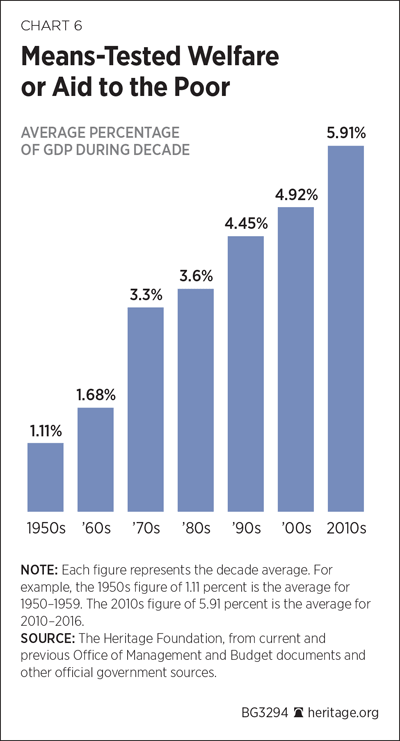

_You_ _cannot_ _legislate_ _good_ _behavior_ _into_ _monopolies_. So while I appreciate the spirit of Net Neutrality rules, the solution is fundamentally flawed.
Let's say you want to open an ISP in your neighborhood. Based on their history (When Google Fiber moved into my area), Comcast will call their existing customer base and offer them services below cost but at the price of a 3year contract. This delays profitability for you as a new player into the space. Comcast can take money from one market (another state) and move the profits into subsidizing a loss to prevent players from entering the space in another market. By breaking this cash flow, you end the stagnation of consumer choice, driving innovation forward.