Of all the things that have been revealed about Uber, this is among the worst:
“The facts are that on the 30 January 2016 a female was sexually assaulted by an Uber driver. From what we can ascertain Uber have spoken to the driver who denied the offence. Uber have continued to employ the driver and have done nothing more. While Uber did not say they would contact the police the victim believed that they would inform the police on her behalf.
On the 10 May 2016 the same driver has committed a second more serious sexual assault against a different passenger Again Uber haven’t said to this victim they would contact the police, but she was, to use her words, ‘strongly under the impression’ that they would.”
Horrible things will happen at scale. But here Uber was directly involved in enabling sexual assault and misleading the victim.
EDIT - some comments believe that this is overly harsh in judging Uber:
1) Uber has had ongoing issues with sexual assault in the US preceding this event. If preventing sexual assault was a priority they would have designed the right policy. Lack of strong policy on sexual assault is an explicit choice:
“firstly it seems they are deciding what to report (less serious matters / less damaging to reputation over serious offences) and secondly by not reporting to police promptly they are allowing situations to develop that clearly affect the safety and security of the public.” *
2) If a serious crime (like this one) is suspected, companies have an obligation to report this and not just conduct their own investigations which will have an inherent bias.
3) Both passengers came away with the impression that Uber was going to take action. If Uber had no intent to take action, this made the situation worse by reducing the likelihood of direct reporting and enabling further sexual assault.
> A complaint was made that, following a trip, a driver got out of the car and hugged a female passenger. This violates our community guidelines and the driver was prevented from using our app while we investigated. He was subsequently given clear direction concerning his alleged behaviour prior to being reinstated on the app. When a second complaint was made some time later, of the same driver touching a rider’s leg, it was decided that we could no longer maintain our partnership with the driver and he was permanently stopped from using our app. At the same time we informed TfL of the allegations in order that they could consider revoking his private hire licence and prevent him from working with any other operators in London. We deal with all complaints on a case by case basis but swiftly identify and deal with any pattern of alleged behaviour such as this. As stated above, we also advise individuals to report incidents to the police and support them in doing so.
> Both cases were charged as sexual assaults and are at court next week for hearing... While Uber did not say they would contact the police the victim believed that they would inform the police on her behalf.
The fact that the victim thought Uber would contact the police, and that the prosecutor has decided there's a case to hear, suggests that this was more than "a hug". We don't have all the information here, but I'm quite uneasy with this downplaying of a potential sexual assault (one that is currently being heard in court).
> Uber hold a position not to report crime on the basis that it may breach the rights of the passenger. When asked what the position would be in the hypothetical case of a driver who commits a serious sexual assault against a passenger they confirmed that they would dismiss the driver and report to TfL, but not inform the police.
Regardless of whether the individual case doesn't sound bad in Uber's telling, their stated position on a hypothetical serious sexual assault is very concerning. Either way it shows either disregard or ignorance for the regulatory environment under which they operate. (It sounds to me like ignorance, since they did report the driver to TfL, and neglected to inform the police as required).
This reminds me of the quote: “It is difficult to get a man to understand something, when his salary depends on his not understanding it.” - Upton Sinclair
Uber's statement potentially demonstrates the exact problem with self-investigating. Given the negative PR from a sexual assault story, Uber employees have a strong incentive to convince themselves that nothing happened and that it was just a "hug".
Uber's statement would be the third significant moral failure in a single incident.
Uber is under obligation to report serious crimes to the police. From their description though, I am not sure it qualifies:
> A complaint was made that, following a trip, a driver got out of the car and hugged a female passenger
I bet it was unpleasant, uncomfortable, unprofessional and a bunch of other "un"s but does getting hugged on a street (not when confined in a car) supports a serious crime claim in the UK or US? This is an honest question, I would really like to know the answer.
>but does getting hugged on a street (not when confined in a car) supports a serious crime claim in the UK or US?
It depends on what that "hug" really was - walking up behind a woman, wrapping my hands around them and grabbing their breasts might be considered a "hug" but it's also sexual assault.
> But here Uber was directly involved in enabling sexual assault and misleading the victim
I can't really comment on the "misleading" charge (and it seems pretty vague in your quotes as well), but "directly involved in enabling sexual assault" is FUD like no other - if that's your claim, then every employeer is "directly involved"!
At the end of the day, Uber isn't (and shouldn't be) responsible (nor qualified) for solving (sex) crime - the police are!
There are two parts to this. First, we don't know how the conversations went between Uber and the vitcims, because both viticms seen to have the impressions Uber would report this to the police, which is odd given the viticms should report to the police first. But on the other hand, Uber should work with the viticms to ensure the viticms are reporting to the police. Imaginr you were sexually assaulted on the train, on campus, or at work, not only you should contact the police yourself, but the administration should engage in aid. A train station worker shouldn't just stand next to a vitcim and say well the alleged attacker denies it so we are lettig the attack go. If you were assaulted at work, you should find someone you can trust and go to either the HR and call the cops. Uber is not responsible for the attack, but as a company it has the responsibility to take every claim seriously, and ensure law enforcement is involved, because Uber's reputation and customer trust are at stake. Every company should have a crisis protocol.
On the other hand, I can't think of better example than Uber's toxic company cultute. Harassments gone to blackhole with HR....
> but as a company it has the responsibility to take every claim seriously, and ensure law enforcement is involved,
I disagree. Customers expecting this results in the awkward situation we're in today. If instead we train people to rely on themselves (and the police), many of these situations could be avoided (or, at least, resolved in a better way).
The problem is that the victim only has the data from the app. Only Uber has the actual identity of the driver. If Uber is unwilling to cooperate with the police, getting the identity will at least require a court order.
If Uber behaved correctly, they would've reported the case to the police with the identity of the driver. This process is much faster and allows for a quicker police investigation.
They are willing to cooperate with the police. They just don't file the complaints themselves. I would say this is reasonable since it is the policy at all companies I have worked with as well.
Any charge of employees doing criminal acts are reported by those who see them. If no one else at the company sees it, then it is left up to the alleged victim. They company does not want to be seen as attacking it's employees based in hearsay.
In Ubers case these aren't even employees so they are left carrying hearsays to the police against third parties.
> It is expected, however, that serious crimes will be dealt with promptly, and reported directly to the police as well.
And
> At this point, the police attempted to investigate (pepper spray is an offensive weapon in the UK) but, the letter indicated, Uber refused to provide more information unless a formal request via the Data Protection Act was submitted.
But they report every crime if they're the victim:
> Uber are however proactive in reporting lower level document frauds to both the MPS and LTPH.
> At this point, the police attempted to investigate (pepper spray is an offensive weapon in the UK) but, the letter indicated, Uber refused to provide more information unless a formal request via the Data Protection Act was submitted.
If I understood correctly, the victim did not contact the police, but that Uber contacted the police after the second assault, after which the scenario above happened. Also, why is it an issue for the police to make a formal request and why does this reflect negatively, instead of positively, on Uber?
Police shouldn't need to make a formal request, because Uber should have reported it after the first instance.
Police are not asking for hidden confidential information here. They're asking Uber to obey the licensing conditions, which are to report criminal behaviour of their drivers.
Do the licensing conditions require taxi services to report contractor addresses, telephone numbers, and rider history immediately anytime there is any potential criminal dispute?
If so, then essentially your history is an open book to any UK police departments.
If not, then your ride history is safe under the Data Protection Act.
DPA isn't some black magic. Medical providers are required to report abuses as well, but they don't send patient history or tell who else an employee has worked with or on unless there's a formal request.
Regardless, I hope that Uber comes into compliance with the ULL shortly, and their future behavior is not merely in line with the standard but better than that of other smaller minicab companies.
Except as a taxi operator (in London) they are required to report these incidents to the police if they are made aware of them. They appear not to, to the extent that the Met have complained.
You missed my early point. Please read what I wrote. I advocate viticms to report first. But Uber has the responsibility to ensure these allegations are rightfully documented. If someone punched you in the face at Starbuck, what is the first thing the worker say to you? "Are you okay?" What else will the worker say? "What happened? Do you want me to call 911?"
Usually stores have policy to notify manager so the manager can decide what to do. If Uber treat this kind of allegations as a normal support ticket, and nothing is done, well, fml. It better now come up with a better protocol so the support team has a manaul book to follow.
eyko's post above suggests that they went above and beyond what you're suggesting (including reporting the incident to TfL and "firing" the driver). (Unless Uber are lying, of course, which is unlikely IMO, but less unlikely than for most other companies.)
And if you start your campaign, perhaps in time you can shift the norms to be what you think they should be. Today, however, the London PtB have expectations that are not being met in this arena and the power to say 'no'. And yet Uber insists on being the definition of a snowflake - somehow their competitors are perfectly capable of interacting with the police and regulators.
Uber is clearly competent to report criminal assaults. They report other things. And ignoring their apparent PR desires, it looks not just stupid and a caricature of bro-havior, but also absurd - why make not reporting sexual assault the hill you want to die on? If I were an investor... Oh wait, there are already lawsuits flying (indirectly) over this behavior.
Uber has a choice. Keep acting like multinational frat house, and likely be pecked to death by more actions like this, or accept that others have no obligation to hold them in the same extreme esteem they apparently hold themselves, and act like they want to run a business in the real world, in which laws exist.
> At the end of the day, Uber isn't (and shouldn't be) responsible (nor qualified) for solving (sex) crime - the police are!
This is the point of the article.
ULL is regulated by TfL and are required to report serious crimes to the police in a timely manner.
They haven't done so, by their own policy, and this has resulted in repeat offences of sexual crimes.
You may now say "the victim should report it", but be aware that you will be blaming the victim here, and the victims did report it... directly to Uber. Uber, who are required to notify the police and failed to do so in a timely way and that allowed repeat offences to occur.
I think by reading the linked letter that Uber aren't legally required to pass crime reports on to the police, but it seems that everyone assumes they have a moral responsibility to do so. I suspect all the other cab firms have a working relationship with the police in this regard.
Just read the operator guidelines and compliance guidelines. They appear to be obliged to fully investigate all complaints and resolve them within 6 months and to keep full records for a further 6 months after that date.
I suspect the police and regulators' interpretation is that they (Uber) cannot possibly investigate sexual offences and so the only correct handling of such a complaint is to immediately notify the police.
But you are correct... the phrasing is ambiguous in the guidelines. But then... UK law :) everything is ambiguous and the default is whatever a "reasonable person" (typically a judge and jury, but in this case the regulator themselves) would interpret the guidelines as being.
Not just the moral responsibility. They mustn't endanger passengers safety. Not reporting sexual assault to the police with the consequence of it happening again appears to violate that.
Uber can't deflect responsibility for this onto the police if they refused to pass it on in the first place and then didn't provide information when asked.
I don't understand what reality a person lives in where their first response after a crime as serious as sexual assault is to go complain to Uber rather than go directly to the police. That said Uber should have advised the victim to contact the police immediately.
"Shock and numbness: Feelings of confusion, being easily overwhelmed, not knowing how to feel or what to do, feeling “spacey” or “out of it.” You may react in a way that is similar to your reactions during other crises in your life (for example with tears, irritability, nervous laughter, withdrawing)."
You don't understand the reality of sexual assault, where many victims don't report to police because of precisely the kind of bullshit dismissal we see in this thread.
Maybe I don't. Doesn't really change anything. You go to the Police to report crimes and she went to Uber. If your SO get's murdered in McDonalds I would better my bottom dollar your first reaction wouldn't be to seek out McDonald's management.
What is going on with this site? Have these people never used UBER before???
The reason they are reporting it to Uber is because when you get out of the car, you are immediately prompted for a rating and a TIP for the driver! Uber is almost forcing you to report a driver who makes you feel uncomfortable.
I'm not saying they shouldn't call the police AFTER. But there is nothing strange about them reporting this instance through Uber's channels.
when you get out of the car, you are immediately prompted for a rating and a TIP for the driver! Uber is almost forcing you to report a driver who makes you feel uncomfortable.
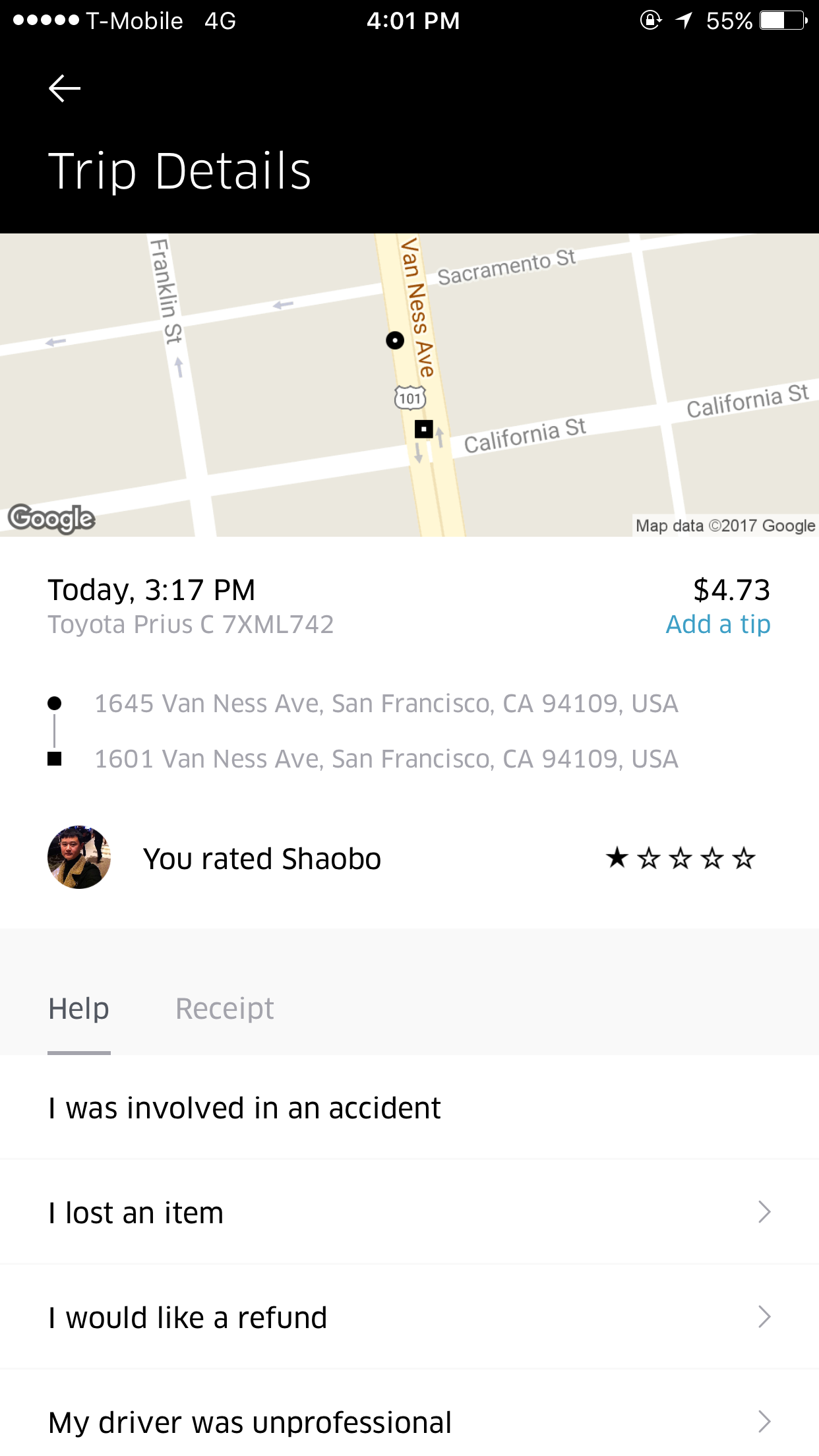
Not only that, but if you get out of the car before you reach your destination, Uber displays a large dialog asking if everything is okay and if you need to report a problem. I can't find a screenshot of that exact dialog, but it included some of the options at the bottom of this screenshot (eg I was involved in an accident, My driver was unprofessional.)
The choice of words is the key. “He sexually assaulted her” actually means “he gave her a hug”. It’s evident she wouldn’t report something like that to the police.
Reporting an unwanted hug (to the police, not to the media) as a “sexual assault” is clearly not going to fly.
I like how the frustrated randos who create accounts on this site purely to justify sexual violence against women can't even be assed to read the article. The one where the police were given the evidence and it's now going to court:
> It is also worth noting that once Uber supplied police with the victim’s details both have welcomed us contacting them and have fully assisted with the prosecutions. Both cases were charged as sexual assaults and are at court next week for hearing.
I strongly suggest being, like, 1000% less overt with your next account. Then, your position on the matter will only be "very obvious", not "mind-numbingly, unbelievably obvious"
Whatever happened, she did in fact report it to the police (after realizing that Uber wasn't going to on her behalf) and it is coming up in the courts. Presumably the courts will hear her characterization of the events then, as well as Uber's, which is all we've heard so far ("he gave her a hug").
"In total, Uber had failed to report six sexual assaults, two public order offences and one assault to the police. This had lead to delays of up to 7 months before they were investigated. Particularly damning, with the public order offences this meant that in both cases the prosecution time limit had passed before the police became aware of them."
People should report crimes to police, they shouldn't report them to school or company. Everyone who tells the opposite enables sexual assault. Uber is not at fault in this situation and it doesn't enable anything.
If I understood the letter correctly, what Uber did was not illegal. And if I understand how police works in most countries, if you report a crime to police they are obliged to investigate it
So my point stands. If you think that people shouldn't report crimes, you enable crimes. "‘strongly under the impression’ that they would." is a laughable excuse. What did Uber do that would provide a strong impression, yet wasn't enough to be accused of being misleading in court?
If what Uber did is illegal in UK, they should face punishment. But as far as I can tell, they did nothing illegal in this situation.
I see lots of folks trying out an argument along the lines of, "if Uber managers aren't being marched in front of magistrates, then everything's peachy and Leave Uber Alloooone!" I can't wait for the ads "Uber - not officially a criminal enterprise yet!"
Unfortunately, this argument ignores the fact that requirements for unusual privileges - like running massive fleets of vehicles on public streets - are a bit higher than the requirements for staying out of jail.
Reporting sexual assault is not exactly difficult. Whether it is a cynical PR issue, some weird philosophical thing, or simply bizarre institutional/emotional damage around sexual assault[1], Uber has a problem that they are apparently incapable of handling, even with years, warnings and a near complete change of management.
It really is freakish.
[1] Given so many different incidents handled over multiple years in multiple countries, that their competitors don't seem to have the same problem with, I'm starting to wonder, frankly.
Businesses should also report crimes to the police. A business who does the opposite enables sexual assault. Uber is at fault in this situation and directly enables sexual assault.
The only difference between what I'm saying and what you're saying is that I imply Uber is run by people and you imply they are a force of nature (or something.)
If you've been a victim of a crime, you should report it. If you've witnessed a crime, you should report it too. Otherwise you enable criminals. If you were told that there were a crime by a random person, you don't have to report it. I think it is as simple as that. I don't think or imply that Uber is a force of nature, I don't know where you got this idea from.
Oh come on there's way more nuance to this issue than you're letting on. Taking away a person's livelihood can be just as bad as a jail sentence and you're acting like companies should act as judge and executioner in the court of public opinion. What's the point of even having a justice system when we can dispatch a lifetime of suffering by blacklisting suspected criminals from employment?
This whole things seems just like "But her emails!" where people are latching onto anything they can to justify their dislike for something they already hate.
Is there really that much more nuance? Uber received a complaint of sexual assault by a driver. The victim was under the impression that Uber would contact the police. Uber did not contact the police and continued to employ the driver. Uber then received a second complaint of sexual assault by the same driver. The second victim was "strongly under the impression" that the police would be contacted. The police were not contacted.
In this situation, Uber are complicit in the second sexual assault to at least some degree. (Perhaps they carried out a thorough investigation which presented nothing. Perhaps they did not carry out an investigation again). They are complicit in any further sexual assaults this driver carries out.
With regards to "Taking away a person's livelihood", that's precisely what a police investigation and CRB/DBS checks are for. The driver simply should not be allowed in such a position if they have a history of sexual assault. No-one is asking for the company to "act as judge and executioner" (in fact, in this case the company is doing exactly that except ruling not-guilty), merely to alert the appropriate authorities so that a legitimate investigation can be carried out according to the established judicial system.
If Uber is complicit, where are the charges? Where are the fines? Where are managers getting jailed for concealment of a crime? Is there even a prosecution?
Uber is not having license, which is a big punishment I would say, is fine on top also needed? Concealment of a crime and failure to report one are two different things with two different punishments. And while I believe companies crimes should be personalized to managers who lead employees to commit them, where such thing can be proven, jail time for this one would be probably too much of a punishment.
We dont need to jail for everything, really. It is expensive and ineffective overall.
It is the job of the justice system to understand whether he is guilty or not. I think that if a company fires a person for a claim of sexual assault that wasn't proved, this person is justified to sue the fuck out of the company for false pretense.
Innocent until proven guilty.Uber respected due process expecting that if the allegation are true the police would have arrested the man.
Uber is not a court, it does not and in my opinion should not have the right to play judge.
I am not following your defense of Uber. Let’s assume sexual assault is equally common among Uber drivers and regular taxi drivers.
It is still not material to the complaint. The complaint is that regulators are getting adequate and timely reporting from regular taxi companies so they can investigate. But not from Uber. This is leading to unnecessary safety issues for Uber riders.
I don't read it as a defense, its a necessary prerequisite question to ask to put this situation in its proper context.
Every sexual assault is horrific - but what if we look closer and discover that the rate of sexual assaults per ride from Uber is less than that from established cab services?
That completely inverts the situation and we would need to ask "What is Uber doing right, and how can the other services emulate their success?"
What if we discover they are about the same? Well, then Uber isn't anything exceptional and we have an industry-wide problem that needs addressing at all levels.
Either way, we don't even know where the real problem is if we don't start with those kinds of questions.
First, no matter what the statistics look like, it doesn't excuse Uber's failure to report sexual assault and protect the people who have placed their trust in Uber.
Second, the statistics do not support Uber being any safer:
"A search query for “sexual assault” within Uber’s customer support ticketing system yielded 6,160 results, or 6,160 cases, for the period between December 2012 and August 2015. Plugging in the search term “rape” resulted in 5,827 tickets, while “assault” revealed 3,524 and “sexually assaulted” yielded 382. In the same report, BuzzFeed obtained data from the company indicating that it had received “fewer than” 170 sexual assault claims and five claims of rape over the same time span.
In a response to the BuzzFeed article, Uber’s heads of communications, safety and global support attributed the thousands of results to misspellings of the word “rate,” words and names that contain the word “rape” and discussions of the issue by passengers who were not personally facing assault.
A January 2015 report by the libertarian Cato Institute found ride-sharing services provided by Uber and its main competitor, Lyft Inc., to be about as safe as taking a cab, which, for drivers, was not exactly reassuring."
I think it's fair to say that India is a special(ly bad) case. I'd like to see the figures for London, which is what would be relevant here. From reading that excerpt in the context of this article, it would seem that ULL is doing a really bad job. Are the statistics in that article global?
Only on Hacker News will someone find a way of taking an article, with a statement that is, in essence,
> Uber failed to report a driver to the police, on the basis of sexual assault against a passenger - said driver then went on his way and just somehow found himself with another sexual assault complaint later on, against ANOTHER woman, while still as an Uber driver -- which is a grave failure on their part
and somehow magically find a systematic way of making it into
> What if.......... hear me out........ just wait....... what if Uber could be the good one here?? Let's ignore the bit about two women being sexually assulted for a second and run the statistics and find out!!!!!!
Here's my alternative position, which I hope you entertain as enthusiastically as you do statistics: Uber was wrong, and no amount of statistics about their dumbass business -- or any of those pathetic "aw dangut, but we're just a startup, doin' a disruption!!!" spiels -- negates people being assaulted, due to their gross, obvious negligence. End of story.
Rationality and reason say that since Uber is a black cab operator, they are, just like other black cabs, legally obligated to report these incidents to the police. They have failed to do so. Case closed.
The victims contacted Uber with the assumption that Uber will carry out that responsibility. Uber failed to do so.
FWIW, Uber is not a Hackney carriage (black cab) operator (regulated since 1654). Only these are allowed to ply the streets for hire, and drivers have to pass "The Knowledge".
In addition to this, the comment you're replying to comes across as dismissive of the issue on the basis of it being common elsewhere. In other words, "TfL are not justified in taking punitive measures against Uber for deliberately failing to report sexual assault because other places also fail to report sexual assault". Needless to say, that sort of apologia is horrific
Perhaps I'm reading more into the comment than was intended, perhaps that is the correct amount.
>If a serious crime (like this one) is suspected, companies have an obligation to report this and not just conduct their own investigations which will have an inherent bias.
Why are rape accusations ever investigated outside of a legal context by police? They do the same thing in colleges and it boggles my mind how anyone would think that's a good course of action.
"Indeed if TfL have any kind of ulterior motive for their actions, it is simply that they dislike the impact Uber are having on congestion within the capital"
As compared with official London taxis (aka 'black cabs'), cars operated by Uber:
1) After dropping off a passenger, drive to their next pickup point (vs. black cabs which drive around for an average of 25 mins waiting to be hailed).
2) Pay the London congestion charge (vs. black cabs which are exempt despite the fact that they're generally on the road for about 10+ hours per day than the average car, and spend a far greater proportion of that total time within the congestion charging zone).
The goal of the congestion charge is not to make money off cars in London - it's an attempt to reduce the number of cars in London. The number of cabs is limited largely by the complexity of The Knowledge, while the number of minicabs is rather less limited, so in conspiracy theory land, TfL have motive to ban minicab operators wherever possible.
In any case, it's very unlikely that this is an ulterior motive - there's no reason why the problems aren't exactly what was listed, i.e. mostly administrative failures on Uber's part where other minicab companies are more cooperative with the license requirements.
"The goal of the congestion charge is not to make money off cars in London - it's an attempt to reduce the number of cars in London."
Surely the goal of the congestion charge is to, you know, reduce congestion. One way would be to reduce the number of cars simultaneously on the road during periods of congestion. Excluding black cabs from this incentive structure does a disservice to Londoners.
Cabs/Ubers have very different marginal driving decisions than "regular" drivers, and a congestion fee is not an effective policy to target them. If London feels like the cabs are the real opportunity to reduce congestion, which doesn't make much sense to me, the way to do so would be in how they implement their medallion system.
  > mostly administrative failures on Uber's part where
  > other minicab companies are more cooperative with
  > the license requirements.
But TfL inspectors gave Uber the green light ten times [0] including recently before suddenly deciding to ban them. There doesn't seem to be a history of repeated administrative failures here.
I'm sure that had they used the opportunity to shut down Uber years ago over a paperwork issue, rather than waiting for the Metropolitan Police to write to them expressing concern that Uber's policies of refusing to report crimes and obstructionist approach towards police investigations may have lead directly to people being sexually assaulted, the people still arguing on here that Uber's conduct is above criticism would have been even more outspoken in condemning authorities.
The ten times Uber got the green light in numerous other inspections and fact it wasn't halted early in operations over paperwork (unlike, say Taxify) is far better evidence in support of arguments that the regulators have been extraordinarily flexible and tolerant towards Uber than evidence for the insinuations they're more bothered about hurting Uber than Uber hurting its customers.
  > rather than waiting for the Metropolitan Police to write
  > to them expressing concern that Uber's policies of refusing
  > to report crimes and obstructionist approach towards
  > police investigations may have lead directly to people
  > being sexually assaulted
Uber responded by saying that they have a "dedicated unit [...] tackling any incidents [...] run by former Met officers". [0]
This easily verifiable so I think it is extremely dishonest to say that they have a "policy of refusing to report crimes" or 'obstructionism'. This would only be the case if Uber was in some way incentivizing this team to fudge numbers.
I also know many people that feel much safer knowing that their friends and family are able to see where they are on a trip, and like the fact that they can retroactively determine the name and number plate of a driver the next day.
If you are assaulted by a black cab driver and they speed off, you have no way of gathering information about your driver. This lack of transparency makes being driven in a black cab much more dangerous.
  > The ten times Uber got the green light [...]
  > evidence in support of arguments that the regulators
  > have been extraordinarily flexible and tolerant
  > towards Uber
If Uber was not given the green light then you see it as proof that they are not playing by regulations, but if they are given the green light you see it as proof that they received tolerance and flexibility yet were not following regulations. What information would change your mind?
If the Metropolitan Police write a letter complaining to TfL about Uber's policy of refusing to report certain crimes and obstructionist approach towards police investigations (specifically, refusing to provide information except as formal FOI requests) then this is clear evidence that in the opinion of somebody who has considerably more first hand knowledge of Uber's actions and expertise in police/minicab co-operation than HackerNewsers who like the app, Uber is refusing to report crimes and acting in an obstructionist manner towards police investigations.
What is extremely dishonest is to respond by pretending those claims are an untrue invention of mine, using a line from Uber's press release which in no way refutes the police officer's specific contentions about information not being reported to the police appropriately as justification.
As for changing my mind, I'd probably start with the need to refute that basic prima facie evidence that Uber isn't viewed as respecting a minicab firm's obligations by the relevant police official. You can't really counter that by pointing out circumstantial stuff like them having their own investigation team or passing inspections of how they comply with other regulations, that's not how proof works. And yes, an extraordinary claim like "actually it's the regulators who've repeatedly refrained from using many possible excuses to shut down Uber over the five years it's spent deploying Greyball and suing them over regulations it doesn't want to follow who are the ones most likely to be wilfully misinterpreting the letter and spirit of regulations here" probably needs evidence a little more extraordinary than their self-exculpatory press release.
In the mean time, Uber has taken the uncharacteristic step of apologising and acknowledging they "need to change".
If their "tackling" of incidents involves not reporting crimes to the police, can that really be called "tackling"? The fact it is run by former police officers is irrelevant if all they do is decide whether or not to retain a driver.
They wanted a 5 year licence back in May but were given a 4 month licence and a requirement to resolve the issues that there were. 4 months later the issues are still there so what else could TfL do?
> it's an attempt to reduce the number of cars in London
Not sure if that's true. I think it's mainly to reduce the polution in central London. Otherwise, electric/hybrid cars wouldn't be exempt but charged the same amount!
> Otherwise, electric/hybrid cars wouldn't be exempt but charged the same amount!
That's an anomaly I'd say. The congestion charge was introduced in 2003, at that point electric cars were a curiosity, a fraction of a fraction of the market. I'd expect within 10-15 years the exemption will be removed.
The purpose was partly to reduce pollution, but as a secondary effect of the primary aim to reduce traffic:
>> I think it's mainly to reduce the polution in central London.
I lived in London when it was launched, it was also to do with making the city centre flow again, so that those who actually needed to be there could travel in a reasonable amount of time.
Ah, true. I do think we'll see a congestion charge on electric cars as they become more popular, though - London plain and simple doesn't have enough space for personal road traffic.
Edit: Hmm. London's own stuff claims that it was originally largely intended to reduce use of personal vehicles, and then in 2008 the Mayor implemented the current system of charging based on pollution. Again, I suspect it'll go back to charging for electric vehicles once people actually own electric vehicles.
I'm not sure the two aims are in conflict. I'm pretty sure that consumer electric cars were pretty much nonexistent when the congestion charge was first implemented.
That's not a contradiction. There's also a separate scheme to reduce London pollution (LEZ), and there's an extension of it currently starting up (ULEZ). They have overlapping aims.
For example, bus lanes were made for busses, despite cyclists and motorcycles (on most red routes) being able to enter them.
It is reasonable to believe that these goals are both in mind! Edit: there's a new Diesel charge coming in soon, to reduce the extra pollution from these vehicles entering central london, for cars as well as lorries. In all the communications emanating from politicians and TFL it seems that numbers and pollution are both problems to be solved. Note also the new 'Boris' buses were designed as hybrids to improve air quality, even though in practice they don't work well and run on diesel mostly.
Your second part is not true. As the blog post makes clear, Uber cars drive under the license of a minicab firm (as personal hire vehicles), and are therefore exempt from the congestion charge.
Given your first point, could you please share the like-for-like data on uber vs. black cab time spent waiting to be hailed/booked? That sounds very interesting.
3) Are typically petrol (gas) rather than diesel, and are often hybrids (less pollution).
Edit: Not significantly smaller, as pointed out below 4) Are typically more compact than a black cab - take up less road space
So no, it's not about congestion in that sense. What the author appears to be suggesting is that there are more cars on the road plying for the same trade, and the more journey miles taken in an Uber, the more idle time a black cab will spend waiting to be hailed - either congestion on the road, or congestion in the taxi ranks.
However, if that were the true ulterior motive, that could be applied to any car service that competes with black cabs, not just Uber.
> 4) Are typically more compact than a black cab - take up less road space
I thought "that can't be right, black cabs aren't all that big". And a quick search suggests that a Prius and a TX4 black cab are pretty much the same length - 454cm (Prius) vs 458cm (cab).
The black cab is 18cm wider, which may make a difference, although length seems the more significant dimension here. And black cabs are much taller of course.
Huh, seems perception is not always reality. Thanks for fact checking!
18cm could make a difference navigating some of our narrower streets, but my mental image was that there was a more significant difference than there actually is.
For the record, London is a city where for some major routes, there's buses every 2-3 minutes. They're a major part of the public transport infrastructure in London. Bus lanes in much of the city centre are never empty.
The simple answer, then, is that black cab drivers are tested on successfully fitting in with the flow on bus lanes so that they don't slow down buses, and minicab drivers are not.
Also for the record, here's a quote from a different post by the same parent:
> 3) I used to drive to and from work every day. Part of the journey took me along the A4/M4 towards Heathrow. There was a traffic jam every day, going home from work (towards Central London). This busy road had a bus lane. I don't recall ever seeing a bus going past me in that lane, but plenty of black cabs did. I don't see why a black cab should get to skip past the rest of us waiting 20 mins in traffic.
Perhaps there are some bus lanes in London that are very very underused and should be turned into regular lanes. Perhaps the people in charge of roads have discovered that if they were to remove that bus lane, the result would be congestion further into the city in a location less able to handle it than a motorway. Perhaps, for operational reasons, the buses absolutely need to be able to bypass traffic on the motorway.
As for black cabs, perhaps it would be a complete hassle to implement a "no black cabs" rule for that one road just to avoid upsetting people who chose to drive into London.
There's all sorts of potential reasons for that bus lane existing - and there's a very good chance that if someone were to file a FOI request with TfL, they have a report on the potential results of removing that bus lane.
> Perhaps the people in charge of roads have discovered that if they were to remove that bus lane, the result would be congestion further into the city in a location less able to handle it than a motorway.
It's a well-known controversial bus lane, which became a political issue. Anyone complaining about it loses my respect on HN, as they didn't look at the traffic engineering problem, just the Daily Mail hate.
The motorway is 3 lanes until the final stretch into London, which has two lanes. The width reduction isn't at a junction, so the extra lane didn't help traffic flow -- it just caused congestion and collisions by making drivers merge. The lane was ended at the preceding junction's slip road, and a bus lane continued for the spare length. This improved journey time for buses (a minority of vehicles, but a decent proportion of people), and also improved journey times for cars!
But, the sight of the bus lane annoyed the Tories, so they got rid of it.
Sounds about right. Major roads in the UK tend to be remarkably well-engineered, and if you can think of doing something to them, there is almost definitely a document explaining the exact repercussions of doing that and how much it'd cost.
> Why do people frame this as "Uber vs Black Cabs"
I can't speak for others, but my tuppence as someone born in London, and who lived there for >30 years:
1) Black cabs are really expensive. So much so that I can count on one hand the number of times I've paid for one out of my own pocket.
2) Black cabs, despite the terms of their licence, are known to refuse to pick you up if they're going the other way, or refuse a fare if you're going to South London (where I was born).
3) I used to drive to and from work every day. Part of the journey took me along the A4/M4 towards Heathrow. There was a traffic jam every day, going home from work (towards Central London). This busy road had a bus lane. I don't recall ever seeing a bus going past me in that lane, but plenty of black cabs did. I don't see why a black cab should get to skip past the rest of us waiting 20 mins in traffic.
4) There are many taxi ranks where taxis wait for fares. For example, near Kings Cross station. 100% of the drivers leave their diesel engines running whilst they're waiting, right next to the pavement where people are walking. I don't like this unnecessary local pollution as I'm walking by.
5) Congestion charge (see my original comment).
Overall, my point is this: Uber and minicab firms work within the same road usage framework as other car owners. Black cabs are somehow exempt from this (which is unfair to begin with) when, given the time they spend on the road waiting to find a passenger, they cause much more congestion and pollution per passenger-mile than other cars.
Right, so you don't like Black Cabs. That doesn't answer my question. The choice isn't Uber or Black Cabs. It's London with Uber or London without Uber.
How are cabs even relevant at all to the point your original post brings up?
"Indeed if TfL have any kind of ulterior motive for their actions, it is simply that they dislike the impact Uber are having on congestion within the capital"
I.E. Uber is adding a mass of cars to the street and worsening congestion, likely by offering cheaper fares and tempting people off busses and the tube.
You've got an argument as to why one Uber car is less congestion-causing than one black cab, because of these regulations. And a list of reasons you don't like black cabs.
What you haven't got is evidence that Uber, by making cab travel cheaper, aren't making things a whole lot worse.
Black cabs are a distraction in this argument. It's Uber vs not-Uber. Trying to frame it as purely a protectionist matter is misleading.
And to add to that, it’s only Uber, not app-hailed minicabs as a whole.
If TfL were banning all minicabs then I could see how a conversation vs black cabs would make sense. But this is just one operator that has flouted regulations other app-based companies have not. They will be more than able to fill the void left by Uber.
Uber seem to be pushing the Black Cab issue here... A organisation that makes money from Uber was very quick to claim that the issue was due to TfL being pressurised by Black Cabs so I half expect it to be in Uber's briefing note pack...
Because democracy is weak to organized capital. Uber proves that you can get away with whatever anti-competative and scummy nonsense you like, as long as you have a good PR department and a lot of money to throw at it.
Black cabs are limited in number due to the difficulty of the Knowledge test. Ubers aren't limited in number and Uber makes no effort to discourage excess drivers from logging on. (If it reduces the average wait by 10 seconds, it's worth it in their eyes, as it costs them nothing. The congestion cost is externalised.)
Uber also sends push notifications to drivers to go to specific areas to prevent surge pricing.
> vs. black cabs which drive around for an average of 25 mins waiting to be hailed
I'm not from London, but where I'm from, cab drivers don't "drive around" until the next ride. That's a terrible waste of gas. We have special reserved parking for them, usually close to places of interest (next to bus stations, malls, etc.). This is one of the reasons there is a limited number of licenses available per city. Uber drivers can't use these parking slots.
How about the fact that black cabs wait to be hailed longer period of times because people choose Uber drives, thus adding more cars on the road instead of using the ones that are already there?
> How about the fact that black cabs wait to be hailed longer period of times because people choose Uber drives, thus adding more cars on the road instead of using the ones that are already there?
Was just about to post this myself, it's an excellent summary of what the dispute is really about. Also includes some history; I hadn't realised that Hailo was British in origin, or that TfL had the same legal structure as a local authority.
"it's an excellent summary of what the dispute is really about"
Except that, like other articles I've read about the dispute, it talks only about Uber/ULL and its transgressions in isolation. Stats about number of offences are provided, but without context. Where are the comparable numbers for other minicab firms (of which there are many)? Are ULL's offences per ride/mile higher or lower than the worst/best/median minicab firm?
Well, yeah, they're the only ones currently trying to renew their license.
> Where are the comparable numbers for other minicab firms (of which there are many)?
Utterly irrelevant when it comes to renewing Uber's license. Much like if I was to apply for, oh, a pharmacist license and using "But Frank has dealt more meth than I have!" as justification. Utter nonsense.
It's perfectly relevant when questioning whether or not the same scrutiny is applied to all players or if TfL are just trying to make headlines attacking the big fish.
I think it's reasonable to go after the people who essentially brag about breaking the rules. If you shine a light on your own questionable activities, don't be surprised by the consequences.
So the theoretical issue there is "why are TfL not applying their regulations to other companies", not "why are TfL applying their regulations to this one". If you have any evidence at all that TfL are licensing other companies which have similar questions around their ability to comply with regulations, I'm reasonably sure you could start a small movement around it.
Of course the same scrutiny is applied to all players. The fact that Uber chooses to respond by launching a petition, rather than attempting to comply with the regulation that every other minicab company in London complies with says much more about Uber than it does about TfL.
Greyball seems like the one aspect of this that contextualizes the rest of the reasons for the non-renewal. If you're an operator and you fail to get right by local rules, you might mea culpa and fix it, or work within the system provided by the authority to do better. In this case, TfL were made aware that an operator had operationalized a program designed to help them skirt regulation, which could have inspired some prejudice when it came down to the decision.
On a broader note, as with all Uber discussions, we will get to the pained point of unfair treatment of Uber by incumbents and regulators. Contrast that with the general SV ethos that one should break the rules to win. Given both of those, would it be fair to say that Uber getting chided and blocked here (and there, and there, and there) is an indication that maybe they're not that good at breaking rules? In other words, who is out there succeeding who is under the radar and is not being scorned for a cavalier approach to rule-breaking?
> Greyball seems like the one aspect of this that contextualizes the rest of the reasons
Deliberately and systematically evading investigation is a clear sign of bad faith. Mea culpas and time-to-fix-it are good faith arrangements; they've screwed that pooch hard.
In the UK there is no legal requirement that someone knowing a crime has occurred to report it to the police.
Uber seem to be reporting crimes where they are the victim (the article says they report a lot of small fraud) but not crimes where others are the victim.
Which leaves an interesting thinking experiment: would Uber report a murder? The victim obviously can't report it. It would be illegal for Uber to do anything to assist the murderer in escaping the law, e.g. by cleaning the car etc; but would they actually report it?
Shouldn't the victims be reporting these crimes? If the victims aren't reporting them, maybe they don't want them reported? Maybe they have a good reason for not wanting them reported? I have heard victims advocates state that it should be up to the victims what legal action/investigation/etc should take place. I am not an expert in this area, but maybe that is what Uber is doing?
According to the article, the victims were under the impression that Uber would report it to the police as part of their investigation in to the driver.
Thanks for pointing that out- now I wonder why they got that impression? Uber should definitely be making changes to their interactions to make it clear. I guess I am not familiar with the customs around such things in London.
Do you have any reason to believe they don't? I'm struggling to find numbers about it, but either they do and there's no news about it, or they don't and not only should Uber be under speculation, so should they. How do either of those change the fact that Uber did something wrong?
"it seems that every journey only covers 41% of the costs involved in making it."
This statistic is dumb.
There is a distinction between marginal and average cost. Uber's marginal costs are negligible, except for the new markets and products where they pay the driver's fare rather than collect a portion. The "costs involved in making" a trip are born only by the driver. Uber's marginal costs are only the probability they have to refund the fare for whatever reason, or get sued or something.
This might seem academic, but recognizing it belies the idea Uber will one day have to raise fares by 41%. The 41% statistic is derived from Uber's total losses. But this involves the significant fixed costs of running Uber...some of which are investments in IP and infrastructure...and which scale much less-than-linearly with demand. If Uber's demand grew enough they would be profitable even with today's fares.
I do not know if Uber will one day be profitable or raise fares, but tying total losses to the price of an individual trip is sloppy.
It's extremely painful to see people defending or justifying Uber's actions on HN. You can absolutely find Uber useful, and if you do and you are a Londoner, you can contact Uber to ask them to revise their policy when it comes to collaborating with the police in case of sexual assault instead of defending the indefensible.
There is something very wrong with a community where people think Uber's actions are normal. It's extremely unsettling.
Uber has always been an "HN favorite", but there are limits... Some comments here are just insane and completely out of touch with reality, or just don't take sexual crimes seriously, which is even worse...
London Reconnections is consistently good. For anyone interested in public transport, it's worth disappearing down the rabbit-hole of their previous articles. (It also has a better-than-average comments section.)
Great article. That Uber drivers of London alone have been accused of 32 sexual assaults in the past year [1] is hard to swallow.
Also, it sounds like Uber would be better off targeting public outrage towards the mayor. Any thoughts on why they went after TfL and not where the power actually resides?
>Uber drivers are accused of sexually assaulting or raping customers almost three times a month, according to new figures which have outraged rape campaigners.
I could point out that accusation is not proof of guilt, but that's not what's bothering me the most. My problem with this article is that no referential is provided : frequency of accusations of others cab services providers (we have a count, no frequency) ? total number of fares at Uber vs other cabs (is it more than a fifth ?) ? Or alleged sexual assaults in London for a month ?
Sometimes this bad journalism looks so deliberate...
I think part of the problem is that these just occurred in 2016. In combination with Uber supposedly keeping information and not reporting assaults (according to the submitted article) it makes it very difficult to make a good comparison.
Someone else asked how Uber assaults compare to the general population and I honestly can't find much apples-to-apples information.
Uber are fully supporting the livelihood of 40k drivers? Doesn't seem likely. They're depressing the market price whilst simultaneously creaming off more of that price for themselves, that surely leaves drivers over all worse off.
What sort of pension are Uber's employees getting, the one's whose livelihood Uber are taking care of? What sort of holiday pay do they get? Do they get perks above the lowest legal level?
TfL is a faceless bureaucracy, and while I think they don't have a terrible reputation many people have some reason to be unhappy about them. Makes an easier target than the mayor who is a quite popular figure and might be able to shrug off attacks against him personally relatively easily (e.g. by simply backing TfL without getting personally involved).
So are you saying none of the other private hire licensees have DBS or health checks? I thought the point was that as employees Uber drivers had to have safety checks and that Uber don't want to accept they're employees because then Uber can't keep as much of the money.
"So are you saying none of the other private hire licensees have DBS or health checks?"
I'm not sure how anything I've written could be interpreted in that way. Perhaps you replied to the wrong comment?
My point is that stats about Uber are only useful when put into context, i.e. compared with stats about other holders of operator licences. Someone said that's irrelevant because Uber are the [only] ones applying for a licence. I pointed out that there are around 40 operator licences granted per month.
Given there are such direct comparisons possible, why are those stating the numbers continuing to do so without sufficient context to make them useful?
It's about context. Anecdotal evidence paired with taking numbers out of context is a keystone of yellow journalism, and is something that is ubiquitous in these articles about Uber. Uber currently fulfills 40 million [1] rides per month. At that scale, even the rarest and most egregious incidents are going to be a regular occurrence, which enables individuals and organizations to be incredible misleading when discussing the issues at hand.
So for instance in the US the average traffic fatality rate is about 1.5 per hundred million miles. With Uber servicing 40 million rides per month, you'd expect to see numerous Uber passengers/drivers killed in traffic accidents each and every month. It can lead to yellow journalism like "Dozens were killed in accidents with unsafe Uber drivers last year. How can we fix this?" The quantity of values is in no way evidence that there's anything to fix nor does it justify calling the drivers unsafe. You need context and relative comparison. It could well be that you get your sensationalistic headline even when the drivers are well above the average in terms of safety - just thanks to the scale of their operation.
Arguments should be decided on logic, not emotion. And that is impossible when you present numbers without any context.
Wow, did I really break someone's feelings with that sentence ?
It is a personal opinion but yes, using an expensive cab or the like instead of largely available public transportation (it's London) is laziness in my opinion.
Is having a personal feeling and general impression from what I've see amongst my acquaintances, about the kind of behavior that brings people to use individual premium means of transportation, breaking HN guidelines ?
Because yes that's what I'm implying but I phrased it not in a "universal truth" way but more in a "personal impression about an issue" way. Which seems a rather common attitude here. Also harassed no one during it (was not targeted at a specific user), so I have a hard time seeing what harm I've done here.
I just added this sentence as a reminder that Uber is a completely unessential service, that its popularity just capitalizes on people's laziness imo, and that I couldn't care less if people suddently had to use their feet and share space and transportation again.
The problem with your comment is a sweeping generalisation since you have no idea why many people who use Uber do not prefer public transport, it's the same problems as statements such as 'Mexicans are...', 'Muslims are...' etc.
> Uber is a completely unessential service, that its popularity just capitalizes on people's laziness imo
Is a computer essential? No? A programmer would disagree.
Is guitar essential? No? A musician would disagree.
Just because it's not essential to you doesn't mean it's the same for everyone.
> Because yes that's what I'm implying but I phrased it not in a "universal truth" way but more in a "personal impression about an issue"
Ok, so let's take:
"Uber is a completely unessential service, that its popularity just capitalizes on people's laziness"
vs
"Personally, I'd say that Uber is a completely unessential service, that its popularity just capitalizes on people's laziness, but opinions may differ"
Which one seems like an universal truth vs an opinion to you?
> instead of largely available public transportation
Whilst London does have generally good public transport, there are times when it suffers catastrophic failures and then people are forced to use "expensive cabs or the like".
"The letter concluded by pointing out that these weren’t the only incidents the Metropolitan Police had become aware of. In total, Uber had failed to report six sexual assaults, two public order offences and one assault to the police. This had lead to delays of up to 7 months before they were investigated. Particularly damning, with the public order offences this meant that in both cases the prosecution time limit had passed before the police became aware of them."
I see, I think we're not discussing the same article ; you're probably refering to the article at the root (that I'm not done reading yet), not the one posted by the user a few posts above.
I'd be interested to know what rights, in English law, Uber think are being breached here:
> Uber hold a position not to report crime on the basis that it may breach the rights of the passenger. When asked what the position would be in the hypothetical case of a driver who commits a serious sexual assault against a passenger they confirmed that they would dismiss the driver and report to TfL, but not inform the police.
English law is technically correct here. British law would be something that applies to England, Wales, and Scotland collectively.
In this case, London taxis are regulated by the London Cab Order 1934, and minicabs are regulated under the Private Hire Vehicles (London) Act 1998, so this is law that only applies to England (Wales and Scotland have other acts that apply.)
I'm still surprised Uber isn't being rejected simple for the reason that they are making a huge profit to drive out (no pun intended) competition.
Something that made me laugh:
"... Uber are a bully. Unfortunately for them, TfL are an even bigger one."
and of course it's all down to this:
"It is also worth noting that all TfL really wants Uber to do is comply with the rules. Despite the image that has been pushed in some sections of the media, TfL has not suddenly become the champion of the embattled London cabbie (many of whom would laugh heartily at the idea)."
This is an informative article, it's a shame about the straw-man that repeats throughout it. Nobody is saying this is "about the app". Obviously, the usefulness of the app is tied into the licence. It's about the licence. Everybody knows that.
It's very interesting to compare some extracts taken from a similar thread that apparead some time ago about Uber being temporarly banned in Italy to the tone in the comments here:
"Innovation almost always sidestep regulations, by definition", "Italy is not a place for innovation", "few corrupt lobbies that are against innovation and competition" , "US consistently outperforms the EU in GDP growth and innovation", "Forcing innovators to "respect the law" squarely is basically killing innovation".
I don't see anybody blaming the UK for being anti-innovation here. Why?
Because the facts don't support it. There are a number of app-based minicab services that are able to comply with TfL regulations. Uber here is failing an extraordinarly low bar - report serious crimes when your drivers commit them, do not implement a system to decieve regulators. The regulators are not coming down Uber-like apps in general, or on some theoretical - they are coming down on Uber in particular for its history of action, with evidence-backed specifics.
London black cabs can take more pax than most cars (5 or 6 plus luggage), they have a very small turn radius, are wheelchair accessible, the drivers have "the knowledge" and actually know where they're going, and if you want, you can also call one online.
You can argue about the overall experience of London cabs vs Uber, but worse "in every facet" is just silly.
Lastly, Uber fares cover only a fraction of their cost, so they're not "sending money to a US company"; at most they're contributing to Uber's $2 bn annual loss.
I don't know the situation in London, but Uber in general has improved 2 situations immensely:
1. Normal cabs are horrible. The drivers are often rude, always try to price gouge or even outright trick you. There is no rating system, meaning no public 'oversight'. Hell, cabbies always tried to get rid of regulations, but now that there's Uber they use it like a weapon: that alone should tell you enough about how scummy and opportunistic they are.
2. Booking a ride in a foreign country. Many drivers don't speak English, so good luck explaining where you want to go. You also usually have no idea what a typical fare should be, so (especially around airports) prepare to be hoodwinked.
In contrast, Uber has a set price, easy way to hail and a rating system that works beautifully. Before Uber, I hated cab rides. Now it's a pleasure.
Did you read the article? Nobody is denying either of those points.
Though generally in London the standard for taxis has been much higher for a long time, primarily due to The Knowledge and the high price of black cab vehicles.
Well, let me just go ahead and deny the first point. Normal cabs are horrible in some jurisdictions and places (try getting a cab at Manila airport, Denpasar (Bali) airport, Singapore, Addis Abeba).
In other places, where they're well regulated, they're perfectly fine by and large (London, Germany, Hong Kong).
And I hope that continuing that behaviour gets them banned from more countries.
They aren't providing value for "common people", they are trying to capture the market with massive subsidies. That itself is cause for a huge amount of concern.
> They aren't providing value for "common people", they are trying to capture the market with massive subsidies. That itself is cause for a huge amount of concern.
Your overall concern is valid, but I'd disagree with them not providing value. They're significantly cheaper, cleaner and more accessible than regular cabs in many places, but I agree this is likely to change once they have a monopoly.
It seems to me that Uber transfers value from Uber investors, Uber drivers, and regular cabs to Uber employees and, yes indeed, Uber riders - for now, as you say.
Billions of VC investment money. Actually, I don't agree with the GP. In my view Uber represents one of the biggest transfers of wealth from VCs to the common man in the last three decades. When the funding eventually dries up and Uber are forced to raise their prices, the common man will just move on and leave Uber to go bankrupt. It's beautiful really (at least the LP money coming from pension funds etc. is finding it's way back to the originators in the form of discounted travel rather than going up in smoke).
It's beautiful until they become a monopoly and jack their prices up. I reckon they've got no chance, though. There's no network effect to speak of and competitors can start small and grow, without needing billions. In 15 years from now, the supply of self driving cars will be the limitation and they'll be available in high quality and low price from all the major manufacturers. The actual technology in uber's app is basically nothing, any company could replicate it without too much hassle.
I'm not sure the drivers really have a good understanding of their cost base. I doubt very much that Uber covers the average cost per mile (though hopefully the marginal cost). Would be interesting to see a proper analysis.
He is talking about fare subsidies for passengers paid for by VC money, slimmer wage packets for drivers, and extreme tax avoidance. He isn't talking about subsidies from a government source as I think you are implying. Uber lost over $1 billion in 2016 alone with the express purpose of capturing a global monopoly by driving down prices well into loss making territory. We had uber-like app based companies in London for years before Uber with the likes of Addison Lee, but Uber effectively destroyed them with predatory pricing funded by VCs.
None, actually. They are referring to what is normally called "VC funding". But here the GP wants you to believe that Uber is somehow receiving billions in public money and gaining business advantage from that. So they used "subsidies".
>> But here the GP wants you to believe that Uber is somehow receiving billions in public money
Absolutely not, subsidy does not only refer to public money, I'm not sure why you think it would. I'm not under any illusion that public money is being poured into Uber, nor would I wish to give that impression.
No, it's a form of business. Big companies often drive the price down, so that they can enter a market dominated by entrenched players. They are able to do this by using their profits from somewhere else. In this case, the money was not directly earned by Uber, but the investors funding Uber.
“I want companies that abide by the rules, I want companies that innovate, harbour new technologies, I want disruptive technology coming to London but you’ve got to play by the rule,” he said. Khan stressed the decision over Uber’s licence had been taken by experts at TfL and should not be subject to political interference, when asked whether he would have talks with the company.
Isn't this the same guy who said terrorism is “part and parcel of living in a big city”[1]? Yeah forgive me for trusting Uber more than him. Violent terrorists killing innocents is all fine, attacks have become a monthly affair in London. But oh my! How dare Uber flout our ridiculous anti-people taxi regulations and charge people a reasonable fare?!
Also, quoting the Mayor doesn't prove anything. He has veto power over TFL, he can tell them to do anything. Your argument is just an appeal to authority, in this case an authority with a huge conflict of interest and a proven track record of not giving a fuck about common citizens.
Are you suggesting that stopping terrorism is as easy as regulating mini-cab licenses, or that we should stop all legislation efforts until all terrorist attacks cease worldwide?
The app has not been banned. A list of reasons for withdrawing the minicab license from Uber London Limited is included in the article. Which of them specifically do you object to?



“The facts are that on the 30 January 2016 a female was sexually assaulted by an Uber driver. From what we can ascertain Uber have spoken to the driver who denied the offence. Uber have continued to employ the driver and have done nothing more. While Uber did not say they would contact the police the victim believed that they would inform the police on her behalf.
On the 10 May 2016 the same driver has committed a second more serious sexual assault against a different passenger Again Uber haven’t said to this victim they would contact the police, but she was, to use her words, ‘strongly under the impression’ that they would.”
Horrible things will happen at scale. But here Uber was directly involved in enabling sexual assault and misleading the victim.
EDIT - some comments believe that this is overly harsh in judging Uber:
1) Uber has had ongoing issues with sexual assault in the US preceding this event. If preventing sexual assault was a priority they would have designed the right policy. Lack of strong policy on sexual assault is an explicit choice:
“firstly it seems they are deciding what to report (less serious matters / less damaging to reputation over serious offences) and secondly by not reporting to police promptly they are allowing situations to develop that clearly affect the safety and security of the public.” *
2) If a serious crime (like this one) is suspected, companies have an obligation to report this and not just conduct their own investigations which will have an inherent bias.
3) Both passengers came away with the impression that Uber was going to take action. If Uber had no intent to take action, this made the situation worse by reducing the likelihood of direct reporting and enabling further sexual assault.
* https://cdn.londonreconnections.com/2013/12042017-NB-to-Hele...