> what tech does this even use? Do they mean using Pegasus or similar malware that the govt has to first get onto the suspect's devices, or is this via Google/Apple or the device manufacturers that makes 'remotely and secretly activating a microphone' even possible?
It would have to be after compromise, which would mean its likely only used on a very small number of cases due to the sensitivity and cost of the technology involved.
This bill could be step one. Step two could be a requirement for SW/HW manufacturers to add a backdoor since this is not really effective to fight crime this way. I'm not saying it is planned or there's some conspiracy for establishing a totalitarian state.
But we can't really predict the future and more loose rules could be introduced by the next government with a totally different agenda who might thank for the previous one for creating this legal framework.
Also, this section is weird too:
> They said sensitive professions, including doctors, journalists, lawyers, judges and MPs, would not be legitimate targets.
Apparently software engineering is not a sensitive job.
> Step two could be a requirement for SW/HW manufacturers to add a backdoor since this is not really effective to fight crime this way
We have already been there, it's just like good old phone calls. They can be intercepted under the proper judicial supervision.
I don't have criteria to answer if this is a necessary evil or directly a blatant totalitarian push, but one needs to consider: does the French government have a bad track record of abusing the capability of eavesdropping any phone communication? has this capability been useful for law enforcement?
Good point, most people however don't expect their phone calls to be private for this very reason.
> does the French government have a bad track record of abusing the capability of eavesdropping any phone communication?
I'd rather look into possible future scenarios, I don't know about past cases, but I don't really follow french politics. I know discussing politics is HN is not encouraged, so I'd just rather suggest to look up what's coming for France (and EU) if the current government fails and major powers switch. Sorry if you already know this.
> has this capability been useful for law enforcement?
In Hungary, Pegasus was used to eavesdrop on many citizens who were simply in an opposing position. Law enforcement is a good cover for data collection and of course can be effective, but we need transparency and safety to see if these tools are abused or not. There are no good answers I'm afraid.
But any surveillance capability results in “good” as well as bad actors, frustrated with the current limits, asking for just a little more formal power or finding ways to justify informal drift in practice.
The only way to stop surveillance creep is openness and clear principles more coherent than a recursive “well they have been responsible so far, so far as we know” argument.
This might be quibbling but true democratic process could be interpreted as direct democracy where the law is directly voted for and people give a specific assent to the law (which ancient Athens did do). This is more of a democratic republic where officials elected through democratic process then make decisions, which usually works more smoothly than a pure democracy, but it does mean that the population at large does not necessarily support this specific law (though they might).
> Is it sensitive to compromise a phone, now that there is a national law allowing it, passed through a democratic process?
The technology itself is sensitive, when you buy a full chain exploit like the ones that have the public bounty price above, if it gets burnt it's useless for everyone else who bought it after its patched.
Generally exploit brokers don't like it when you burn their exploits.
> In the US the major cities have police budgets of between $200 million and $5 billion
Yeah and most didn’t have this capability generally considering both the costs and the little amount of use you'd have for it.
You'd expect something more federal like the NSA, CIA or the FBI to have this kind of capability which is why its kinda a big deal when normal cops get it.


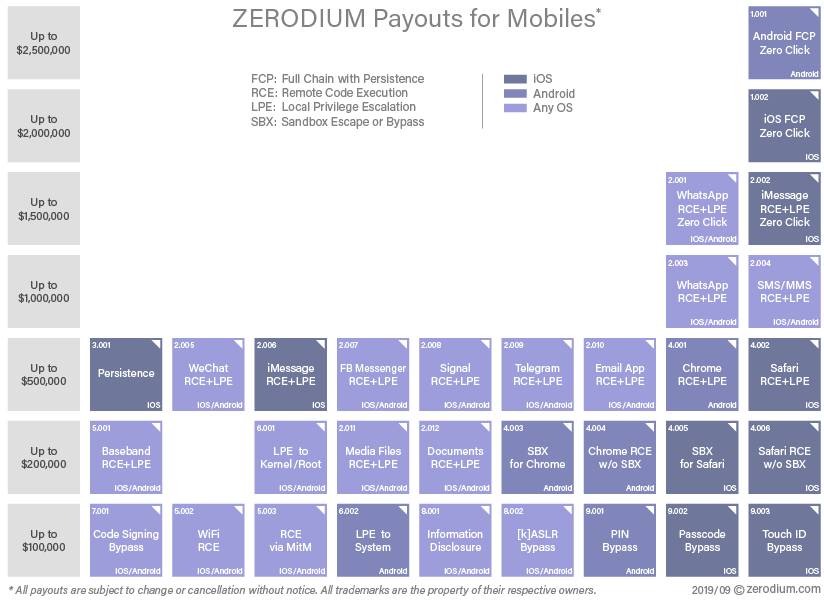
It would have to be after compromise, which would mean its likely only used on a very small number of cases due to the sensitivity and cost of the technology involved.