It's fantastic to see Waymo's progress. SF is a real nightmare to drive. If they can nail it there, that's 2/2 for busy, urban street driving (SF) and "boring" suburban driving (Chandler, AZ). They've been quietly very confident of their tech, but this is a real test.
Tangentially, I've also noticed that Waymo has picked up pace ever since the recent leadership changes. They are publishing more blog posts, offering more insights into their tech and generally seem to have increased their PR game. I wonder if that was a mandate from Alphabet leadership to show some urgency.
I think people vastly overestimate the challenges of weather conditions for self driving. With modern car tech (traction monitoring, ability to redirect torque to a specific tire, ABS, radar) an automated car is going to have an easier time navigating snow/ice/rain than a human driver.
The real challenges when navigating city streets are the human ones – delivery vehicles blocking lanes, municipal worker fixing a manhole with a single cone to redirect traffic, pedestrians/bicyclists appearing out of nowhere, no one following traffic signs. This is the kind of stuff that tests "intelligence".
> I think people vastly overestimate the challenges of weather conditions for self driving.
This remark makes me wonder if you've ever lived in an area that actually experiences winter.
Around here, dead of winter, there are no lines visible on the streets. Heck, after a good snow storm the lanes are basically a function of group consensus.
This is a situation where automation has the advantage. With detailed position information and detailed maps, the fact that the lines on the street can't be seen is irrelevant. The car didn't need them anyway.
(noting that Waymo requires full detail maps to be able to drive an area, including all signage).
First, it's optimistic to assume that data is accurate and up-to-date.
Second, I can't emphasize my "group consensus" point enough.
Anyone who's driven in real world winter conditions has seen a day where three lane roads turn into two. Or lanes form in the shoulder. It'd be actively dangerous to insist on driving according to the underlying lane markings during those types of road conditions.
Maybe in a world where all cars are autonomous and using map data that could work. In reality it really doesn't.
> With modern car tech (traction monitoring, ability to redirect torque to a specific tire, ABS, radar) an automated car is going to have an easier time navigating snow/ice/rain than a human driver.
Huh, what? Human drivers can already take advantage of all of those, and they still find snowstorms and torrential rain challenging.
The challenge is understanding what you see (and hear), and dealing with very noisy and limited--sometimes actively misleading--inputs.
I suspect it will know where the lane markings are better than human drivers. They are mapped ahead of time and the car can likely localize itself via other landmarks to determine where they are without being able to see them.
The harder part is driving like a human and detecting that a path has been made in the middle of two lanes in heavy snow and not obeying the lines at all.
The first idea seems like it would require a lot a lot of data stored in the car. Is it feasible? And even so, to be that dependent on matching up with existing pre-mapped data suggests a system that would be quite slow to roll out across a country.
Easy, my dumb level-0 car can tell me when it's icy. And finding lane markers is one of the easiest tasks in self driving (the hard part is knowing when to ignore them).
You're being downvoted for the flippant and dismissive tone of your comment, but I do wonder how computer-driven cars will determine when it is acceptable to violate lane markings and road signs. Boston in winter is more than just traction control. There are snow piles that might be icy, ridges left from a plow, shifting conditions, and bad visibility. I suspect it IS a hard problem.
Lane markings are a fraction of the triangulation.
We ourselves identify and confirm other urban waymarks via captcha which feeds the nav data -- bridges, signs, hills, hydrants, chimneys, lights. There is mass live verification from android auto in vehicles. There are many yearly layers of street view images and scans.
If a pedestrian slips in deep snow while crossing a street and is no longer visible because the snow obstructs them, does the car see a clear path and kill someone or not?
The human driver detects the pedestrian, laughs at the fall, then get worried and wait for them to get up, because a human knows someone fell and didn’t magically disappear.
Waymo et al will have to install snow tires or else no matter of traction control or even all wheel drive are going to help when your tires cannot find grip.
Source: grew up watching subarus do 360s on the freeway.
Lived in Boston for quite a while, and grew up driving in a city.
I find SF much more challenging to drive in, at least wrt the other drivers. In Boston, drivers are aggressive and take calculated, dangerous risks to meet their goal.
In SF, a lot of people on the road act like it's their first time driving in like 5 years and they're still figuring it out. There's no rational risk-taking towards a goal, but more people bumbling around unpredictably while unsure of what their goal even is.
That's a great description of driving for literally everywhere in the country that's not the Northeast. It's also why I think driving in the Northeast is the safest. Driving on highways in the South is scary.
What if the car/service just doesn't work or is planned to be offline based on the weather? It would suck to be stranded because it started raining, but would it still be valuable to have an automated taxi service on good weather days in big cities? I am inclined to say yes, and also delighted that this is the question I'm asking, but I'm an optimist.
In my experience with snow driving, a well maintained car (including good snow tires) goes a long way, and a fleet of commercial vehicles (like these) will have that as an edge over the average driver.
Yes and no. The weather conditions are probably close to perfect for a project like this. A city that spends months with icy roads... _that_ would be the real nightmare.
Yeah, fair enough. Only adverse weather they'd encounter in SF is fog and may be light rain. But I still consider driving in SF pretty challenging, especially for an autonomous vehicle – narrow roads, people not following rules, pedestrians everywhere, cable cars in the middle of roads. Certainly more complex than Chandler, AZ.
> I wonder if that was a mandate from Alphabet leadership to show some urgency.
Surely Alphabet has noticed that their competitors are nipping at Waymo's heels. If they don't pick up the pace, all sorts of business books will be written about how Waymo squandered a decade-long lead in the industry.
It may not scale to rural areas though. There are some roads were you don't need to look at the road in front of your: it is there and nothing else is. Instead you need to watch the ditches in a wide area around because that is where wildlife will jump out of in front of you.
Having driven many rural roads, that is something I would be much more comfortable with an automatic system on: staring around for deer at night is the classic attention task where humans tend to fail.
What I wouldn't be as comfortable with is the "random sheet of ice" or "oh look, rocks" or "suddenly washboard dirt road".
Most drunk driving accidents/deaths happen in rural areas because there is really no other alternative for transportation. Because of low population density and long distances taxis are basically impossible to find. Self driving cars could definitely fill a niche there should they ever become cost effective.
If the price is right, maybe. I live in a semi-rural area (about a house per acre, but unevenly distributed) and we have one Uber driver and a handful of taxi companies. Competition is tough though, my PHEV costs very little to operate and there's always parking and the bus system does on demand rides for $2 during weekdays between the morning and evening peaks.
I can't speak for the US, but in Europe (experiences from Sweden, Norway, Russia) rural areas usually have a handful of taxi drivers and you "use their services" by calling their numbers which you can get from locals.
In Finland we had a law that required the taxi monopoly to provide services even in rural areas, so disabled and elderly people could get transportation to services they need. Worked well in my town of 7 000 people except sometimes on weeknights the only driver could be in the next city 50km away.
(Had, as in they changed the law few years back. Not sure how it's now)
Robotaxi(s) could be quite good solution to the problem - the drivers were often pissed if you called them for a single ride when they were home or far away.
So long as it is only urban areas it is a band-aid for the lack of good transit options.
Not that you are wrong, just that you should be wrong because if cities actually had useful transit rural areas would be a much larger share of demand despite not having many people.
Very true, but retrofitting good transit into a city that didn't plan for it is extremely expensive and disruptive. I see these kinds of services being a great complement to public transit in cities that have struggled to make them attractive.
For example, I am way more likely to take Cal Train into SF if I can use a point-to-point service like Uber/Lyft/Waymo to get me the rest of the way there. Without that missing link, I'm much more likely to just give up and drive instead.
I’ll grant you that the muni busses are really terrible but they should get you (almost) from point to point. The muni system covers all the city of San Francisco (even Treasure Island) and run frequently.
The only problem is that they are painfully slow. If muni had more dedicated bus lanes (like, a lot more) it might very well be the best bus network in the world.
The best time to do good transit was 20 years ago, the second best is today. SF needs to quit making excuses and make transit good. What they have is not good even if it better than everyone else in the US.
The superiority of a blended computer vision system for this task, over a human performance, is almost impossible to overstate. The computer is not going to overlook even one deer.
>The computer is not going to overlook even one deer.
Oh it will. Animals have evolved amazing camouflage. Computer Vision will easily miss a deer hidden in a dark treeline. And radar/lidar even more so because the forest is going to have a pretty irregular geometry.
Even identifying a bicycle in a regular city street is something we have not convincingly solved yet. Animals on the side of a forest road is pretty far away.
It isn't possible to not overlook deer because they are often doing things such that you cannot spot them. Unless you mean they won't fail to see a deer 2 meters in front of the car - but it is too late to do anything about it then.
SF is unpleasant to drive as a human, but slow, dense traffic seems like a near ideal scenario for autonomous. SF needs lots of social calculations if you don't want to get honked at, which is mentally taxing, but they're far from necessary for safety.
Even fairly simple autonomous tech will have better peripheral vision at near-to-mid range than one human can manage, so for all those bikers, crazy walkers, and chaotic 15mph cars you shouldn't hit, it stands a pretty good chance of being better. And when it's not, come to a stop and you're fine (barring some honks) - few are moving fast enough to hit you dangerously hard in those human-complex areas, and you don't need to stop instantly, just fast enough.
---
Honestly, I'd put SF at dramatically easier than either residential or highway roads. Residential (and adjacent) has fast-moving cars ignoring signs with obstructed vision, and inattentive humans at relatively high speed (bikers used to low traffic and swerving, kids and animals running literally through bushes adjacent to roads, general lack of care around vision-blockers like fences due to perceived low risk, etc). Who's-at-fault doesn't matter - in car vs human, humans lose, and people rightfully get upset.
Highways also seem harder, if highly specialized: accurate decisions 100+ feet in advance are absolutely critical due to the speeds involved, computer vision at that range has fairly low detail compared to humans, and lidar is practically braille for "car". Radar has trouble distinguishing stopped cars from the road because neither are moving. Ultrasonics as an ultimate backup really only work up to around 10m (and that's about the distance to stop a car at 25MPH, which you'll regularly encounter in dense city traffic).
I'll also point out that more people have died due to Tesla's autopilot on highways than Waymo, Uber, Cruise, heck all self-driving companies I'm aware of at any size combined. They're riding all the terminology lines they can to get away with it, and they may very well have an order of magnitude or two more miles, but I believe the point still stands - highways are hard.
SF is a real nightmare to drive. If they can nail it there, that's 2/2 for busy, urban street driving (SF) and "boring" suburban driving (Chandler, AZ)
Both are low-hanging fruit. When it can navigate a snow-covered road at night while it's still snowing, get back to me.
But the bar to be better than a human in this case is also wickedly low.
I basically can't do this. If it was absolutely necessary I would go out there and drive like 5 mph and be terrified the whole time, but otherwise I would just treat whatever I needed to drive to in a snowstorm at night as temporarily inaccessible. I have lived in places where it snowed in winter before.
But the use case is not the middle of the night but perhaps during evening rush hour where it gets dark after 5 PM in the winter, and a storm began in the afternoon.
Cities that did decide to tear up urban areas for freeways aren't really any better. Consider places like Los Angeles, Dallas, or Houston.
What makes SF difficult to drive in (from my perspective of only ever being a pedestrian there) is a) extremely hilly terrain, b) the general difficulty of a dense urban environment anywhere, and only a distant third is c) traffic, which is merely an added stressor to the complex choreography that is an urban street.
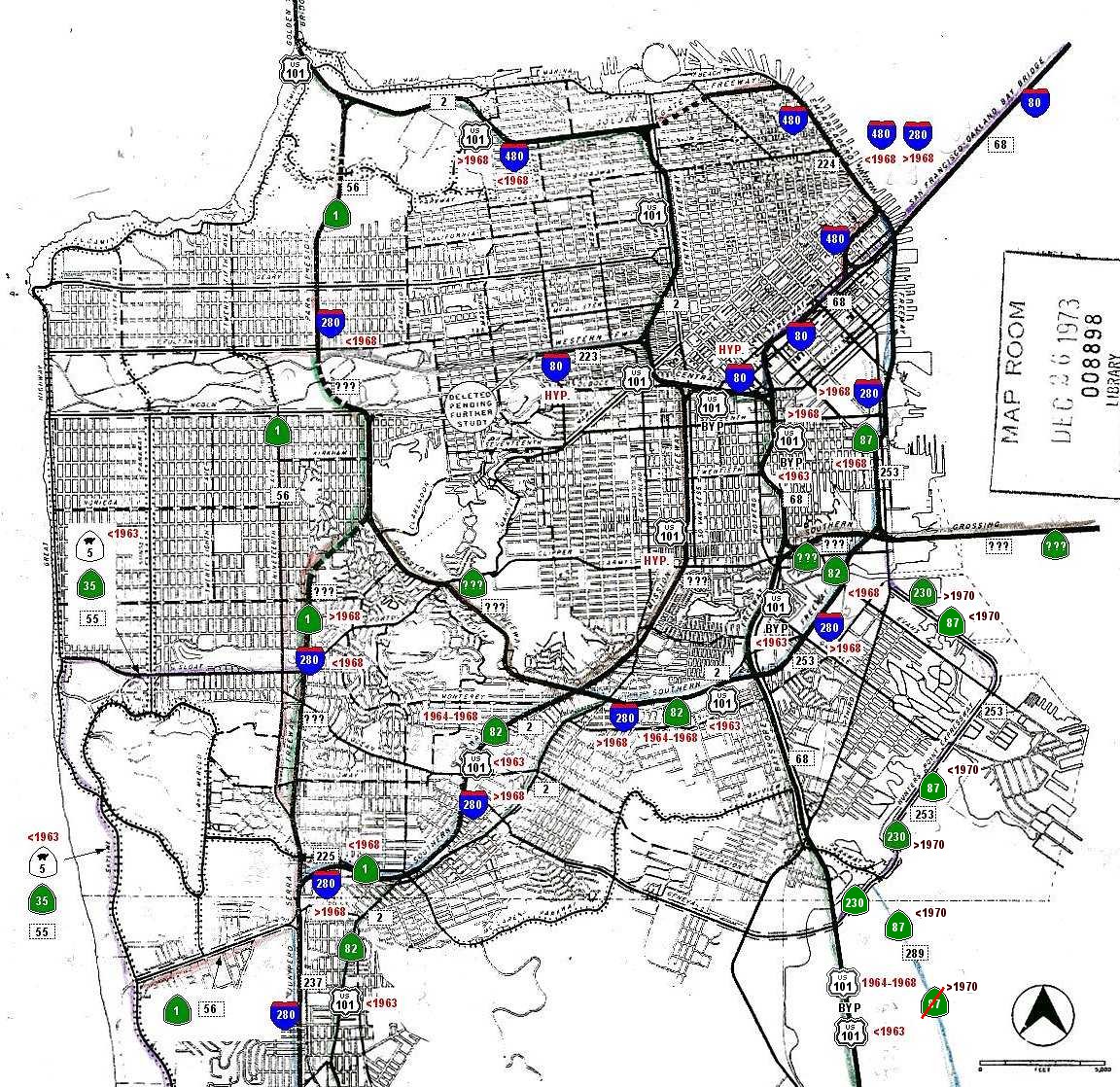
For SF, not rebuilding the 480 after the '89 earthquake made the Bay side of San Francisco really pleasant and enjoyable place to be. The Embarcadero from Giant's stadium to the Wharf and around to Fort Mason is such a beautiful place to walk/jog/ride, I can't imagine the area with the double-decker highway it used to have.
Wait do you mean? As in, the highways proposed in 1955 weren’t built?
I’m not sure how highways going through SF would make it easier to drive in SF (outside of the highways): wouldn’t that generally increase traffic and conflicts?
So just to clarify, you're thinking that traffic would increase because people would live outside SF and commute in? But don't people who live in SF need to get to work too? In that case, it seems like having giant highways carving up the city is going to make walking / biking to work harder which would cause more people to drive to work. That's what we see in "car-oriented" cities and it leads to an increase in traffic congestion that makes it miserable to drive, in addition to an environment that makes it miserable to do anything else but drive.
Commute through, eg Mill Valley to South San Francisco, or similar. Right now, because there's no freeway that goes through the city, that commute is technically possible, I'm sure there are people that do that, but it's not a fun or easy commute, so people try and live in San Francisco and commute to one or the other. If there was a freeway from the Golden Gate bridge, through the city, instead of Lombard and then Gough, then the Mill Valley - South San Francisco commute would be (more) viable at a cost of increased inter-city traffic. Ie traffic that is in San Francisco, but not doing anything there other than transiting. Which is the so-called "extra" traffic GP refers to.
There's a second Oakland/SF bridge that doesn't exist. Well, I assume it would go to Oakland. It's marked with "???" and just says "Crossing". I presume that hypothetical bridge wouldn't have Yerba Buena Island to connect through, so would be really impressive and long (compared to the Golden Gate and Bay bridges).
At one point it was also planned to be just north of SFO. Have you ever taken I-380 east instead of one of the exits to 101N/S? There's a huge multi-lane road that dwindles to basically an airport access road exit.
Oh man, thanks for those links. TIL. A causeway or something that extends off of Alameda? It's wild to think about what that would have done to the area.
This is a bizarre thing to say when all of those roads exist, more or less, except for the Embarcadero which was removed after it collapsed in the 1989 earthquake (and was a crazy eye sore).
It is certainly true that the taste for elevated highways through cities has waned given the pollution and dust and general unsightliness that it produces. In the 1950s, when cars were all the rage, people were very excited by these things.
> This is a bizarre thing to say when all of those roads exist, more or less
Personally, as an SF resident I would much prefer all the cars to be tunneled or elevated instead of idling in front of my house or blowing loudly through my block. It's a safety issue.
When there's only so much surface area where else are people supposed to build except up and down? That's why we have skyscrapers, and those don't seem to provoke the same vitriol as the roads.
Even the famously-hated Embarcadero Fwy wouldn't have been visible if the plans for the World Trade Center (lol) at Market/Embarcadero hadn't also been canceled:
> Personally, as an SF resident I would much prefer all the cars to be tunneled or elevated instead of idling in front of my house or blowing loudly through my block. It's a safety issue.
This is a false choice though. It would be better to design the city in such a way that we don't need personal automobiles for most trips. Building high-speed roads (elevated or not) through a city tends to have the opposite effect. If you live in SF, just think of the parts of the city that do have high speed roads. Is it pleasant to walk along division street? People choose their mode of transit based on what feels safe and convenient to them.
In the space and money taken up by an elevated highway, we could have low-speed mixed-use streets and an entire separate highway for bikes, and it would be safer and quieter.
Yes, inducing some demand is the point. People have to live somewhere, work somewhere, and until recently generally had to commute between the two. When this happens in your circulatory system it's called a stroke :p


Tangentially, I've also noticed that Waymo has picked up pace ever since the recent leadership changes. They are publishing more blog posts, offering more insights into their tech and generally seem to have increased their PR game. I wonder if that was a mandate from Alphabet leadership to show some urgency.