Just to remind you all why it's not a coincidence and also not an argument for conspiracy.
The only organizations in the USSR who were hunting for best talent were KGB and military. So when the first businesses emerged and started hunting, almost all talent came from there.
Factually incorrect: only a small minority of talented people went working for KGB. It had many perks but wasn't a place where a serious talent would thrive.
Poke any notable Soviet science and technology figure and see if they have KGB in their biography.
Soviet R&D wasn't structured within end users but was own network of research institutes and design bureaus. So if you wanted to work say on solid state rockets you wouldn't go to artillery school but rather something like Central Scientific Research Institute of Heat and Mass Exchange. There you'd be working for tactical rocket stuffings for the rest of your life, have a certain academic career track and as a perk have an occasional international publication with peripheral results.
Being investigated by KGB is so categorically different thing than being a KGB officer that I'm not even sure where to start.
But sure: Sergei Korolev, the champion of Soviet space programe had his jaw permanently broken in one of NKVD/KGB torture sessions. This later led to his untimely demise.
KGB was renamed and split into four agencies (FSB, SVR, FAPSI and FSK) that were later merged down back to FSB and SVR. There are still KGB people working there that didn't even have to move their offices.
The country is now ran by a clique of ex-KGB hardliners but I guess that does not count because it was renamed in 1991.
It was when he was enrolled in it (1980) and when he graduated from it (1987).
That's how education worked back then. If you wanna study cryptography, you go The Technical Faculty of the KGB Higher School, now known as Institute of Cryptography, Telecommunications and Computer Science (FSB still runs it).
> In June 2021, the University officially transferred from the Defense Department to the Office of the Director of National Intelligence to better serve the diverse and varied needs of its students and the United States intelligence enterprise.
That was the official name at his time of graduation, and the school is still the Russian security service primary institution.
> I'm not sure what you try to proof with your picture and kaspersky.
Oh, only that his link to Russian secret services is not ephemeral. He is still a bloody state security reserve officer.
Now of course there is no way of proving if this vulnerability was planted or merely a poor implementation. However to think that Kaspersky Labs has no substantial embedding of FSB is incredibly naive, it's simply not how things work in Russia (even if the CEO isn't an FSB reservist).


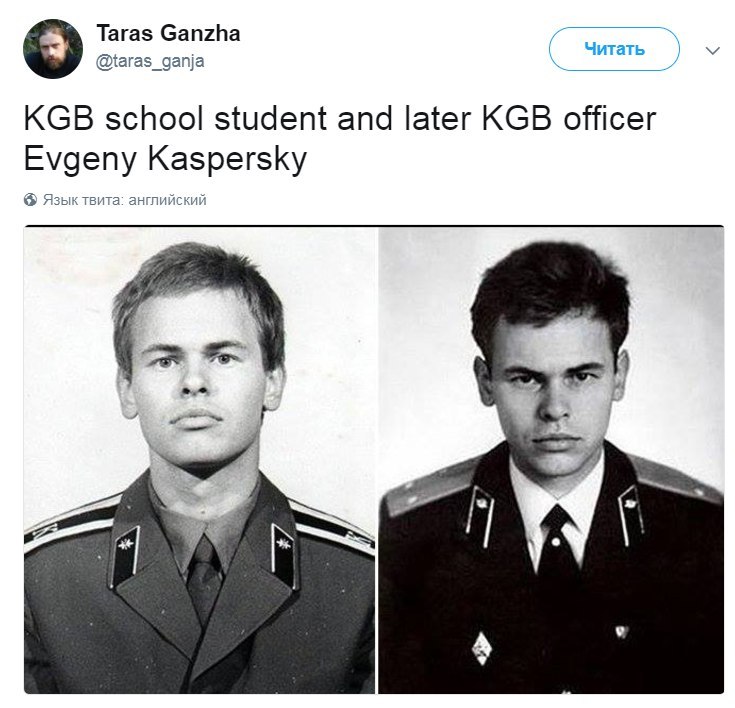
Insert Kaspersky owned by Russia intelligence conspiracy here...