The comment is not fitting to the article, but I wanted to respond to it anyways because I found it interesting and it's not something talked about here much, for obvious reasons.
The problem is going to escape many on the left, including most people here as well, as many people here are mostly agnostic/atheistic/anti-faith and believe having faith is somehow anti-intellectual. The reality of the situation is the US was founded, both socially and politically on Judeo-Christian principles of morality, and the nuclear family and it is undeniable the evidence to support this in our laws and constitution.
We have seen more upheaval and social change in the last 10-15 years than the previous 50 all in the name of "progress" (never mind it is those very people who subscribe to that "progress" that are leading the way in unhappiness, depression, low marriage rate, low birth rate, and suicide).
There are positions now being held by major political frontrunners that are simply not compatible with any person of faith, or any sort of compromise with the opposite political party. There is simply no compromise to be had. The biggest elephant in the room is abortion. My two favorite writers on this subject are Caitlin Flanagan for a left-side perspective, and Alexandra Descantis for a right-side perspective. Both write very thoughtfully on this issue: https://www.washingtonpost.com/outlook/how-democrats-purged-...https://www.realclearpolitics.com/2019/11/16/an_honest_abort...
Many people call America a Christian nation. I know this will get downvoted to hell here. I consider myself a well traveled man, and I will quote one famous professor I had the pleasure of listening to a lecture of that rings especially true to me: "The only country in the world that doesn't know America is a Christian nation is America."
I have no more interest in religious authoritarianism than I do with "progressive" authoritarianism. Fundamentally, its the same problem from a different direction. If your faith (religious, political, vim/emacs, whatever) requires me to do something, things aren't off to a great start.
Authoritarianism leads to tyranny, and it doesn't particularly matter who's boot is on your neck in the end.
The backbone of the USA in its formative years was slavery and outright slaughter of native Americans. By people who went to church.
This dark legacy stretches into today - the last lynching was in 1981, and white Christian America still worships a vision of a nice, pearly white European looking Jesus, presented by millionaire preachers in mega churches who say “just give me some money and you too can be redeemed”.
And not to mention their pseudo worship of a man who is so laughably espouses the exact opposite of the Christian teachings. A man who had sex with a pornstar while his second (or third?) wife was pregnant at home and has never read the Bible.
I’d appreciate knowing how you can reconcile thinking what you commented with what actually happened, and how you can view a system of oppression, control and political propaganda (USA’s brand of “Christianity”) as anything but that.
> The backbone of the USA in its formative years was slavery and outright slaughter of native Americans.
Actually, most founding states sought to abolish slavery when the Constitution was being drafted. The Southern States were vehemently opposed to such action to the point that they would not ratify the Constitution. As a compromise, slavery was allowed, and no law could be made restricting the importation of slaves until 1808.
Consider, though, that the importation of slaves was banned on the first day which was legally allowed.
I think your problem is that what you refer to as "the USA" is really "the South." The South fought hard for slavery because of economics; slaves were cheap, and plantation owners were powerful. My view is that the powerful Southerners who benefited from slavery created a cult which poisoned the minds of other Southerners into believing that slaves were necessary. It takes a long time to erase all that.
> the last lynching was in 1981
And a school district in Alabama was ordered to desegregate less than ten years ago. What's your point? These are outliers. They don't represent the majority view. You're cherrypicking to make things seem worse, which is exactly what the post discusses.
> white Christian America still worships a vision of a nice, pearly white European looking Jesus
Consider that the book (and movie) "The Shack" portrays the three parts of God as an African-American woman, a Middle-Eastern carpenter, and an Asian woman as the Father, Son, and Holy Spirit, respectively. "White Christian America" still ate it up. But, according to your logic, they never could have because Jesus wasn't presented as white. Perhaps your viewpoint isn't actually correct here.
> And not to mention their pseudo worship of a man who is so laughably espouses the exact opposite of the Christian teachings. A man who had sex with a pornstar while his second (or third?) wife was pregnant at home and has never read the Bible.
Should a Muslim hate Trump? Should a Jew? Should he only be loved by athiests? What are you saying? People are far more than their religions.
I am close to someone who does things I could and will not do in my regular course of life. I see their lifestyle as degenerative and a coping mechanism, and that's my damn right. Yet, I still bought them a book on their least-harmful hobby.
People can still care and want to see others do well for themselves while recognizing the limits of their ability to affect change. Should we hope that Trump is a failure? That's like hoping for the bus driver you hate to crash into a tree; if that happens, you're gonna get hurt as well.
Maybe those people just see the world from a different perspective than you. It sounds like you're pretty "woke," but have you ever had a kind, thoughtful conversation to genuinely understand their point of view? By mocking them in this way, you're invalidating their opinion. But wait, isn't the left tolerant...
> Consider, though, that the importation of slaves was banned on the first day which was legally allowed.
None of this counters my original point. Cotton was an utterly crucial crop in the USA's development, and the total value of all slaves was 48 times the expenditure of the federal government, and 7 times the total value of _all_ the currency in circulation at the time (1860). I'd call that a pretty important backbone, even if it was localized to mainly the south.
> And a school district in Alabama was ordered to desegregate less than ten years ago. What's your point?
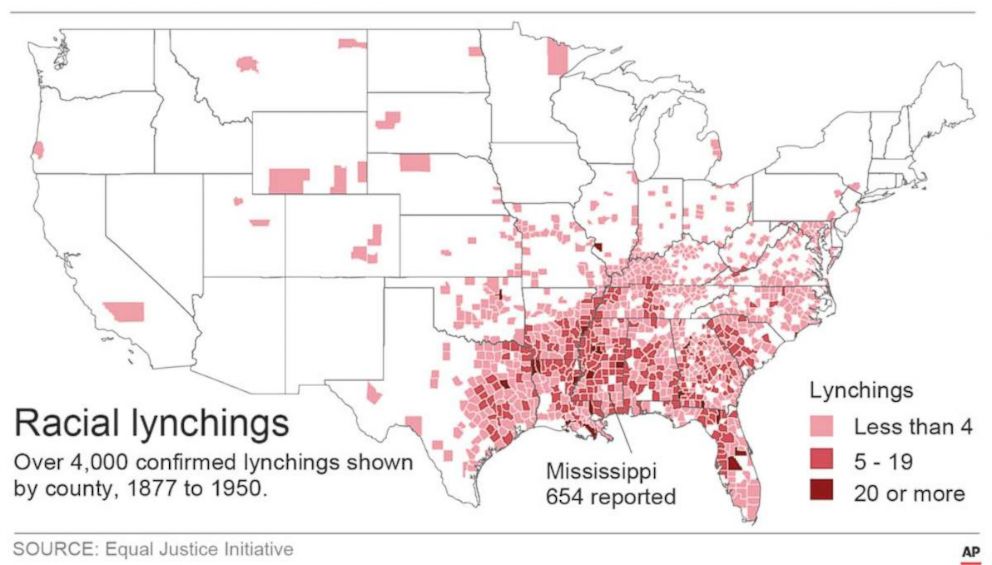
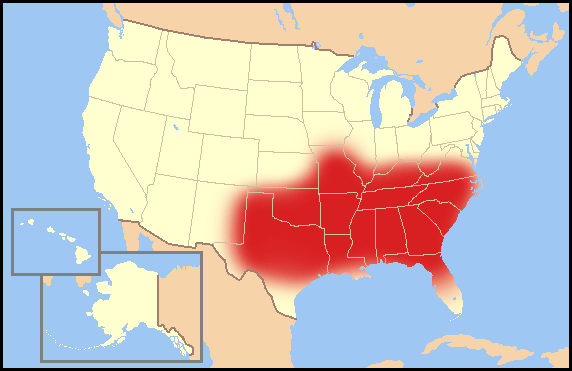
My point is that the last lynching was in 1981. That's utterly ridiculous. It only trailed off in the 1950's. Also here's a map of the lynchings[1], see a pattern? Maybe if you overlay a map of the bible belt[2] it becomes clearer. Love thy neighbour, right?
> Consider that the book (and movie) "The Shack" portrays the three parts of God as an African-American woman, a Middle-Eastern carpenter, and an Asian woman as the Father, Son, and Holy Spirit, respectively. "White Christian America" still ate it up.
To quote you: What's your point? These are outliers. They don't represent the majority view. Maybe they ate it up because it was "wacky" to see a brown Jesus on screen. Only on screen mind you, I don't expect many of them would want that imagery taught in churches! God forbid.
> Maybe those people just see the world from a different perspective than you.
Yeah, I expect their tax-excempt churches had a pretty fair and balanced discussion about both sides. No wait, riling people up about abortion then using that as a device to get people to vote your party into power, so you and your tax-excempt gravy train can continue to benefit is far too much of a good thing to risk. Especially by discussing how we can adapt society for the future rather than harking back to the good, clean family-friendly past (lynchings or not).
Everything is about control. Some people form opinions from TV, some from church. Just because a man stands at a pulpit doesn't make his words any different from a news anchor behind a desk. It's just unfortunate for their followers that they support such a regressive party. And as certain segments of the population age out and Christianity continues to shrink you'll see them ratchet up the furor to stay in control. Control people like you.
But hey, hold your nose and vote for the candidate that was sent from god[3], right?
> I'd call [slavery] a pretty important backbone, even if it was localized to mainly the south.
The localization of the issue to the South is incredibly important to consider, though. They actually seceded and became a different country for around four years because they felt slavery was that important to their economy. And, as another poster mentioned, the South (primarily agrarian) was much poorer than the North (manufacturing and agrarian) and had staggering levels of inequality compared to the North.
You say it's a "dark legacy," but what do you want to do about it? Crap all over the country for something which was last actively practiced 150 years ago? My ancestors were still poor farmers in Hungary at that point; they didn't have anything to do with slavery in the US. Slavery is awful and unjust, but don't expect me to hate others today for the injustices of the past.
> My point is that the last lynching was in 1981. That's utterly ridiculous. It only trailed off in the 1950's.
Racism is learned and taught. During the Reconstruction, the South reinvented their economy and culture, since slavery was dead and the white Southerners had to live near the newly-freed black Southerners. Unfortunately, that reinvention of culture included the significant perpetuation of racism.
It takes a long time to erase all that. Unless they're willing to sit and reason, there's nothing you can do. We can, however, raise our kids right so, with time, the racists will die off.
> Only on screen mind you, I don't expect many of them would want that imagery taught in churches!
Have you ever been to a majority-white Christian church in America? What about a majority-black Christian church in America? They all sing, pray, and listen. There's no discussion of Jesus' skin color, because that's not why they go to church. They go because they want salvation.
> riling people up about abortion then using that as a device to get people to vote your party into power
> you and your tax-excempt gravy train
> good, clean family-friendly past (lynchings or not)
Ok, it's clear you're hateful toward Christians. But are you really hateful toward all of them?
Yes, it's possible for a liberal Lutheran to exist. Do you still hate them? Would they hate you?
You lump white Christians together as some massive homogeneous blob, but you just can't do that because it's not fair. Also, do you think all sermons are just political rants? I can tell you they absolutely aren't. In fact, many people will go to church to get away from politics.
> There are positions now being held by major political front-runners that are simply not compatible with any person of faith, or any sort of compromise with the opposite political party.
And the political front-runners on the conservative front have given up on having a position that's compatible with those who live outside of faith. Those who reject the idea that an abortion should _ever_ be performed, those who advocate or even demand for re-implantation of ectopic pregnancies, despite doing so would kill the patient.
How, as a moderate, am I supposed to take those with such outlandish views as anything other than a rallying cry for further radicalization?
As for the rhetoric about what faith our nation should have or was founded on, I think if you're going to advocate our nation have a single faith you might want to further consider the founding father's original intentions, and the intentions of those in the 50s who chose (in fear) to try radicalizing us by adding "under God" or "in God we trust" to our official notes and pledges.
>the US was founded, both socially and politically on Judeo-Christian principles of morality
What principles of morality excuse and justify native genocide and chattel slavery: practices that formed the actual economic and political foundation of the United States? "Judeo-Christian" is a white-evangelical term that erases Jewish culture and folds it into a narrative of supremacy.
>There are positions now being held by major political frontrunners that are simply not compatible with any person of faith
Your presumption is false. Not all people follow your faith or the narrow view you have of the faithful. Of all the founding narratives, the one grounded most in the historical political reality was the need for American to encompass the varied faiths of the early country. Among the colonists were Quakers, Catholics, Lutherans, Jews, Baptists, Anglicans and many others. They attempted to write a constitution that would ensure they couldn't create a State that would allow one to impose their beliefs on another.
It follows that this same constitution would not allow the State to impose the beliefs of a minority[1] on choices a woman makes with her own body.
> What principles of morality excuse and justify...
That a system is hypocritical or irrational is not criticism of it existing, only criticism that it should exist. The culture very obviously exists, otherwise there wouldn't be a heteronormative, patriarchal, workaholic, individualist, capitalist, suburban culture for far-left types to fight.
> Your presumption is false. Not all people follow your faith or the narrow view you have of the faithful...
You are attacking a strawman. Obviously not all faithful hold traditional views, but a large group of faithful obviously do hold traditional views.
> Among the colonists were Quakers, Catholics, Lutherans, Jews, Baptists, Anglicans and many others.
All of whom were Judeo-Christian and grossly compatible with the traditional culture I described above.
The core point of the article linked and the grand-parent comment is that the US used to have a single, "traditional" base culture. We now have two, competing cultures. I don't think your comment addresses that point, rather it only addresses the inconsistencies within the traditional culture. Debating first-level politics doesn't ascend to the level of something that is "interesting to hackers," which is why political debates are softly banned on hackernews.
>The core point of the article linked and the grand-parent comment is that the US used to have a single, "traditional" base culture
Article author and grandparent are conflating political participation/power with demographics and trying to map complex multi-dimensional political realities onto a two-dimensional liberal/conservative line (author himself admits flaws in that analysis). We used to have three television broadcast channels back in the days of Eisenhower!
You are doing the same by collapsing varied faiths into "judeo-christian" a term now widely recognized as serving christofascist historical revisionism[1,2]. What you describe as "base culture" is actually hegemony, a dominant culture. Other cultures (far more than two!) have always existed.
It's easy to conflate culture and political party, but they are very different things[3]. The fact that we only have two parties is likely due to structural issues FPTP imposes on our democracy[4].
Technology in many ways has enabled various factions to find their voices and be represented. A topic of incredible interest to hackers!
Ah I had forgotten about the term "hegemony", thanks for reminding me! I will use "hegemony" in the future instead of "base culture". At a surface level it seems to be a term that accurately conveys what I meant by "base culture", but will have much wider recognition than some term I invented.
And rereading your original comment in the context of this comment, I think I understand your point better. When one uses the term "judeo-christian culture" they imply multiple things, some of which are incorrect:
1. That the collective systems of the US operated under a single shared system of beliefs. I would have referred to that as "culture", but perhaps the better term is "hegemony".
2. That most individuals in the collective "liked", or rather "personally subscribed", or rather had a culture compatible with that single hegemony.
You are arguing that point 2 is incorrect. There have always been many cultures present in the US, but due to Judeo-Christian hegemony, those other cultures expression was suppressed and the "Judeo-Christian" hegemony was all that presented. Users of the term "Judeo-Christian culture" are not recognizing that many members of the "Judeo-Christian" hegemony were only participating in the hegemony because they _had to_, not because they _wanted to_.
On your other point:
> Article author and grandparent are conflating political participation/power with demographics and trying to map complex multi-dimensional political realities onto a two-dimensional liberal/conservative lime
I think you are mostly right about this; however I think that within the right wing, demographics, culture, and politics are largely intertwined. I think those demographics, culture, and politics are largely the ones that were traditionally present under Judeo-christian hegemony.
So, refactoring my points under my new understanding, I think:
1. We both agree that the US had a Judeo-christian hegemony (perhaps there is a better name needed).
2. We both agree that the right wing is descended from that Judeo-christian hegemony.
3. We disagree to the degree that various Americans' cultures across history were compatible with the hegemony or were suppressed by the hegemony.
4. We likely disagree on whether a [edit: replaced "the" with "a" here] hegemony is good or bad.
On 4), I get the sense that argument will be rather boring. On 3), I would love to get some references to material that studies this. I do not particularly care if the material has a left or right bias, as learning those perspectives would be interesting itself.
> I think those demographics, culture, and politics are largely the ones that were traditionally present under Judeo-christian hegemony.
And this is where we disagree. It is useful for branding purposes to put forward the notion that what you believe has always been the belief, but that by itself doesn't provide inherent justification for that belief. As the article[1] I posted elucidates, the construct of "Judeo-Christian" is a relatively recent political tool. This tool has been used to erase Judaism's unique cultural impact (which directly contradicts the presumption put forward by the thread starter[2]) and the abrahamic roots of Islam in order to exclude and justify violence.
For the purposes of defining what America is, the topic that began the thread, we must recognize the difference between handwavey rhetoric and what is grounded in the historical record. There's also much to be said about how relevant what America was should be to what America can be, which is why I tried to expand the scope by elucidating that what America is also includes how America has changed since its foundation from a marginal, slaveholding, collection of thirteen disparate colonies into a world power.
> The reality of the situation is the US was founded, both socially and politically on Judeo-Christian principles of morality, and the nuclear family
The truth is it absolutely wasn't. It's true that various forms of Christianity (with more virulent anti-Semitism than any “Judeo” component) were broadly popular with the general population at the time of founding, the intellectual elite who were the thought leaders shaping our model of government were largely members of the Enlightenment faction that started the whole idea of anti-religious secular liberalism.
The nuclear family also played little role in America’s foundation, only becoming dominant in the US sometime early in the latter half of the 20th Century, quite late in US history.
Though both the nuclear family and “Judeo-Christian” values being essential to the foundation of the American nation is one of the (fact-free) defining myths of American social conservatism of the late-20th Century to the modern day.
If you really think this, then all I have to say to you is you must read the Federalist Papers, Declaration of Independence and Constitution with quite the set of blinders on my friend. For example, consider this quotation from John Jay in Federalist No 2: https://www.goodreads.com/quotes/1329146-it-has-often-given-...
> the intellectual elite who were the thought leaders shaping our model of government were largely members of the Enlightenment faction that started the whole idea of anti-religious secular liberalism.
Really going to need a citation on this. Besides that point, the Enlightenment being anti-religious is a myth in of itself as well. Most standard taught US history on the events that took place basically from the split of the One Catholic Church, through the dark ages, and up to just before the founding of this country is woefully inaccurate. We are pretty good at documenting things that occurred on this continent roughly mid 1700s on.
> Most standard taught US history on the events that took place basically from the split of the One Catholic Church, through the dark ages, and up to just before the founding of this country is woefully inaccurate.
I don't think anyone who places the East-West Schism before the Early Middle Ages (on top of the still using the term “Dark Ages”) really has any leg to stand on in accusing any other portrayal of history as “woefully inaccurate”.
Did I place it before the early middle ages? Whoops! Not my intention. The schism took place in 1054 officially, however it was very much in the works before that. Thanks for pointing out my comment read as such. I use the term dark ages purely because that is the term the greatest amount of people will be familiar with, and I am referring to the period roughly between 1330 to enlightenment period.
> I use the term dark ages purely because that is the term the greatest amount of people will be familiar with, and I am referring to the period roughly between 1330 to enlightenment period.
I am pretty sure “Dark Ages” is not a term people are generally familiar with for the period from the Late Middle Ages through the Renaissance, since even when the term was more popular, that's not at all what it referred to.
Actually, suicide rates in the US are concentrated overwhelmingly in rural areas [1], which corresponds strongly to conservativism, while some of the lowest suicide rates in the country are in ultra-progressive bastions like New York City and San Francisco.
It doesn't have to be Christianity, but a nation needs moral fiber to prosper, and not just economically. The decline of faith in America with no underlying moral philosophy to replace it has led to normalization of far too much injustice, monopoly, and downright selfishness. Democracy is on shaky ground these days.
> The decline of faith in America with no underlying moral philosophy to replace it has led to normalization of far too much injustice,
I'm a Christian, but I disagree. Far too much injustice has been, both throughout history and recently, normalized because of faith, including variations of Christianity. While there is certainly injustice that comes from other avenues (including certain highly unjust atheistic belief systems), there is simply no substance to the claim that declining religious faith is driving some general increase in injistice, or decrease in strength of moral principles. It certainly involves a shift in moral principles (for instance, away from the dominance of the view that the outward forms of the forms of Protestant Christianity historically dominant in the US are obligatory or at least morally preferred), but that's often (including the cited example) a shift away from principles that have justified gross injustice.
I'd also disagree that the decline in faith in America hasn't involved a replacement by alternative moral philosophy; sure, not one single alternative, but while that might frustrate forging a singular tribal identity, it doesn't indicate a lack of principles in the populace.


The problem is going to escape many on the left, including most people here as well, as many people here are mostly agnostic/atheistic/anti-faith and believe having faith is somehow anti-intellectual. The reality of the situation is the US was founded, both socially and politically on Judeo-Christian principles of morality, and the nuclear family and it is undeniable the evidence to support this in our laws and constitution.
We have seen more upheaval and social change in the last 10-15 years than the previous 50 all in the name of "progress" (never mind it is those very people who subscribe to that "progress" that are leading the way in unhappiness, depression, low marriage rate, low birth rate, and suicide).
There are positions now being held by major political frontrunners that are simply not compatible with any person of faith, or any sort of compromise with the opposite political party. There is simply no compromise to be had. The biggest elephant in the room is abortion. My two favorite writers on this subject are Caitlin Flanagan for a left-side perspective, and Alexandra Descantis for a right-side perspective. Both write very thoughtfully on this issue: https://www.washingtonpost.com/outlook/how-democrats-purged-... https://www.realclearpolitics.com/2019/11/16/an_honest_abort...
Many people call America a Christian nation. I know this will get downvoted to hell here. I consider myself a well traveled man, and I will quote one famous professor I had the pleasure of listening to a lecture of that rings especially true to me: "The only country in the world that doesn't know America is a Christian nation is America."