To understand this, you need to realize that San Francisco politics is a perpetual no-holds-barred fight between two factions within the local Democratic Party: the "Moderates" and the "Progressives" (although the Progs also contain some members of other parties, like the Greens and the DSA). The Progs hate the Mods with a burning passion and are constantly trying to undercut them. Generally, Moderates tend to win city-wide races, while Progressives tend to win district supervisor races. Right now, the mayor's office and all state-level seats--including Scott Wiener, who authored the bill in question--are occupied by Mods, while the Progs have a veto-proof supermajority on the Board of Supervisors.
The Progressives tend to lean more NIMBY than their Moderate counterparts, and some of this opposition is certainly the result of that. (Gordon Mar, the president of the Board, is probably the biggest NIMBY of all the supervisors at the moment, possibly excepting Aaron Peskin.) But most of this opposition is purely tribal: the Progs on the board just want to snipe at Scott Wiener. Progs are not categorically opposed to housing: as others have pointed out, when Brisbane was waffling on approving market-rate housing just to the south of San Francisco, Jane Kim, a Progressive, threatened to annex the city!
Most of this anti-SB-50 resolution is properly understood as San Francisco tribalism more than any sort of policy grievance. SB 50 doesn't even have much if any of an effect on a lot of the districts these supervisors represent, either because they're exempted as "sensitive communities" (e.g. much of the district I live in, D10) or because the districts are already upzoned (e.g. the Mission).
That instance of Jane Kim threatening to annex Brisbane came off more as “everyone ELSE should build more housing so we don’t have to” than anything else to me, personally.
They’re not wrong that other cities also need to build more housing, too, but SF equally needs to. They’re the city, not the suburb.
Forgive my municipal ignorance but how does one city "annex" another? It's not like they have an army to do it with? Are there legal maneuverings to accomplish this?
A brilliant summary for those not following closely. And then I look at the username to see who wrote this, turns out it was an immediately recognisable Rust and Compiler expert.
When it comes to big-money issues like housing, self-interest takes precedence over professed ideology. Ostensibly liberal California not only has rampant NIMBYism, but is also in contention for the most regressive property tax policies on Earth via Proposition 13.
Yeah Prop 13 passed when the state was much more republican leaning. Remember both Nixon and Reagan were from California and Schwarzenegger won the governor's race. Arguably the state only went democratic because anti immigrant efforts, particularly prop 187 in 94, pushed moderate latino and asian voters to vote democratic.
There are costs to changing it, just like there are costs to rewriting an app in a new language. Only rewriting something from php to python 3 doesn't potentially leave senior citizens on fixed income homeless.
That doesn't mean people like it, or think it's not problematic, but there has to be an upgrade path that's viable.
We lean towards stability for low-income populations. An ability to live somewhere, accumulate relationships, and find a stable job, without being thrust into homelessness any moment at the will of enterprise.
Above all else, we support real public housing, maintained by democratic institutions. Our numbers are growing at record rate lately, so if you want to build density, do it like this. Our armies of enthusiasm will be right by your side.
Sigh, this kind of thinking is some sort of variant of broken-window syndrome:
> But Board President Norman Yee said San Francisco should be exempted altogether from Wiener’s proposal.
> He said that SB 50 “does not take into account the nuances and intended impacts that comes up upzoning entire neighborhoods” and he noted that there are large developments planned in the district he represents.
> "We’re actually building our share of housing,” Yee said. “Maybe we could better. But we certainly are probably doing better than most places in California. We have motivated communities that want to plan. We should be exempt from SB 50.”
It's definitely true that San Francisco is building more housing than the other counties in the Bay Area, and that they should also do better. But that isn't a license to ignore the need for more housing directly in San Francisco. If anything, it's almost a non sequitor to the basic challenge facing any major city: how do you have enough housing within a reasonable commute of the jobs in your city?
Just earlier today [1] the mayor decried the lack of housing in the city that our public transit employees can afford. Over 250k people were already commuting in back in 2013 [2]. For a city of under 1M people where job growth has outstripped housing growth, that seems like a fairly high "deficit".
The problem is not housing it’s the ratio of commercial to residential development. Ban new commercial development and you kill job growth and thus the ever growing demand for new housing. That’s not going to fly, but clearly it’s all about the ratio not the absolute numbers.
PS: Well not kill, companies would end up packing more people into the same space up to a point.
Right, it’s all about the ratio. A group of us pointed this out to the planning commission in relation to the Central Soma Plan. It called for something like 32k new jobs and only 8k housing units (and IIRC, nothing about transit other than claiming through magic that existing muni, Bart and Caltrain service would suffice).
I’ve since moved out of Soma, as the commissioners and supervisors made it clear that while they understood the problem, they also didn’t have anywhere else to plop down tens of thousands of jobs.
They hem and haw about building in the city, but they’re okay with bullying a neighboring community[1] in a different county into building (they threatened Brisbane, down the road, an independent jurisdiction in another county!!)
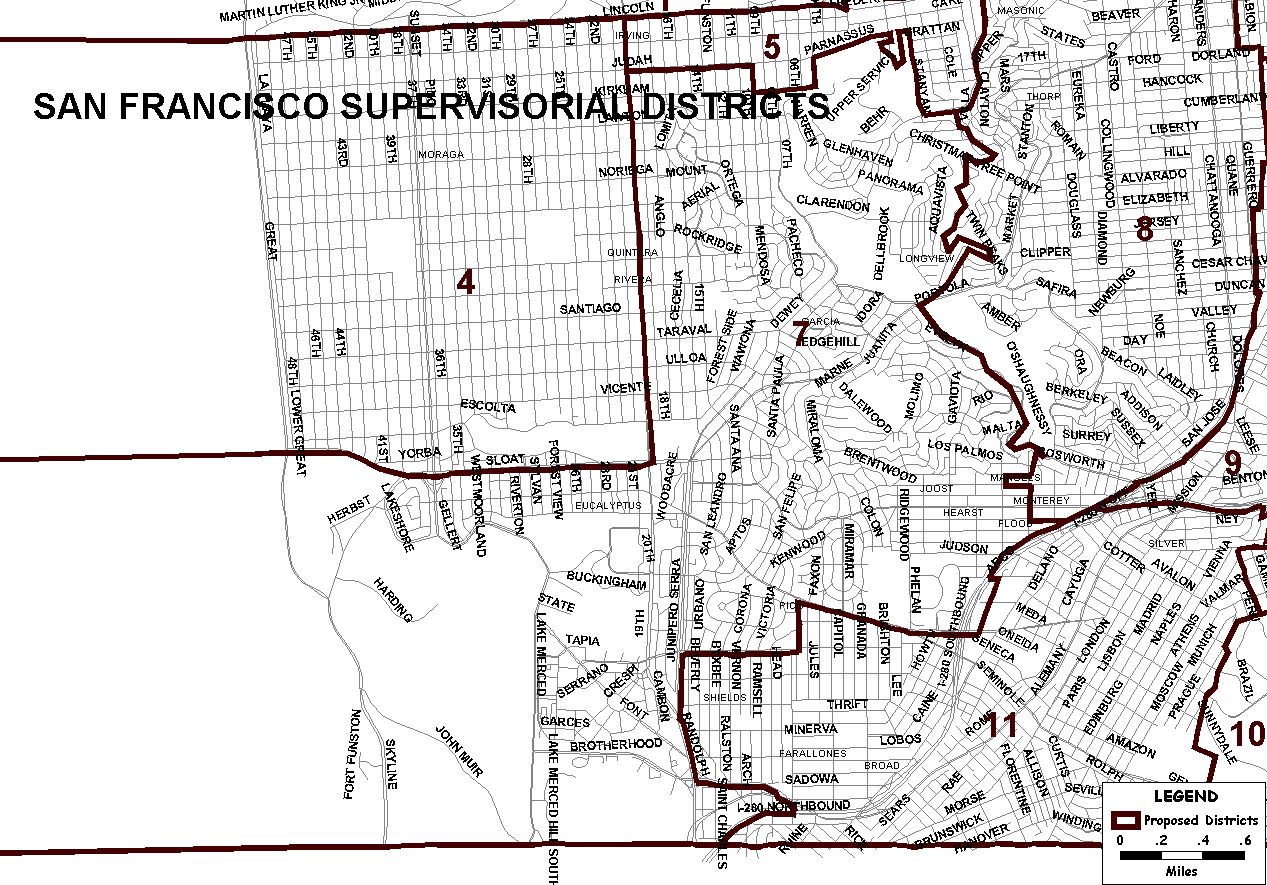
A friend points out that Yee is Supervisor for District 7 [1], which is essentially entirely zoned as 40-X [2] (40 foot height limit) and mostly RH-1 and RH-2 [3] (single-family homes and two-unit residential respectively).
As the N-Judah line runs through it, the SB 50 bill would immediately cause entire swaths of his District to be upzoned fairly dramatically.
which does seem to show that 7 borders the Judah line (on Judah itself). But to be fair, I'd assumed District 7 went to the park and that it included part of the UCSF area.
So he's getting hit by MUNI lines on both sides :).
I know this will never happen, and I'm sure is not a popular opinion, but San Francisco needs a Bloomberg/Giuliani (pre-nutcase) style Republican to come in and clean house. Sometimes that is needed, and sometimes the opposite is needed; otherwise you get run away situations like deep red and deep blue areas that progress backwards.
Hope springs eternal but we’d have to change the city charter so we’d have city-wide elections.
It doesn’t matter what stripe, but yeah we need someone with determination to come in and clean house like after the Koch era.
People are so fed up neighbors in the west part of the city are wondering out loud if it’s possible to secede from the city while remaining in the county cuz they just want a government which takes care of the hoi polloi. The police don’t even want to bother with robberies unless it involved a weapon because the DA won’t take the cases and the perps are instead given citations...
The term "cartel" is interesting here, if the power structure is indeed the voting population of San Francisco being predominantly homeowners, then as those homeowners are the suppliers of the housing market, it is a cartel in form.
Actually it is. I've always felt that many 19th century local governments in the US were run like start-ups with a grand vision of creating a better society for their citizens. If you look at the efforts to build transportation, support business, promote local education, and the like it's hard not to see the parallels.
because the supervisors are just acting in the short term best interest of property owners. limit supply and prices will go up. they're all on the take.
This is such a sophomoric take on a complicated issue.
Speaking as a long-time renter who is now a property owner, I almost never think about things in terms of “limiting supply”, and as far as I can tell, my neighbors don’t either. They do care a lot about things that you’d expect a non-cartoon-villian to care about: neighborhood quality, schools, access to daylight, preservation of views, congestion, etc.
While I’m sure there are idiots out there who think like economist robots, generally, characterizing the other side of a debate as one-dimensional doesn’t do anyone any good.
You are right. I own a property, and I wouldn't probably like crowding in my neighborhood. But despite the fact that I don't like it, I would vote in favor of denser zoning.
I keep coming back to parts of San Francisco are already over 60,000 people per square mile. People talk about more housing and talk zero about infrastructure. Want to pack more people in? Where the fuck are the subways?
Not my experience. The people that blame the city for enforcing existing zoning are the same that would get the vapors if you suggested the city raise taxes to run more buses and build subways.
Exactly. I’ve been saying for years that the key to greater density in SF is transit. Trying to force developers to build high density housing is pushing on a string; make the place desirable for commuters, and density will follow the demand.
HN’s average level of discourse on housing policy tends not to be particularly intelligent. Mostly folks who read the first chapter of their econ 101 textbook, then got bored.
The money going into SF is big enough these days(just look at the city budget, it's a multiple of similarly large cities elsewhere in the US) that the government has fallen into a default of over-regulating everything and then carving out shortcuts and excemptions, and this isn't a new trend, even - SF has always been expensive but the pay-to-play system really started picking up steam with Willie Brown's mayorship back in the 90's, amid the original dot-com boom.
When a city is "hot" and the working population is very transient, which is the case with SF's new tech workforce, nobody is really being a watchdog. The existing property owners will drift along, yelling about anything that might concievably affect their property values, and they get thrown bones to stay complacent since they're the most consistent voters. But they don't pay rent, and the majority of the workers still expect to be here as a career stepping stone and then move on to somewhere that doesn't suck, and so they put up with the rent and don't put down roots. People staying long-term under rent control hang onto their position for as long as they can. There's a lot of kicking cans down roads going on, hence the system trundles on.
In the Bay Area city I live in, there was an empty building on "main street" which remained that way for about 13 years.
Every few years a potential new business would file for permission. Nope, no, "not a good fit", "too many of your idea already here", and more endless excuses kept the building empty.
Finally, about 1.5 years ago, a business was finally granted permission to move in. About 6 months later, a second business [a refugee from San Jose] moved in upstairs.
Both businesses resemble other businesses already on "main street".
I'd like to know more about the previous 13 years of "we don't want your tax money, we'd rather a big gaping hole and an empty building but thanks".
Lvl Up and AFK aren’t all that similar to businesses already in Campbell though.
The empty bank building was a real eyesore though, especially with its prominence on that end of Campbell Ave. And now that it’s filled, a couple more of the empty storefronts near it look like they won’t be for long either.


The Progressives tend to lean more NIMBY than their Moderate counterparts, and some of this opposition is certainly the result of that. (Gordon Mar, the president of the Board, is probably the biggest NIMBY of all the supervisors at the moment, possibly excepting Aaron Peskin.) But most of this opposition is purely tribal: the Progs on the board just want to snipe at Scott Wiener. Progs are not categorically opposed to housing: as others have pointed out, when Brisbane was waffling on approving market-rate housing just to the south of San Francisco, Jane Kim, a Progressive, threatened to annex the city!
Most of this anti-SB-50 resolution is properly understood as San Francisco tribalism more than any sort of policy grievance. SB 50 doesn't even have much if any of an effect on a lot of the districts these supervisors represent, either because they're exempted as "sensitive communities" (e.g. much of the district I live in, D10) or because the districts are already upzoned (e.g. the Mission).