The Lisa cost too much in 1983. It competed with UNIX workstations such as the Sun II, and was almost as expensive. Sun and Apollo had nice desktop workstations with a megabyte of RAM, monitors in the 19 inch range, and hard disks. The Lisa had a dinky screen and an unreliable hard drive. Apple's one foray into the disk drive business was a dismal flop. Which is why the Macintosh was so late getting hard drives.
What Sun didn't have was a usable GUI. The BSD crowd never comprehended how to do a GUI. Sun went through about three in-house windowing systems, including Sun Windows, before ending up with MIT's X-Windows, which sucked less than anything Sun could write.
The original Macintosh was a huge failure. Really slow, 128K of RAM, and no hard disk. IBM was shipping the PC/AT at the time, which had 640K of RAM and a 20MB hard drive. The original Macintosh had one floppy drive. Most users got a second external floppy drive, but external hard drives were not supported. Sales were very low. Lots of press coverage, but it was "the world's greatest toy computer" and "a machine for the intensive study of wait icons" for the first two years.
It wasn't until 1986, when the first Macintosh models with hard drives and more RAM came out, that the product line started to sell. With enough engine to make it go, the Macintosh GUI started to perform usably.
But it was years too late; the IBM PC was the industry standard, and Apple's desktop market share dropped below 10%.
> The original Macintosh was a huge failure. Really slow, 128K of RAM, and no hard disk.
When I was 12 in December 1984, this was my family's first computer (at a time when every kid in the entire neighborhood seemingly had a Commodore 64, Apple II or IBM PC). With absolutely no overstatement, it was definitely one of the single most important events to ever happen in my entire life, as I had never had my mind blown in such spectacular fashion before (hint: I'm a programmer now who enjoys UI design). To put things in perspective, this was the computer I was most familiar with prior to the Mac: https://en.wikipedia.org/wiki/Commodore_PET Prior to the Macintosh, I wanted to be a doctor. After playing around with MacWrite, MacPaint, Microsoft BASIC (including some 4-voice synthesized music generation), some early groundbreaking Macintosh network games such as MazeWars and NetTrek... It was pretty clear to me I wanted to be a programmer, because at the time, all of this was completely amazing and unprecedented.
I respectfully submit that I think your measurement of "failure" is flawed.
I remember when I first saw a Macintosh. To my childish eyes it was a joke compared to the Apple II because of its laughable screen. Tiny and B&W? What? What the hell were they thinking? I still have no idea, though I realize that's not such a big deal.
To my adult eyes it's still a joke compared to the Amiga, but that's another story. I'm still not sure what was supposed to be special about that original Mac. WYSIWYG? I get a squint. The later ones were okay, though expensive.
I don't know. Perception is a funny thing. The high resolution of the screen made it seem more like paper than any other computer of the time. The Amiga always struck me as "janky". Sure it had color and games, but some kind of magic was missing.
Physically small, but much higher resolution. The high-resolution mode of the Apple II was 280x192. The image was much crisper, too, as it didn't have to be passed around as composite video. :)
Remember, Apple had the market to itself in 1984. The Amiga and Atari ST weren't out until 1985. That said, I'm with you as I was an Apple //e user who jumped to the Amiga 1000 on day 1: it was a decade ahead of anything else at an unbelievable price point. The Mac made no economic sense if you were somewhat technologically savvy in the 80's. But for that first year, the Mac was amazing product that stood alone.
I had an Amiga in the late 80's.
The Mac felt like a joke in comparison. The Amiga OS was much more advanced (true multitasking, shell, etc.), never mind the games.
You could even emulate a Mac on an Amiga (using AMax.) There were pirated versions that had the ROMs on disk.
What is fun is how they raised the list price of a Mac II in late 1988 by ~$1100, and even the IIcx in 1989 was not much cheaper. To their credit, they did release the SE/30 which had the processing power and was even cheaper but still had the same screen.
I worked at Xerox Office Systems Division 1984-86. At Xerox they made hardware 10 years ahead of its time, and got the software finished in 5 years. Then, the computer was 5 years too early, and too expensive. This was the problem with Xerox Star 8010 Workstation, and Macintosh Lisa which was very similar. What Bill Atkinson & Jef Raskin did at Apple was to make a screen-based picture language, store the pictures in the resource forks of files, and copy the Smalltalk software virtual-memory system, reducing the memory footprint by a factor of 4x. Star 8010 workstation didn't have this amazing advantage, and was too expensive (you needed 512KB or better yet 768KB to get anything done; the Mac needed only 128KB).
Since most of the cost of a computer was RAM, the Apple innovations reduced the price 4x, to $2500, roughly, making the computer viable. It was not useful until Bill Atkinson wrote MacPaint and Apple wrote MacWrite and MacDraw, so you could do WYSWYG word processing on it for only $2500, plus the cost of a memorywriter printer. So the Mac priced like a PC but it did something new, and more importantly, it was a blast to play around with that computer, and internally the software was 20 years ahead of anyone else, it was a joy to read the programming manuals. Many companies (even Microsoft with MS-Word) immediately switched over to Mac development, and after getting stuff working on Mac, figured out how to port their software to the IBM PC.
I got my first Mac (a Mac II color machine) in 1987. It was light years beyond the best Xerox-internal prototypes in that year. It lacked virtual memory, but with 1GB of RAM, 80 MB of Disk, and better software than the Xerox Star (MS-Word, by Charles Simonyi who invented Wyswyg/Bravo at Xerox), it didn't need it. I had left Xerox to go to grad school.
> What Sun didn't have was a usable GUI. The BSD crowd never comprehended how to do a GUI. Sun went through about three in-house windowing systems, including Sun Windows, before ending up with MIT's X-Windows, which sucked less than anything Sun could write.
That's inaccurate according to my general understanding of the history. X-Windows didn't win out over Sun's NeWS on technical merit, it was political.
And now we can muse about why Mac never overtook IBM-style machines. I had a Mac Plus with Paradise system external scsi hard drive and it was great (1986 IIRC). 1 MB ram, etc.
A couple years later I was talking to a secretary in grad school, and asked her why she didn't prefer Macs. She said she typed 100 words a minute and always had to wait for the Mac to catch up- making it unusable.
Back then, secretaries really had control of office equipment. All typing was done by secretaries- from hand-written copy by the authors.
So, at least part of why Mac may have failed to overtake DOS machines was that they only had a great GUI, at a time when processors were too slow to redraw the screen quickly, and they had no "character mode" which would have allowed the secretaries to use them. Thus, companies wanted DOS (except for graphics- Macs were used by graphic departments).
Minor correction - Apple released the 20MB HD20 hard disk that hooked to the original floppy port of those machines, provided you had 512k or better RAM.
Fun fact: I think the IBM PC/AT was released just before the Mac 512K. The former used stacked 128Kbit DRAM while the latter used the then-new 256Kbit DRAM. IBM tended to be more conservative than Apple was.
Wow what a horribly wrong article. I was there (at Xerox OSD) in 1984 when the Mac was released.
in 1984 you could hire a secretary for one year for $10,000 and give her a $600 IBM selectric typewriter. The star 8010 computer was 10 years too early, and way too expensive. Also Xerox had their head up their ass about bitmap draw programs and refused to release their internal "doodle" program. Apple made "MacPaint is fun!" the primary selling point of the Macintosh. it was used in every print advertisement where they showed a floyded picture of a New Balance shoe being edited (... Not!)
The Macintosh used a software virtual memory system and quickdraw picture language and file resource forks to cut the ram requirements by a factor of 4. This made it possible to sell the computer for $2500. At that price point the computer did something quite new (wyswyg word processing AND printing on memorywriter) and was priced like an IBM PC.
Don’t forget that the Xerox hardware was slower than even Lisa, being built atop a microcoded implementation of the Data General Nova instruction set running at a very slow clock rate. An 8 MHz 68000 was about 1 MIPS.
The Lisa had a very bad start, but by the time it had become the Macintosh XL it was way more competitive. The fact that you needed one if you wanted to develop for the Macintosh initially made it sure it couldn't be a complete failure.
But whenever Jobs is involved, you have to take into account personal motives as well as business and technical ones. He was still angry about having been kicked out of the Lisa project due to his age (the board decided that it was the most important Apple project and needed someone more experienced to run it). When a company reorganization brought the Lisa (now Macintosh XL) under his control, he used old sales numbers to stop the purchase of new parts and then when they ran out "unexpectedly" due to rising sales he simply cancelled the product, which was now possible as native development on the Macintosh had arrived.
By the way, I have no idea how the story I just described fits in with a large number of Lisas being destroyed and buried. I think these were older models.
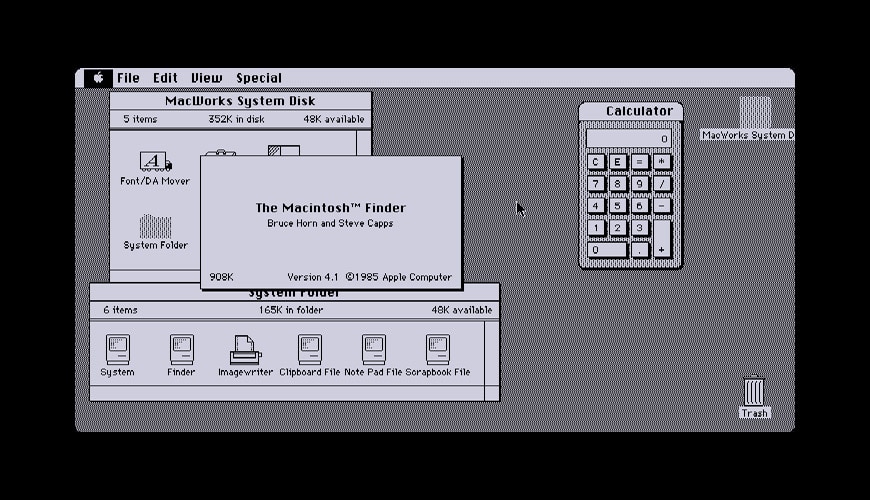
the article has an image captioned 'A screen shot of the Lisa Office System 3.1 (actual resolution)' but the image is from a Mac. The Lisa didn't have an apple menu and used a different font.
Ah, the memories! I did some third-party development for Macintosh in 1985, and we used Apple Lisas as our development workstations. These Lisas usually booted into Apple Pascal, which looked very much like the UCSD Pascal development environment that was very popular in the early 1980s. But I don't know if Lisa Pascal shared any common code with UCSD. That development environment also included a pretty good 68000 assembler that we made heavy use of.
Even before the Lisa was officially rebranded "Macintosh XL", developers could boot the Mac OS and test their programs on their Lisa. This was great, because the Lisa had 1MB memory while the original Mac had only 128k (and later 512k). The only issue was that the Lisa pixels weren't square, so all Mac graphics looked noticeably squished on the Lisa. We also had an issue with the floppy drives on some of the Lisas: their ejection springs were too strong so dragging a floppy to the trash icon sometimes resulted in the floppy disk flying over the office floor.
> Using the Macworks software, the Lisa can also run Macintosh software.
> This screen shot shows the Lisa emulator running the Macintosh operating system using Macworks. Supposedly with a little bit of hardware tweaking a real Apple Lisa can run up to MacOS 7.5.5.
> This lets the Lisa run the vast amount of software developed for the earlier Macs. Which was a good thing as there was apparently very little software developed to run natively on the Lisa OS.
I am the guy who wrote that article. Though you have pretty demolished my English ;), I want to thank you all. I apologize for my bad English; yet, your attention, suggestions, and remarks really will help me writing better articles, as well as to improve those I have written in the past.
About the grammar / spelling errors.
Yes, English is not my first language; I am Italian and, though I'm always trying to make my best to avoid errors and typos, I am aware that something wrong will always come out in my texts. Sometimes it is just a typo (such as weather / whether) which is rather easy to amend.
Sometimes what's wrong there are short pieces of texts, phrases, or even entire paragraphs that I wrote thinking in Italian and writing in English, thus clearly revealing that English is not my first language. These are much harder for me to catch, since their grammar is often not totally wrong, strictly speaking; yet, they sound odd or even absurd to a native English speaker.
About technical / historical inaccuracies: I am not an IT engineer, I am an architect, and a professor of product design and computer aided design; I am more a tech enthusiast than an IT professional, though I am also an amateur programmer and someone who likes to build his own computers since the 1980s. Therefore, I focus my articles more on product design than on technology; even if I always try to collect as many technical details as I can from reliably sources, I can, and often do, make mistakes. Again, your remarks are highly valuable to me, because they help me correct those inaccurate / wrong information I am giving to my readers, though I made them bona fide.
As amyjess correctly pointed out, the screenshot of the Lisa is from the Nathan Lineback's GUI emulator website, I know it's not the best example to show; unfortunately, I haven't able to find a single screenshot of a real Lisa with an acceptable image quality so far. A friend of mine who has been Apple's product manager for both the Lisa and the Macintosh still has a functioning Lisa; I'll ask him to let me take a photo of the GUI on the real machine to replace the one I used.
I didn't included the iMac intentionally; by and large, the article is essentially a comparison between the Lisa and the Mac, and I deem the iMac design too different from theirs to be part of that comparison. Yet, I am currently writing an article exclusively focused on the iMac.
The circumstances in which Jobs left the Lisa team.
Aside from my horrible grammar error :(, I agree with you, daotoad. That point needs to detailed a little more. Therefore, I rewrote the whole paragraph and added a reference.
I sincerely apologize for the mistakes I made in that article, hope it looks a bit better now.
Again, guys, thank you so much for your help.
"weather this name is an acronym or..."
An image labeled "A screen show of the Lisa..." which has multiple items clearly labeled as coming from a Mac...
"Furthermore, Jobs had leaved the Lisa team..."
Odd unattributed quotes from ???
The article asserts that Macintosh product design was key to its success. Then shows an original Macintosh with a Mac Color Classic 2 (a machine that hardly had an impact) but completely ignores the original clear iMacs (the computer which was part of revitalization of Apple and whose design owed much to the original Mac).
The English proofing tools for MS Word, and likely competing platforms, should be able to catch most of those. Those are the green squiggly lines. Stylistic choices I am fine with, as long as they're readable. Grammar and spelling errors should not be so prevalent if you respect your writing and your audience.


What Sun didn't have was a usable GUI. The BSD crowd never comprehended how to do a GUI. Sun went through about three in-house windowing systems, including Sun Windows, before ending up with MIT's X-Windows, which sucked less than anything Sun could write.
The original Macintosh was a huge failure. Really slow, 128K of RAM, and no hard disk. IBM was shipping the PC/AT at the time, which had 640K of RAM and a 20MB hard drive. The original Macintosh had one floppy drive. Most users got a second external floppy drive, but external hard drives were not supported. Sales were very low. Lots of press coverage, but it was "the world's greatest toy computer" and "a machine for the intensive study of wait icons" for the first two years.
It wasn't until 1986, when the first Macintosh models with hard drives and more RAM came out, that the product line started to sell. With enough engine to make it go, the Macintosh GUI started to perform usably.
But it was years too late; the IBM PC was the industry standard, and Apple's desktop market share dropped below 10%.