The political entity that is above the organization currently holding it has shown zero respect for any law or tradition and could conceivably seize it and give them an IOU in US currency. I’m not saying it would go on container ship but it would probably fit in a few standard containers.
27 tonnes of gold fits in a single container. You're talking about like 1 or 2 cubic meters of gold (for comparison, a standard 2TEU container is like 50+ cubic meters). And that'll fit as a partial payload in a single military transport aircraft. The actual flying of the gold isn't super interesting (not like there's roving piracy in the air), but the logistics of how it would securely get from NYC to airport etc is kinda cool.
The first book in The First Law series was published in 2006 and the last in 2021, it’s kinda like pulp noir fantasy combined, I am guessing you haven’t read those based the age you listed but could be wrong.
The book The Language Puzzle delves into this a bit - even our closest genetic primate cousins appear to lack the physical adaptations in both brain and voice box/mouth to develop verbal language and written language is a step farther, other species show some signs like cetaceans and elephants. There’s a bit of speculation in there that advanced hand tools and language may have been coincident (from archaeological evidence with close time stamps) and that still took a very long time.
There’s a general benefit to the SF Bay Area outside Palo Alto as each municipality, county, state, federal and open space organizations like the Midpeninsula Open Space District have been maintaining and increasing public parks under their respective jurisdictions open to most all, and free to non drivers. Only my personal experience but it’s a sharp contrast to Texas where 95 percent of land is privately owned and access to open space is much more limited by comparison. I had a few favorite parks in Texas and new ones since I left 30 years ago are close to nil - there’s still a bit extra you can pay the owner for access.
In some sense this (not as literally as this case, but in measurable scientific tests) is true for other species. Processing is demonstrated to be distributed through sense organs in the frog in What the Frogs Eye Tells the Frogs Brain https://ieeexplore.ieee.org/document/4065609, i.e. in frogs at least, the eye is not like a camera sending pixels to its brain
I think if you should be able to at least have the peace of mind that you did all you could (within reason, short of pulling a Ted Kaczynski or his modern equivalent Luigi Mangione). Maybe it’s inevitable - history shows tons of species go extinct and maybe unbridled capitalism is how we go, maybe seven million years give or take is all humans will have. Maybe I absorbed too much of Meditations by Aurelius.
It hasn’t gone up yet here in California but I see from the boxes I usually eat that these are sourced from Vietnam (in spite of Monterrey being a short trip away) so these could come from China (one of the usual tariff bypass mechanisms) and hence anywhere in the world (ghost fleets) and possibly not reflect real world ecosystem pressure until multiple fishery collapse.
Multiple fishery collapses are probably incoming in the next decade or so. For as much as we have and do catch from the ocean, it is as a whole a fairly nutrient bare place by comparison to the land. Its scale and exploitation beyond recovery has allowed it to look far more prosperous than it really is.
The polling must have shown a vulnerability - Democrats in Texas (and a few MAGA like Sid Miller) were hammering GOP on this issue until Abbott finally changed his tune. Texas voters hate it more than pedophiles cause Ken Paxton mismanaged a bunch of those cases resulting in lenient plea deals that didn’t make a dent in Paxton support earlier this year, and he won the GOP statewide primary. He probably will win the general election but here’s hoping against it.
NAFTA and successive treaties forced Mexico to allow much cheaper corn from the USA to displace many smaller corn farms in Mexico, only larger farms could survive that and farming of corn is declining in Mexico. Also inexpensive processed food displaced traditional diet goods at the same time for the same reasons, probably contributing to obesity epidemic that only started in Mexico after those treaties.
Says that obesity was shooting up in Mexico before that. The obesity rate doubled in the 15 years before NAFTA. After NAFTA the rate doubled again in about 30 years. I can't really see any obvious change after 1994.
Are these numbers incorrect, or were you meaning some other metric of obesity or obesity epidemic?
Good point. I should have written something like correlated with urbanization and other factors. But ever increasing percentage is a correlation. The USA obesity rate has stabilized for a year iirc, but those of Mexican heritage have some unique vulnerabilities to obesity as well so a multi factorial issue.
Likely, and then... after Mexican farms went out of business, they added biofuels, the price spiked, and Mexico had no domestic corn people could buy.
It's sort of what they want for Canada. They keep trying to attack our protected agricultural sectors, and no sane country doesn't protect their food supply. Amusingly, they want 10% of our dairy market (as a start), and they already have a few percent.
Yet we're 1/10th the size of them. So they make a massive fuss, over 5 additional percent of our market or so, which for their market size is 0.5% of its overall size. The US economy won't even notice, but the Canadian market will 10x as much. It's just petty.
Yeah, but our dairy quota system is kinda fucked imo. We've created a market where the quotas are estimated to be worth somewhere between 40-45 billion. This financialization and the fact that banks have leant heavily against the quotas is part of the reason we're unwilling to move on this aspect in negotiation imo.
I'm not saying that there's not value of protecting our food supply. But, in an affordability crisis, kinda feels this should be on the table for discussion given our supply chain management costs the average consumer an extra $250 a year or so.
You see, the Americans are liars, as you may well know. They get upset at supply management, but they do it too. Instead of controlling production, and setting fair prices for producers, they handle it, like a bunch of nitwits, on the backend.
They buy up excess milk, make cheese out of it, to artificially keep the market price high, and then store it for decades as it rots, in large underground limestone caverns.
They buy out herds if production levels are too high. They have bought out large numbers of farms more than once, spending enormous sums, to reduce the supply.
In fact, the American government has cost the American consumer far more than a measly $250 per year, for they force higher pricing too. And to do it? They spend like crazy, they spend tax money like crazy.
But here's the thing. Every single government handles food production in some way. Every one. And the result is upward pricing pressure, almost always.
We act responsibly. Sanely. The Americans just shrug their shoulders, blather on about not interfering, then do it anyhow regardless.
Do not fall for their lies. It's all they do these days. The only goal they have, is to make us far more dependent upon them.
Brother, nothing in my comment did I learn from American sources as a result of this trade war. I've found our dairy cartel silly for a long time. Look at the impact of NZ and Australia removing their quota system around the turn of the century.
I just don't like how opaque the whole thing is and I don't think most Canadians have an understanding of the impact on their pocketbook.
The concept of an entirely unrestrained market, is an illusion spread primarily from US thinktanks and sources.
Yet my point was, even though Americans spout blather about market intervention via Governments, they do it too.
Australia and NZ are bad examples. They are incredibly isolated for fresh milk competitors, and fresh cheese too. We, meanwhile, have a market 10x larger next door.
But beyond that every government manages its agricultural industry. If NZ and Australia "did well" without market supply at the front, then you can be sure they did so by bail outs, market interference, and other methods at the back end.
And those methods cause consumers money, taxes are used to do these things.
There is no open dairy market in the US. It's an illusion, as I mentioned.
Look at thr disaster of 2008. Americans did the same thing, didn't manage and regulate, then the market explodes, and they spend trillions in clean up.
That's still manipulation and market management, it's just the most disruptive, damaging, stupid way to do so.
And American have the money, and the ability to manipulate the world's reserve currency in situations like this.
We don't. We have to manage things responsibly.
I'm OK with positively modifying supply management. Find a specific problem, fix it. Improve it.
Yeah, I actually think we're relatively aligned here. I'm not saying burn it all down, free market, fuck the goals.
I'm just saying, and I know this is an estimate, but if you take the $244/annum/pp estimate from studies as to the cost of supply chain management... you're looking at about $10 billion per year.
Broadly, I think the goal of our supply chain management is to preserve a robust domestic dairy, poultry, and egg industry, maintain emergency production capacity, support rural communities, smooth out extreme price volatility, and ensure farmers can survive downturns.
I'd just be very surprised, if we asked ourselves, ok, how can we most efficiently achieve the above, and actually tried to solve the above problems from first principles today, we'd land on the current solution. It just feels like we should be able to achieve a much better outcome for $10 billion dollars, or we should be able to achieve the equivalent of the current outcome for far less than $10 billion.
A hate just pointing at the cost, because where does that money go? What is that cost? Is it just more cash in the pockets of producers? Who then hire people to work on the farm, and all that blather?
Is it a bloated bureaucracy, which needs some trimming, but still regardless pays wages to Canadians?
Are other things wrapped into that $10B?
Also, it seems those numbers aren't just dairy, but chicken too?
And another thing (I'm full of ideas today, sorry), we don't use hormones to increase milk production, or bulk up animals. That definitely means more cost per animal. That figure seems to also include chicken meat, not just eggs. Healthy isn't necessarily free.
Look, you find horrible costs, I'll support you. I think that's fair.
Hah, no worries brother. Yeah, I agree keep bovine growth hormone the fuck out of our supply. And yes, its poultry, eggs, and milk products wrapped up in the $10 billion.
I agree generally that just looking at cost often misses the bigger picture, but it's the magnitude of it here that gets me. $10 billion is equivalent to 2% of the federal budget!
We spend a similar amount in the budget, $10.7 billion, to ensure the viability and sustainability of all our crown corporations with the exception of CMHC! So, a national railway, a national postal service, a public broadcaster, museums, infrastructure entities, finance institutions, housing institutions, export support, tourism, bridges, agricultural finance, and thirty other random Crown things… All made viable for approximately the equivalent of the cost born by Canadians to support chicken, egg, and milk producers.
And, it's not like this is our entire food supply. Massive error bars here, but based on the average consumption numbers for Canadians in the egg, poultry, and dairy categories, which, the dairy part is admittedly quite fuzzy... But my back of the napkin math suggests that's somewhere between 10-20% of the caloric/nutritional needs of Canadians, so it's not like it's securing the majority of the food supply for Canadians, we're very much still dependent on the global food production.
Ultimately, I believe what it comes down to, is that a different system that would likely be more effective at achieving similar outcomes, would force some level of support onto the federal government and hit the budget. Whereas the current system allows the government to say, we've created a system that doesn't depend on government subsidies! Yes, we've done that, but it's effectively a regressive tax that hits consumers at the checkout.
Anyhow, I am not an expert on food supply, so I don't know what exactly a better solution would look like. But, we're currently all in on a system that was developed in the 1970s, and it has a feeling of 'too big to fail'. That to me, is a recipe for horrible inefficiency, and given the magnitude of the numbers, I can't help but feel that we'd be well served to take a deeper look at the situation and consider whether there's a better way to achieve the outcomes at lower cost to Canadians. Hell, even if we determine, nope switching over to a subsidy model paid by the government would cost the exact same amount for the same outcome, at least it would achieve a more equitable outcome for Canadians in switching from a regressive to a progressive tax.
Due to spoilage concerns grocery stores price food based on shelf stability not just production costs. Processed foods are generally shelf stable enough for this not to be a major concern.
Similarly economies of scale apply in many situations. Slow cooking beans takes more energy the smaller the batch size due to surface area to volume ratios etc.
Combined with the opportunity costs associated with cooking + cleanup means there’s very few healthy options that can compete with highly processed foods.
I bought over a pound of steak the other day for $5. (Yes, it was on sale. But it is frequently on sale.) Along with a potato for 50 cents, that's cheaper than a bag of Doritos.
This canard again [0]? You're comparing one piece of beef with a massive bag of Doritos. The banana's irrelevant, but last time you compared it to an enormous block of chocolate [1].
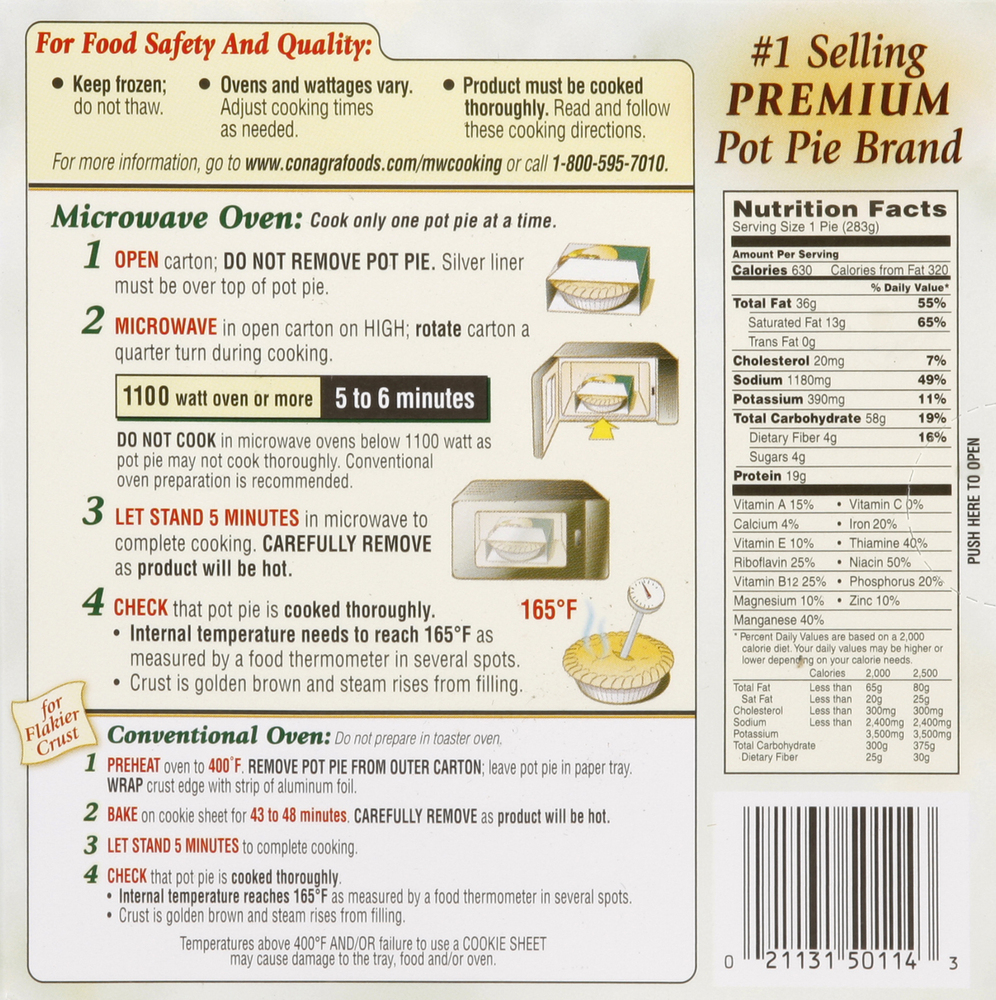
From experience a microwave meal should take about 3 minutes to cook so I don't know how you're taking more than 10 minutes unless, like your food item comparisons, you're cooking enough of them to feed an entire town.
This is possibly the craziest goddamn conversation I've ever seen on HN. Michalena's swedish meatballs are like $1.50 for 350 calories[0].
It's been a while since college, but I would guess they are delicious when compared to Walter's shoe-leather brand steak. Mac-n-cheese of various offbrands also cheap, and potato flakes ridiculously cheap.
Marie Callender and Stouffer's are not cheap, they are convenient.
Steak takes me like 45 minutes, gotta season, let it sit. On stovetop need a cast-iron skillet, 5 minutes to heat it, etc.
Also cooking time doesn't really matter a lot, I'd use a toaster oven because the meatballs tasted better, and would be studying or whatever waiting for the timer.
A pound of fresh ground pork is ~$1.25 and it's 1100 calories.
Throw in all the other stuff to make the swedish meatballs and you are coming out way ahead.
The "poor tax" in processed food is that they are paying double to triple the underlying food cost to have someone else make the food for them.
I'm confident that if you meal prepped Swedish meatballs, you would be able to make something 10x healthier for 1/3 the cost. Even at a "rock bottom" $1.50 per meatball package.
You didn't specify frozen - I'm looking at a meal taken out of the fridge, which still has a shelf time of ~a week. You're not comparing to a frozen steak either, which will also need an extended cooking time.
If you're concerned about cooking time then don't buy frozen, or let them defrost, and they take less time to cook. Since you're comparing to preparing a whole piece of steak and a potato, that shouldn't be too hard to do.
Also, your example is $3.34 [0] i.e. less than your $5 steak and 50 cent potato.
The potato requires prep, 10 minutes in the microwave ~= 1/4 kWh, and presumably a little salt and butter. A microwave meal is a more complete nutrition source and takes less time, making them more complex point of comparison.
Wait why are you guys cutting the potatoes up before putting them in the microwave? Steps:
* Wash in water
* Cut out any bad parts
* Stab the whole potato with the fork a bunch of times
* Nuke until gushy
A few medium sized potatoes will take maybe 8 minutes to cook all at once here. That's not really an issue of course, as you'll cook a small piece of meat in a pan, which takes about the same time. EG, you start the pan heating, while taking 2 min to defrost the meat, and you're prepping the potatoes. Then meat in pan, potatoes in microwave, they're done mostly at the same time.
Note you don't need to completely defrost the meat. It doesn't matter if it's -5C or +5C. A "little" frozen is fine, especially for steak which can be rare inside. Anyhow. Sorry to interject, but the potato thing is weird to me.
The article, I just noticed, does cite the fork.. but talks about exploding? No, it won't explode, the fork instead allows for an evener cook.
Smaller pieces cool faster without the need to cut up a very hot potato and it’s obvious you’ve done it correctly. The fork approach generally works fine, but it’s not obvious when you mess up.
Same deal with hotdogs, cut it with a knife and it’s really obvious it worked, get a little lazy with a fork and you get uneven heated and the occasional pop.
correct stab a few times with a fork and it doesn’t pop.
They do want you to let them cool, but that’s true of anything you heat to a cooking temperature in a microwave. Potatoes have the same limitations, but most people don’t include the “don’t be an idiot” instructions in recipes just cooking times.
If that’s true you should be able to provide actual evidence of a 10 min 30 second cooking time listed on their box art.
However it’s clear that microwave meals are generally designed to have shorter cooking times for simple convenience and the underlying physics involved.
When I was a grad student, I pointed this out to my poor neighbor with lots of health problems (5 pills a day!) who was shocked that I ate such expensive food despite being poorer still.
15 years later she's 50 lb lighter, takes no daily medication, and we have a mortgage and three kids. That's right, I fixed her up and married her.
It has been my experience, as a general rule (so it may not apply here), that people who grow up in the city are the worst at this.
People with strong rural roots, or who grew up in rural areas, tend to have lived in houses, have freezers, space for long term storage of items, and may have personal knowledge of canning, and food storage. If one grows up in an apartment, there may not be space for a shelf with canned food and bags of rice and potatoes.
I find that during harvest times, last year's canned foods are marked down. The logic being, I think, clear out their warehouses and get people to take last year's stuff home. And if you have space, you can take advantage of such things, and save, save, save.
For food, poor rural people often have better outcomes than city folk, due to the ability to store when sale items are found.
So when I read stories such as yours, I always wonder. City girl? Country boy? And as I said at the start, this is not a hard fact, just something I've noticed being a common reason why some people just "don't know".
Microwaving takes less attention and less skill, though. And less cleanup. And you don’t need to own a pan. And you don’t need to own spices (steak is a bad example ofc). And you don’t need to think about the side dishes. And you don’t need to agree on what’s for dinner. And I think it’s worth repeating, you don’t need any skill and can’t really screw it up. And you don’t need to worry about it going bad because you were too lazy to cook it. Etc.
Processed food may not be cheaper, but the flavor:effort ratio is waaaaaay higher.
You can microwave a meal by tossing it into the microwave and walking away, you need to actually participate in cooking a steak and then clean up several surfaces. The stake is conservatively 10x as much effort and time is money, plus microwaves use far less energy.
Processed food isn’t a single unified thing, the prices definitely overlap but the minimum and maximum prices for processed foods are lower. That’s why our food supply ended up looking like it does, economies of scale beat home cooking. That’s true even going back thousands of years where communal cooking drastically reduced the fuel needs in warm climates.
Except i think the American heart and minds campaign in Vietnam was lip service to a campaign that was measured by body count, and dead non combatants can’t litigate their combat status, so McNamara was befuddled the USA was “winning” and losing every square inch where there were not American soldiers in force. That there was no equivalent to insurgent Viet Cong embedded in North Vietnam says everything.