Deutsche Bahn doesn't manufacture rolling stock. They buy it from Siemens, Stadler, Talgo, Alstom etc...
Edit: AFAIK, some of it - mainly high-speed trains - is designed according to DB specs and subsequently offered under a new name (and with changes) to other train companies. For example DB ICE 3 (manufactured by Siemens) / Siemens Velaro.
It does happen occasionally, but DB tends to run, maintain and sometimes upgrade its successful (~reliable and widely introduced) rolling stock until it falls apart or is grossly outdated (40+ years old). Rail passenger numbers are increasing, so there is no need to sell stuff to downsize.
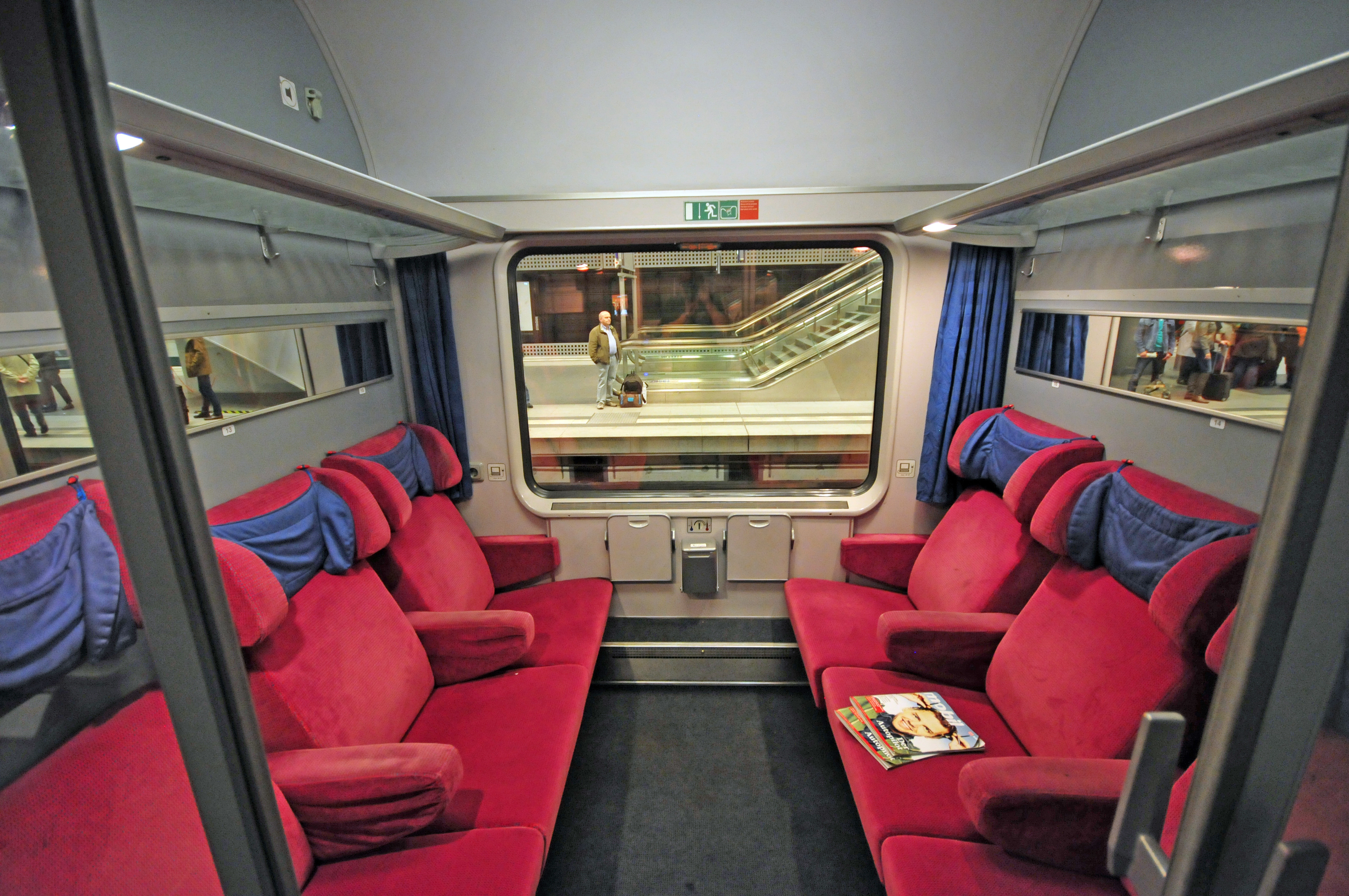
The Flixtrain company uses 40+ years old IC (intercity) cars - they have no air conditioning and it's really loud inside with open windows, especially so in tunnels. That is the kind of stuff that DB sells.
Hrrm. Funny. I thought that those were so called "Eurofima", which I remember as fucking cold in summer, because then their AC were set at full blast, which was annoying at the times.
They did look like Eurofima cars in the article, but my memory of that train ride is pretty clear - it was just a few months ago. I guess most likely the European Eurofima fleet is in very different states of upgrade from the 70s original. I have never been on an Eurofima car with air conditioning, let alone air conditioning turned up to 11. As far as I can tell, none of them have air conditioning in Germany.
Maybe they upgraded them without the AC, or they are based on slightly different wagons.
Anyway, in the 80ies they had AC. In Germany, als die Bahn noch kam, regular IC, no matter if 4-, or 6-seat cabin(depending on class), or Großraumwagen. I remember because sometimes I've been naughty and dialed it down a little, after opening the panel at the end of the wagon with a multitool. Non-destructive, OFC :-)
I liked to sit on the window, and there was a metallic grille on the underside of the window. With small slits, maybe 2 to 3 cm long, 3mm wide, a few 100 at all? And that blasted right into your face, or your side if you sat upright, or leaned back. Not noisy, just cold.
Different, probably later design, and apparently adjustable.
In the Nahverkehrswagen (Silberlinge) it was different. They had no AC, just heating. Which you could turn down or fully off with an open lever. Nobody ever did that. Except me :-) At least their windows could be opened by pushing the upper half down.
Incorrect. They wouldn't fit in the tiny UK loading gauge (profile). UK trains are indeed variants of continental models, but made to custom size, and many (most?) of them in the UK.
Everything about UK rail is custom (apart from the gauge). Apparently it's one of the (many) reasons HS2 is such a mess.
They were trying to run trains faster than typical continental high speed lines, which meant custom design work that needs loads of additional testing and certification. Rather than just use the Spanish or French high speed designs.
Max line speed of HS2 is 360km/h, with provision for 400 in some sections in future. This is entirely in line with many other modern HS lines. China’s been running regular 360km/h services for years.
This is a project with a 200+ year shelf life. Designing to 300 or less would have been short sighted, and many of the changes to accommodate such high speeds actually reduce costs in the long term (slab track, headroom to catch up delayed services, ability for one trainset to operate more services per day etc).
The cost overruns of HS2 are primarily from plain old poor project management, complex planning law and constant political meddling, not engineering decisions.
China has run at 360kmh before, but last I checked they mostly run slower.
Air resistance is a killer as you go faster. So for trains 300 is usually about the best compromise between energy use and speed. If you want to go faster a jet at altitude is going to be much faster at a better fuel efficiency. High speeds make sense for long distances.
This is a project designed to last for centuries. We’re not even fossil free yet and already seeing days of negative electricity cost thanks to renewables. In 50 years the extra energy cost is going to be a rounding error. Locking ourselves into 300km/h forever to save a relatively small sum is unfathomably short sighted.
> Max line speed of HS2 is 360km/h, with provision for 400 in some sections in future.
That's already been reduced to 320 km/h under this year's "HS2 reset". Which I imagine in reality will be 300 km/h normally at most, with even lower speeds seen day to day
Interestingly the written report to the government stated "However, no railway in the UK, or globally, is currently engineered for 360 kph". Are you incorrect or did they forget to include China in their research?
Anyway, I thought these were last decade's talking points? I thought it was all about capacity now, not speed? Except I thought there were also rumblings about reducing capacity from the previous announcements? Hard to keep up...!
The messaging, in general, has been abysmal. But capacity and speed are not separate concerns. Consistently high average speeds increase capacity - I wish this had been actually communicated.
One of the drivers of cost has been the high speed part. It meant the route needed to be straight which meant more tunnelling to avoid certain areas. Lower speed track would have allowed them to route around problem areas.
High speed rail does not need to be straight! You can get away with 6km radii at 360km/h on dedicated passenger lines. The high power output of the EMUs they’ve selected and all new OHLE power supplies mean that trains can accelerate and decelerate much more aggressively than on legacy mixed use lines like the WCML, allowing smaller radii in practice with short slower sections. It’s a myth that HS2 is expensive because it had to be straight.
The vast majority of the tunnelling for HS2 has been either to get in and out of dense urban areas without too much demolition, or to reduce the political cost of driving a building site through Tory heartlands (Chilterns AONB).
I got an LLM to analyse all of my messages and e-mails from the launch of gmail to work out my writing style, it says I heavily favour em-dash's. I used to work in the industry of type settings and press and publishing. I even use — in HTML when I have to write it nowadays. em-dash is not a LLM thing. It's just most people don't know how to use it. It also said I'm wry. Go figure.
As someone with the ID 1653, I've totally given up on the thing. I've even created my own rust based forge, ironically, hosted on github at the moment.
Same can be said for people using LLM agents to complete jobs faster than humans ever possibly can. It's not like they just fluked it. They've learned how to harness the capabilities of the tech. Now companies are introducing this stuff as a normal workflow but they are clueless as to how it actually works and expecting 10x output from people.
It will all crash when they will see that people can't do 10x, even with AI. It requires too much expertise and knowledge in the field to actually make it work as a hired professional. Look at the AWS outages... and they are professionals, right? RIGHT?
Nail guns are tools, just like hammers. However, you have to know how to use it and to know how to adjust the pressure for the depth you need. It also costs money, much more than a hammer. And you can't use normal nails, you have to have a specific cartridge of nails, and you must know how to adjust it, and ultimately to not die.
Nailguns are not as complicated as you think, anybody with IQ over 80 can be trained to the top proficiency in 30 mins. Same goes for other power tools, they are generally much easier to use and more productive than their human-powered equivalent. The effect of the construction industry adoption of those is in smaller crew sizes, which is also being observed in SW industry.
I think it's a fair comparison; experienced carpenters who've learned to work fast with a hammer, now asked to be 10x more productive while using a new tool they don't have experience with. It probably got more than a few a bit bothered.
get your carpenter a circular saw, a drill, a router, a hand planner and an orbital. on many jobs you ll get your 10x.
you don't need much experience. the tools make you insanely faster with much much less physical strain and maintenance time. they're simple, predictable, reliable, and obscenely powerful.
an experimented carpenter would take a few minutes to be decent at using then.
- stable and "slow" is best
- don't ever let the blade get pinched (by wood)
- be mindful of the cords
- keep the flesh out of the way
- goggles up and don't breathe the dust
There are very few contractors still swinging a hammer. They're going to be slower and more expensive than the competition, which is a major factor in getting the job.


British person living in Berlin.