My amazing experience with DICOM, an open standard with viewer software on SourceForge, is that I once took pictures in the format to a locally renowned neurologist.
She plugged my USB stick into her Windows XP workstation, ca. 2019, without the slightest hesitation, then proceeded to claim not to know what DICOM is, and to ask me why I didn't bring her either the proprietary viewer program, or JPEGs.
Had I brought the viewer, she would have probably launched the .exe with equally no hesitation.
At least in these parts of the woods, this once again confirmed to me that medicine and IT usually exist at opposite ends of a spectrum.
Until I took a senior developer role at a radiology practice I had no idea what DICOM was. The idea that a physician should know is kind of fanciful, isn't it? In 99.99% of cases, they load images by clicking a button that says "Display images" in a PACS, or RIS, or the images are loaded automatically by workflow. It's like expecting someone who has only ever viewed webpages, and never even viewed the source let alone made a webpage, to know the difference between JPEG, GIF, and PNG.
Physicians know that a DICOM file is what you get when you export from their viewer software. I asked a chiropractor for my x-rays and they just gave me a CD with two DICOM files on it. That chiropractor was an idiot, but at least they knew what a DICOM was.
IMHO, I don't think it's ever safe to assume that someone, even if they're in tech, would readily know what file format X is or have the right software for it. If in doubt, you should provide them the way to easily see whatever it is you want to show them, whether it's a x-ray or a hiking map or a giant party banner.
When I got my scans from the radiologist, they came on a CD-ROM (remember those?). I had to dig up my old disc drive from storage, then loaded the files onto my phone. At the orthopedist, I just showed it to them right on the phone with a Android DICOM viewer. I also brought the original CD, along with the same files plus 2-3 different viewers on my laptop, juuuuust in case. There's no way I was going to risk another clinic visit, at what, $300/visit?, just because they couldn't read the images. I'd do the same anytime I was visiting another professional. I don't assume to know their tech setup or level of file format expertise... that isn't what I'm paying them for, after all.
As an aside, in my brief investigation into DICOM (a format previously unknown to me before my injury), I discovered that it's actually a pretty complex format, with different viewers having pretty different UIs in terms of how they handle layers within a file (in both time and space), overlays and contrast adjustments (to emphasize/deemphasize certain artifacts, apparently), different collections and naming schemes for the same body parts, etc. Some of them were barely more usable than a JPEG viewer, while others could interpolate/extrapolate the data into a 3D point cloud and create rough anatomical models by combining collections of images from different angles. It's quite a complex system of raster imaging plus metadata, and no two viewers worked quite the same, even between the several free and/or open-source options. It reminds of the nonstandard mess that is file packaging for GIS (geographic information systems) -- a lot of power, but no simple system for organizing that power. In that sense DICOM is more like a database of radiological data that happens to be plottable in 2D (and sometimes 3D) space, rather than a simple image. If you export it to JPEG, you get a static output in time & space and lose a lot of the power of DICOM.
There are a loooooooot of ways to store imaging data out in the wild, and many different versions & viewers for each format... rather than looking down on someone for not keeping up with the tech stacks du jour, why not just help them get what they need to do their job more effectively? Especially when they're working to heal you.
There is also a problem that many DICOM viewers are outdated and abandoned, e.g. written in GTK+ 2.x which is not availabe on modern systems, and weren't updated for many years. Take, for example, AMIDE[1] - no changes in the development repository for 5 years already. Same story with many other projects.
This is like a restaurant that has a QR code on the table instead of a menu.
Yes, it's absolutely possible for someone to use the QR code to fetch the menu from a website using their phone. But unless you do it often, you just don't even know how to do it.
Doctors are insulated from DICOM the same way that most humans don't normally type "h t t p : / /" They just click on links and things show up for them.
My clinical work is in TB control and we read a lot of chest X-rays and CT scans. I'm very used to DICOM and I have my personal preferences for DICOM viewers, but outside of an actual radiology suite most docs will just use whatever viewer came on the disc, if there's one at all. And that's largely true for the ones I've worked with in this field, too.
Dicom files are usually in a structure that includes a viewer (there is a IHE profile which standardizes it). Barring radiologists physicians rarely know about file formats, and the portable media "just works" (mostly).
In my experience the specialists just offload this problem (and any other imaging tech problems) to their radiology provider, and while that might be a local phenomenon, I’d hazard a guess that it’s universal.
> Had I brought the viewer, she would have probably launched the .exe with equally no hesitation. At least in these parts of the woods, this once again confirmed to me that medicine and IT usually exist at opposite ends of a spectrum.
Well, on the other hand she'd be able to do what she needed without any other distractions - and in case you happened to break the machine, you'd be around to slap or pay up for the fixes :-P.
At the end of the day for most people computers are there to help their jobs.
> then proceeded to claim not to know what DICOM is
98% (made up number) a non-radiologist physician is going to bring up the image on whatever institutional lightweight PACS viewer is provided, and then occasionally in clinic on a disk that has some viewer provided. Not providing a viewer with a disc is kind of a dick move.
Most people using smartphones have no idea what HEIC or JPG really is, and why should they?
> this once again confirmed to me that medicine and IT usually exist at opposite ends of a spectrum.
Do you actually know how to read even a chest X-ray or an echocardiogram?
I never quite understood this tech fascination with pointing out/being surprised that specialized experts are not generally deeply familiar with IT. It has little to nothing to do with their everyday jobs.
I don't know of any doctors that would be surprised that an IT worker/engineer cannot properly read a neuro MRI or any other image for that matter. But people here are always surprised when most doctors don't have beyond a lay understanding of computers.
I do think the tech crowd tends to have a lot more hubris though. Amateur docs and lawyers seem not to be in short supply around here.
> that medicine and IT usually exist at opposite ends of a spectrum.
Working in Medicine you learn that specialists, and in particular renowned ones have their worlds optimized around having them do what they do best, and not wasting time not doing what they do best.
My father practice moved digital in the late nineties, they had a cd robot that would burn the dicom images together with a quite decent windows viewer from Siemens (actually it had nice contrast and zooming features) on the disk with autorun config (nobody cared at this time about security). The future was here...
Fun side aspect of the story is that they bought the wrong type of CD-Rs for the robot and I am still having empty CD-Rs from a batch of 500 or so I am using (once every other year).
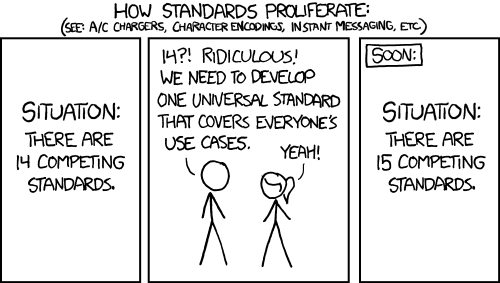
Many of us have, and painfully if I might add, finally convinced people to abandon insecure messengers and move to something like Signal. Now the solution is to tell them to abandon Signal in favor of Matrix? I'll pass.
The problem is Signal is not a standard unless they open up their ecosystem, so we're not actually increasing the number of standards here.
I've been through the pain of convincing people to Signal due to lack of better alternatives at the time. And I've done it yet again for Matrix. In this case, each move brought us closer to a global optimum so I'm not sorry for it.


She plugged my USB stick into her Windows XP workstation, ca. 2019, without the slightest hesitation, then proceeded to claim not to know what DICOM is, and to ask me why I didn't bring her either the proprietary viewer program, or JPEGs.
Had I brought the viewer, she would have probably launched the .exe with equally no hesitation.
At least in these parts of the woods, this once again confirmed to me that medicine and IT usually exist at opposite ends of a spectrum.