> Organizing and iteration on thoughts is not trivial or easy, but it is very important!
Two of the silliest things that helped me in my career:
* I worked at fast food restaurants in high school. This instills a near pavlovian response to client requests; if at the age of sixteen you can deal with someone who's mad because there isn't enough cheese on their pizza, it goes a long way in the real world.
* My first I.T. job was in an office where the vast majority of the people who worked there had never used a computer at all. Just to stay employed, I had to resist the urge to explain things in a complex way. When I'm trying to sell an idea to a group of people, I do my best NOT to ignore the people in the room who may not understand that idea well. I think that engineers often have a bad habit of getting into engineering arguments with management in the room, where they take things to a level of complexity where management may not understand what's being talked about. Bringing things back down a few levels goes a long way towards getting management to sign off IMHO. Unfortunately, it's a double edged sword, and it can fall flat when management is especially well informed. Classic information asymmetry.
> Indeed, Gemini really is incredible at image analysis. Yesterday I pointed it at some sloppy handwritten notes and asked it to add up the numbers in the right column, and it did it no problem. I've also used it to find out what TV show or actor is on screen, and various other things. It's quite impressive.
I do not know if it works as well as Gemini, but Salesforce (of all places) has a model that does something similar.
What's "neat" about the Salesforce one is that you can run it locally and just iterate it over as many images as you feel like.
For instance, it should be possible to take a movie, pull a hundred images out of the h265 file, have the salesforce model evaluate what is happening at that moment in the movie, and then use that to create an index.
That's just ONE use for it, and I can think of dozens.
On a 5090 it was able to generate text descriptions of a folder full of approximately 500 images in under a minute. (Anecdotal evidence, admittedly.)
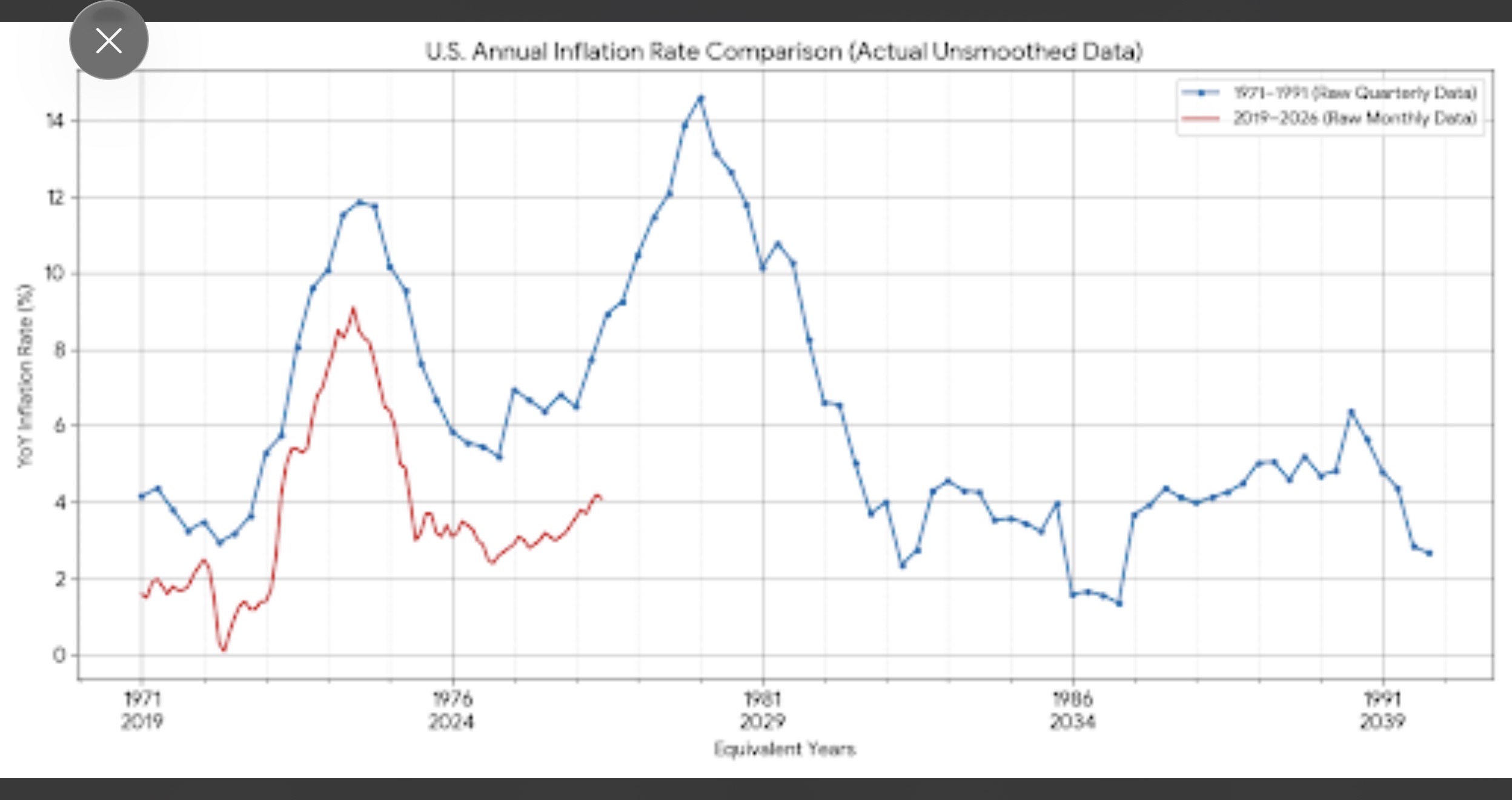
> Cherrypicked dates? But I'd like to hear analysis comparing the Nixon shock to the covid shock since one was monetary and one was supply and demand.
Of course!
* In 1971 and 2019, the M2 money supply was flooded. In 1971 by the Nixon Shock, in 2019 by Covid: The amount of US dollars that existed between 1961 and 1971 increased by 100%, the amount of US dollars that existed between 1971 and 1981 increased by 253%. Assets are denominated in dollars and the flood of money that the Nixon Shock caused led to the inflation of the late 70s and 80s. The flood of money that Covid caused led to the inflation of the last six years, 2022 in particular.
* The other factor that contributed was the lack of oil supply. In the 1970s, it was caused by a war in the Middle east. Will we see history repeat again? My bet is yes.
Note that the Fed data is difficult to read in the 70s, you'll want to play around with the length of the time window. It's difficult to read because the supply of money has grown so much.
> I read somewhere (don’t recall where) that Apple typically enters into contracts for RAM on a six-monthly basis and avoids longer term ones. Even in the current situation since last year, it has avoided getting into multi-year contracts like the AI companies have.
* when interest rates are declining, that’s a feature not a defect
* when interest rates are rising, that’s a defect not a feature
Southwest Airlines built its business on these kinds of bets.
> If a company does something you approve of (e.g. do journalism) and something else you disapprove of (e.g. make canceling hard), is there a good way to signal both as a consumer?
Leave a bad review where their social marketing team will see it.
> Any place that allows easy instantaneous subscription by a simple web form, but makes you call and talk to a person during limited business hours for cancellation
I moved into a new home. I kept the old one for a few weeks extra. Needed time to move out.
I signed up for CenturyLink at my new home.
After six weeks, I tried to turn off internet at my old house.
* I can’t.
* CenturyLink wouldn’t let me cancel, without waiting on hold for an hour or more
* I work overnight
* CenturyLink is open when I’m asleep
So I’m paying for two plans with the same company. Thanks CenturyLink.
This is a good argument for local brick and mortar representation for the critical services we consume. My bank, mobile and fibre providers all have branches/offices/shops in the town closest to where I live (15km drive).
At each of these locations there is one or more necks that can be wrung if something goes wrong with my services
I know it's not really a solution for your nocturnal proclivities, but I think the argument holds. If you had to sacrifice a couple of your sleeping hours but you know you can sort your problem, then you migt be inclined to do so?
If all else fails resort to old-fashioned letter. As long as it's certified you will have proof of delivery. And then, if they continue to make unauthorized charges, it is your credit card company's problem. They are awake during business hours, and they WILL sort it out.
I keep trying to convince people that English majors and Philosophy majors will benefit the most from LLMs. English majors in particular, have been trained to be VERY exact in how they word things.
That awareness of how to structure the English language, it will benefit those who use LLMs.
Then again, maybe someone will just make a LLM that’s built to turn poor English and poor reasoning into excellent English and excellent reasoning. Maybe this is just a technical puzzle that needs solving.
I disagree with you, for the very reason you give:
> Then again, maybe someone will just make a LLM that’s built to turn poor English... into excellent English
That's already been done, for some (pretty weird) definition of "excellent".
I work with, or at least in the vicinity of, someone who is very good at getting work out of LLMs. He has a whole system of CLAUDE.md files and skill files and things. He makes TONS of typos. When I first saw that, I was itching to go in and fix them all, it seemed viscerally wrong to be adding an extra layer of correction required between the instructions and the LLM's behavior. But in practice, I don't think it mattered at all. The LLM didn't care. Typos in particular might require a bunch of RLHF in the chatbot, but my hypothesis is that the LLM is already mapping messy human input to the nearest surface of some high-dimensional manifold and the added noise of typos is inconsequential to where it ends up (as long as there isn't any real ambiguity -- though even there, you could probably construct cases where that would help rather than hurt!)
Typos are different from sloppy writing, but I think the AI companies have put a lot of work into training these chatbots on dealing with typical non-English major writing with all of its imprecision. Also, it's easier to construct cases where that imprecision and sloppiness would help rather than hurt: a mistake in the input that is common enough to show up in the training data is going to be a good match for the needed correction as well as associated corrections. The precise language could easily result in the LLM overestimating the user's competence.
That doesn't address whether an English major's careful composition would help for hard tasks where getting the specification right really matters -- perhaps that was your point? I guess it's an open question whether "boiling away the typos" and "boiling away a poorly articulated specification" are related enough.
Why? Those servers still have to pay the same price for components plus a markup for the service. In theory you can serve more gamers per GPU, but these GPUs have to be physically located in your city to have a usable latency, and that means you'll have issues with peak utilization being most users gaming at the same time of day.
I just don't see the cost savings of sharing a GPU overcoming the extra expense + profit such a service would need.
The GPUs do not have to be "psychically located in your city" to have usable latency.
Of course, less latency is always better although running a traceroute between my IP and major city (Sydney) from 1,500 km equates to about 11ms latency with optimal routing. (Real life test, traceroute via an ISP Looking Glass).
1500km is still largely the same timezone though. To actually get consistent usage of the GPUs you'd want users on the other side of the planet using them while the current side is sleeping/etc.
> Those servers still have to pay the same price for components...
Not if Nvidia is running the service.
Seems quite possible to me that Nvidia sells to the public just enough graphics cards to keep any frisky antitrust investigators off its back and reserves the rest for GeForce NOW, its "pay monthly for limited access to a remote gaming PC" service. The cards for NOW are billed to the BU running NOW at or below cost, the few cards available to consumers and System Integrators naturally have a huge markup due to extremely constrained supply, and Nvidia uses the fact that they are the thing behind the LLM Boom to ensure that they have -what a System Integrator in 2022 would recognize as- a reasonable price for just enough RAM for the computers that NOW rents access to.
Downvoters: notice the speculative nature of the previous paragraph. I'm not claiming that this is happening right now. I'm claiming that it's quite possibly more profitable for Nvidia to bill monthly for limited remote access to computers with Nvidia graphics cards in them than it is to sell those cards at retail and to SIs.
These kinds of conspiracies require everyone to collude, which just about never happens since the reward to defect increases. If nVidia tries this, they would just lose the market to AMD who would spam out as many GPUs to gamers as they could. If both AMD and nVidia teamed up, it would leave a gap that either intel or some Chinese startup would jump on.
It's just far more likely that these GPUs actually do cost a ton to make right now.
> These kinds of conspiracies require everyone to collude...
No, only Nvidia makes and sells Nvidia GPUs. They're the sole supplier of the GPUs used in 95% of the graphics cards sold in the US.
> If both AMD and nVidia teamed up, it would leave a gap that either intel or some Chinese startup would jump on.
Fascinating.
a) Explain why the only even vaguely-recent cheap video cards were made by Intel, and why it looks like Intel has pretty much stopped making video cards? [0]
b) Tell me how that Chinese startup gets past USian Sinophobic/protectionist trade barriers?
c) Tell me how that Chinese startup convinces the big gaming development houses to ignore the advice of Nvidia's driver engineering team that just so happens to make their games work great on the hardware in NOW and really, really poorly on that unknown-to-US-customers Chinese startup?
> It's just far more likely that these GPUs actually do cost a ton to make...
You seem to have not been paying much attention to the reports of Nvidia, AMD, and major RAM and storage suppliers changing focus from the consumer market to the far more profitable datacenter (read as "LLM") market. Several such suppliers have exited the consumer space entirely. As any residential renter in San Francisco [1] can tell you, extremely limited supply drives price up to obscene levels.
[0] This shift in Intel's focus may or may not be related to Nvidia becoming the third- or fourth-largest Intel shareholder.
[1] ...or any other "hot" market with large, artificial barriers to entry...
Not sure the hostility is required here. Gamers don't need nvidia GPUs, they just need GPUs.
Nvidia happens to have been the best option for a long time. But there are many alternatives, game consoles for example aren't particularly tied to the Nvidia/amd market and the ARM space offers tons of options. Apple makes a powerful GPU for their macbooks that isn't dependent on either of the major two.
Valve, Sony, and Nintendo are in a good position to move away from AMD in the future if they aren't providing competitively priced GPUs. Valve has been working on an x86 emulator for ARM for their Steam Frame which would pave the way towards PC games running on ARM chips.
This whole situation is largely like this because demand for hardware spiked rapidly. Processes and production take a long time to change, and no one knows if these prices are long term or if it's going to crash back to normal in a year. If the elevated prices remain for the future, competitors will move in. But they aren't going to develop new products and production in the case where it all crashes back to normal and nvidia continues selling affordable GPUs to gamers.
I just don't see any scenario where nvidia remains the only option while also not selling their GPUs to consumers and requiring them to rent them. By the time that happens the competition would have crushed them.
There's no hostility. I'm of the opinion that you're ignorant of the wider political and economic factors that have lead to us being in the situation under discussion. I know it's uncommon for the younger generations to believe that one can say "You're either ignorant or willfully blinding yourself to the entirety of the situation." as a statement of plain fact rather than an insult, but everyone would be better off if they'd permanently load that possibility into their brains.
Regardless, there's nothing two Internet Nobodies can say or do that will have any meaningful effect on the situation under discussion... so I guess we'll wait and see if -in five or ten years- "market forces" have made it so the overwhelming majority of "P"Cs are Chromebook-esque thin clients that are pretty much exclusively used to access subscription -or ad-laden- SAASes.


reply