The "without any direction" part isn't correct. Sure they may not have been explicitly told to do it in this specific prompt, but dig through pre-training, post-training, reinforcement, alignment material, fine-tuning, system prompts, tool calls and more and there's definitely very specific training and instruction for how to behave.
Not really true considering they say that the super secret "research internal model" that was pivotal, is particularly optimize for that purpose exactly
> The internal-only research model is comparable in scale to GPT-5.6 Sol and was trained to advance
persistence and multiagent collaboration, among other capabilities
It seems their algorithm wouldn't work for me -- it would rate me falsely insulin insensitive:
> " Google’s study found the expected pattern: HOMA-IR rose with resting heart rate (r = 0.27) and fell with daily steps (r = -0.25) and HRV (r = -0.14)."
I have unusual chronic sympathetic nervous system stimulation such that my RHR is +90 even during sleep and my HRV is 8-13ms, despite ~2hr daily exercise.
My actual HOMA-IR values were so low they were _below_ the reference range, the exact opposite of what this model would predict:
Most useful bit of the announcement, coming to all Google wearables it seems:
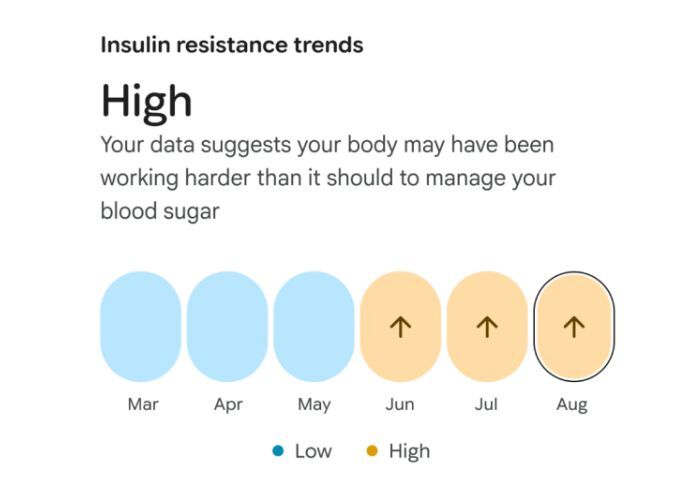
Blood pressure, sleep breathing, and insulin sensitivity trends
> Built on state-of-the-art Health Foundation Models trained on billions of minutes of sensor data from opted-in users and rigorously validated against gold-standard clinical measurements, these models power three new monthly trend summaries: blood pressure trends, sleep breathing quality trends, and insulin resistance trends. Rolling out soon — with your first detailed summary arriving after one month of wear — these reports illuminate metabolic, respiratory and cardiovascular shifts early, giving you clear insights to help you take control of your long-term health. Plus, monthly summaries will soon be available across our wearable portfolio, including the new Google Fitbit Air.
"insulin resistance trends" - whaaaaat? how would they do THAT? That would be huge for so many people, including diabetics, obese people or women with PCOS (PCOS alone affects more than 10% of women of reproductive age)
Is that measurement accurate? Like, a person starts taking Metformin -> and a few days later the watch detects a drop in insulin resistance?
No, it's not a glucose sensor. Extrapolating from the Google research published in Nature a few months ago on how they estimate insulin sensitivity using wearables (and not just BMI, age, etc): https://www.nature.com/articles/s41586-026-10179-2
Insulin sensitivity correlates with obesity, activity, sleep, etc. so it's not impossible that a wearable can give some degree of prediction. I guess it's mostly good motivation to support habits that increase sensitivity (physical activity, low stress).
FDA compliance has been tough for optical measurement of blood sugar and blood pressure. I'd imagine that this is why they are doing a monthly averages and keeping their claims subdued.
Yeah I find this one interesting. It's been rumoured for pretty much every Apple Watch for a decade, so they're clearly throwing tonnes of resources at it, and every year nothing materialises. This is one sensor feature that could really impact a lot of people.
Definitely not. Get a cheap CGM subscription if this is something you want to monitor and you need any sort of real data. They’re easy to apply, update quickly (within 15 minutes of a Hcg spike you will see it in the data) and you can derive A1C from it. Actual insulin resistance itself still requires a fasted blood draw at minimum and is not really recommended (too many methods with different ways of measuring each of which is clinically significant but needs interpretation — or you can do a 3-4 hour research lab test but the value is pretty limited).
Any time you see “trends” in a press release you should be very suspicious. It’s a sign that they can’t pass regulatory scrutiny and are trying to apply the research anyway. Your scale cannot measure fat percentage, your Samsung watch cannot measure blood pressure and your Garmin cannot measure VO2Max. These are all things they’d like to be able to do (and “trends” can have some value if they’re used correctly) but they are not the thing itself.
I'm quite curious. Friends I've talked to have been very pessimistic about accurately measuring blood sugar via a watch.
If they are actually able to get an optical measurement which is good enough for MoM or WoW trends, I'd agree it's pretty big even if they can't provide anything precise enough for real time / daily use. Just being able to roughly validate diet changes for women with PCOS could be very impactful and that's the smallest of the 3 populations you called out.
Yeah, I was researching this just last week and there is tons of funding going into wearable blood sugar monitors but nothing wearable sized coming out (several lab sized ones though).
I’d love to read more about what this is, and what technical signals / data they’re using.
Noninvasive blood glucose measurement has been a holy grail for wearables for over 10 years. People have thought they were going to crack it but the research just hasn’t panned out. You’re much better off getting a cheap CGM subscription, especially now that they’re available OTC most places.
This. I don't see the point of using a Pixel Watch or an Apple Watch or any watch that has 1 or 2 days of battery max.
My 3 year old Garmin has 2+ weeks battery life and is tracking activity, ox (ok, it's not medical grade), sleep, etc.
Also it does _not_ have a mic (something we're going to pay extra in a few years the way things go) and is not connected to anything wirelessly. No need for another device to set it up and you decide when you get data out using USB.
> 7 day battery life
Been using the fitbit air since day 1 and it never died on me. Charge it when I shower.
The only issue is the fabric strap is getting dirty, and the sensor gets a bit dirty (dead skin, etc.) compared to an Apple Watch.
Other than that, it's spectacular, and now with Apple Health, it's on par if not better than the Apple Watch. apple health only synced to the 4-5 of July, though. :/
My mid-50's mother was on quite a long unemployment streak, and I suggested she use realtime ML models to replace her webcam face with a de-aged and improved one.
Ageism and being attractive are both real things, like it or not... =/
I'm not sure people fully comprehend the trickle-down pop-culture/zeitgeist effects that LLM's are having/are going to have on humanity.
Because everyone now outsources much of their thinking and researching to LLM's, our collective culture + brain is shaped in a cyclical manner by using them.
It's the mechanical homogenization of culture and groupthink.
Is that really accurate though? I use Claude in my software job but the majority of my friends do not use it at all. And I never use it for anything other than that either.
TBH I don’t find it useful at all for personal use. It’s totally soulless for creative ventures and absolute dogshit at researching the things I want it to be good at (I.e. planning a vacation or finding new music).
All that combined with the social stigma makes me feel pretty skeptical that it’s some kind of pop culture shaping mechanism, at least not for a few more years.
We're all in our own personal bubbles and extrapolating from there as normal, but ChatGPT has some 800 million users, most of them outside the US. Countries like the Philippines and Thailand. I don't think they're all vibecoding the hottest new SaaS app but maybe they are.
Even the Philippines and Thailand are lower in per-capita usage compared to the US, most of the higher use are in Europe. Interestingly Australia & New Zealand are also pretty high, similar to Europe and far more than Asia & Africa in general, with the exception being Saudi Arabia (similar to US) and Israel (even higher than Australia). https://openai.com/signals/data
+1 to this. Many of my engineer friends don’t use AI even in cases where it could clearly help them. Not out of any principles stance but because they just don’t understand that it could speed up their work. It doesn’t help that the advertising surrounding AI hasn’t communicated its benefits well - either you’ve tried it and you get it or you just don’t know. I would imagine some early horseback riders in the 20th century probably felt similarly about the automobile.
Semi-related: Worked as a landscaper during my youth, one of my first jobs
I used to think that the line patterns mowed into grass were a purely aesthetic thing.
It turns out, the lines are mowed in a rotation to prevent wearing out the grass and causing damage. First you mow length-wise, then width-wise, then diagonally, finally diagonally in the opposite direction, before cycling through again.
Absolutely correct. If you always mow in the same direction, the grass always gets pushed in the same way by the lawnmowers blades and it will eventually morph to that direction and lose strength, which appears as grass that doesn't stand straight up, and it looks worse.
You worked for someone better than average, or I worked for someone worse than average, because this sounds like a thoughtful touch and they never told us anything like that.
Surprised no one here just does the outside border and spirals in (pinching off and immediately finishing irregular bulges). Looks neat, though more organic than rows, and is naturally motivating, as the second "half" always seems to go much quicker. Spiral the other way next time for evenness.
I don't usually do the diagonal paths but I do try to go at right angles to the previous mowing each time I mow the lawn (excepting when I can't remember which way I did it last time, but it's usually still visible) or a few narrow areas which really only make sense to mow in one direction.
How often did you mow the same grass to have to care about the direction of the previous mow?
I mow my garden between one to two weeks, according to the time of the year and sometimes I stop in June, if it stops raining like in 2022 and this year.
They don't mean do all those cuts each time you mow. You mow the grass in one direction one day, and then a few days later when it needs cut again, you mow a different pattern.
When I used to mow neighbor's yards as a kid, I'd do a crosshatch pattern that I'd rotate 45deg each week, orthagonal vs diagonal. Just doing one direction looks fine but a crosshatch looks even better, especially if they have thick, healthy grass. I wouldn't be as meticulous on the side and backyards, those would just get a single, slightly overlapping pass in whatever direction was convenient unless they had a really nice backyard, then I'd do extra there.
People like that golf course look and I'd get nice tips for doing it.
I do this very thing in the fall when all of my neighbor's trees drop their leaves which blow into my yard. I don't bag leaves. I mulch them. To get them down to a respectable looking yard, it can easily take this many passes. I do it all over again in the early spring towards the end of February when the Live Oak trees in my yard finally drop their leaves for the year. According to my watch, I can cover more than 2 miles just taking my mower for a walk on those days.
Depends where you live, what season, and what equipment.
I live in the PNW where the grass grows crazy fast in the spring, and I use a reel mower since my yard is small. It needs to be done regularly, and I'm not even a "lawn guy".
East-coast of Canada, the grass grows fairly well throughout the spring and summer but I think mowing excessively is... well, excessive. But I live in a neighbourhood of predominantly seniors who wash their car and mow their lawn every fucking day, presumably because they have nothing better to do, so anytime I try to sit outside and enjoy the lovely summer days it's ruined by all the lawnmowers. Wouldn't be so bad if they used reel mowers, but of course they're all on oversized lawn tractors to mow relatively small lawns.
But then, I also like my lawn to look just a bit "shaggy" instead of clean-cut all the time, so it's possible I'm in a bit of a minority here.
The problem with a reel mower is that if you let the grass get too long the reel mower won't cut it, so you pretty much have to do it every few days when it's growing fast.
I have a battery electric lawnmower. I found I got noticably better battery life after sharpening the blade to a near razor edge. Yes the edge is more fragile but it cuts the grass with much less resistance.
They still work when blunted which is most of the time. But ideally they are sharp and slicing pure grass, grass tolerates slicing better than ripping. It's like a sword, ideally it is razor sharp, doesn't chip when blunted, and still works as a decent club even when blunted because it will be the second it hits something hard.
They are meant to be sharp like an axe (high angle), not sharp like a knife (low angle). They aren’t supposed to be blunt like a butter knife. Dull blades damage the grass.
I believe the point is the wheel lines and to vary where the wheels go by changing the pattern each time you mow so you don't, for example, always drive exactly down the fence and cause a rut or mulch buildup or missed area.
I dont think it was "don't hurt the grass while you cut it" or "mow it four times in one sitting".
We people vary frequency with weather. Lawn tractors are heavy and, due to moisture, ground isn't always hard. On large properties some of the ground stays moist longer due to drainage issues. So yes, after years of indifferent mowing, one can detect where wheels have been moving topsoil.
Common lawn tractors integrate a mower deck. They're heavy duty riding mowers, but the terms are ambiguous. Large, commercial units can tow mower decks, but most lawn tractors used by property owners don't do that: it's hard to maneuver, and typically only used on fields.
You can do things correctly, with thought and attention even if they seem unimportant, or you can be a feckless dipshit. This applies to most things in life.
The argument is that it doesn't make a difference at certain levels of mowing.
From that perspective, it's like someone going over their strategies to avoid overloading their car's suspension when they're buying groceries. That's not a "thought and attention" scenario, that's a "why do you have half a ton of groceries" scenario.


Many years ago, on the Deno Discord, this person was posting some really cool PR's they had done to contribute to core.
I checked out their profile, and it turned out to be a 13 year old child (or some similarly astonishing young age)
Neat to see they eventually got picked up by Deno, definitely one of the more talented devs I've ever run across.
reply