Libraries find their roots in academic institutions, a context in which they are absolutely intended to be a place of study, not just a repository of books.
Well, apologies if I think kids being encouraged to go to libraries is more important than grown ups who can go _anywhere_ refusing to finding somewhere to read.
What kids should be encouraged to do is not merely attend a library as if simply being there is an end in itself, but to learn to appreciate and enjoy quiet, reflective learning.
I agree, children should be taught this. When I was a kid, the sanctity of quiet of the library was absolute. It was a special place. In a world where there's a screen literally everywhere you go, we should value the last quiet place rather than destroy it.
My 4 and 7 year olds do, my 10 month old doesn't, and I'd still like to be able to go to the library (and yay, I can, because we have nice libraries here that aren't full of aggressively shushy weirdos). Plus _I_ want to be able to talk in a library, about what books we want, about what words mean, about chess moves, whatever. It's just wrong to exclude people from a space because you want a free, quiet office, and I'm glad that more and more libraries agree.
Another problem is that thousands of turorials get few to none updates. It’s not unusual to google for whatever.js quirk and find yourself in a tutorial that uses method that was deprecated 2-3 versions ago. Of course part of this problem is in whatever.js itself, that bumps versions like hell, but you end up with tons of crap that will be never relevant anymore, but still hit the top because its author still writes popular articles.
Idk about HN-ers, but I find myself in this situation at least few times a week since the beginning of my webdev.
Yeah it's definitely odd, and rationally makes zero sense as you've pointed out, but feelings are weird, especially feelings of nostalgia and tradition.
I don't think so, the images were pretty low res iirc. I did some googling though, and the only thing I found was somebody that said "the game reads the model data out from the file's alpha channel". However, I'd expect the data to just be appended to the end of the file, since PNG works anyway with that.
PNG is extensible, so they could totally have defined a PNG "chunk" in the private namespace and shoved the data in that. They didn't though. They treated PNG as just a way to store image data and wrote their extra data into the image, encrypted in an amateurish way.
Bagel, lox, cucumber and cream cheese has become my new favorite thing lately (bonus points for a squeeze of lemon, capers or some red onion if those things are to be found).
However, I of course have no bagels or bagel accessories on the one day I read about mathematically correct bagels :(
I get the impression Go runs the microservice space. It's built for it and is incredibly fast despite the GC. I don't see Rust claiming that position anytime soon.
Where I live and work, golang is only used at one major client (because they’re US based, the decision must have happened elsewhere.)
Everything else is Spring Boot (java), Akka (Scala) or Nodejs. Apparently nobody wants to embrace a language designed for offshoring, so no Meetups, noisy user groups and so on... even Clojure is more popular
"The key point here is our programmers are Googlers, they’re not researchers. They’re typically, fairly young, fresh out of school, probably learned Java, maybe learned C or C++, probably learned Python. They’re not capable of understanding a brilliant language but we want to use them to build good software. So, the language that we give them has to be easy for them to understand and easy to adopt. – Rob Pike 1"
"It must be familiar, roughly C-like. Programmers working at Google are early in their careers and are most familiar with procedural languages, particularly from the C family. The need to get programmers productive quickly in a new language means that the language cannot be too radical. – Rob Pike 2"
So a language that makes it quite easy for enterprises to deal with developers as cogs.
Are you really saying that Rob Pike is part of some kind of conspiracy to offshore all the coding that's currently being done at Google SF? Golang has been around for a while now, and there's no sign of that happening.
Your responses to K0nserv and singhrac suggested that you were defending the claim that golang was "designed for" outsourcing.
If you're making the weaker claim that Go's design "can" have the effect of triggering outsourcing, then that's speculative and consequently rather difficult to refute. But you haven't provided a single piece of evidence that this has actually occurred, so far as I can see.
I was making the claim that can be a side effect of its design and the way the community is against common features in modern languages, deemed too complex.
Lets see how it looks a few years from now, given that it is becoming a mainstream language thanks to Docker and K8s adoption.
Software is more than just language features. Rob undoubtedly meant that he wanted it to be quick to be understood by a vast majority of Googlers, so that they can focus on writing good software.
Rust's USP over Go isn't more speed, it's better abstraction, and better correctness. Go is definitely a good tool for microservices, and it isnt going anywhere. But writing Rust is a joy, and I wouldnt be at all surprised if it also carves itself a niche in this area.
One of clippy's authors and maintainers here (though I didn't choose the name); why would you name such a program "lint"?
For me clippy evokes the image of a well-meaning, if at times clumsy helper that tries to nudge you in the right direction. I find that very fitting for a tool that...well...tries to nudge you in the right direction of writing good, fast, idiomatic code.
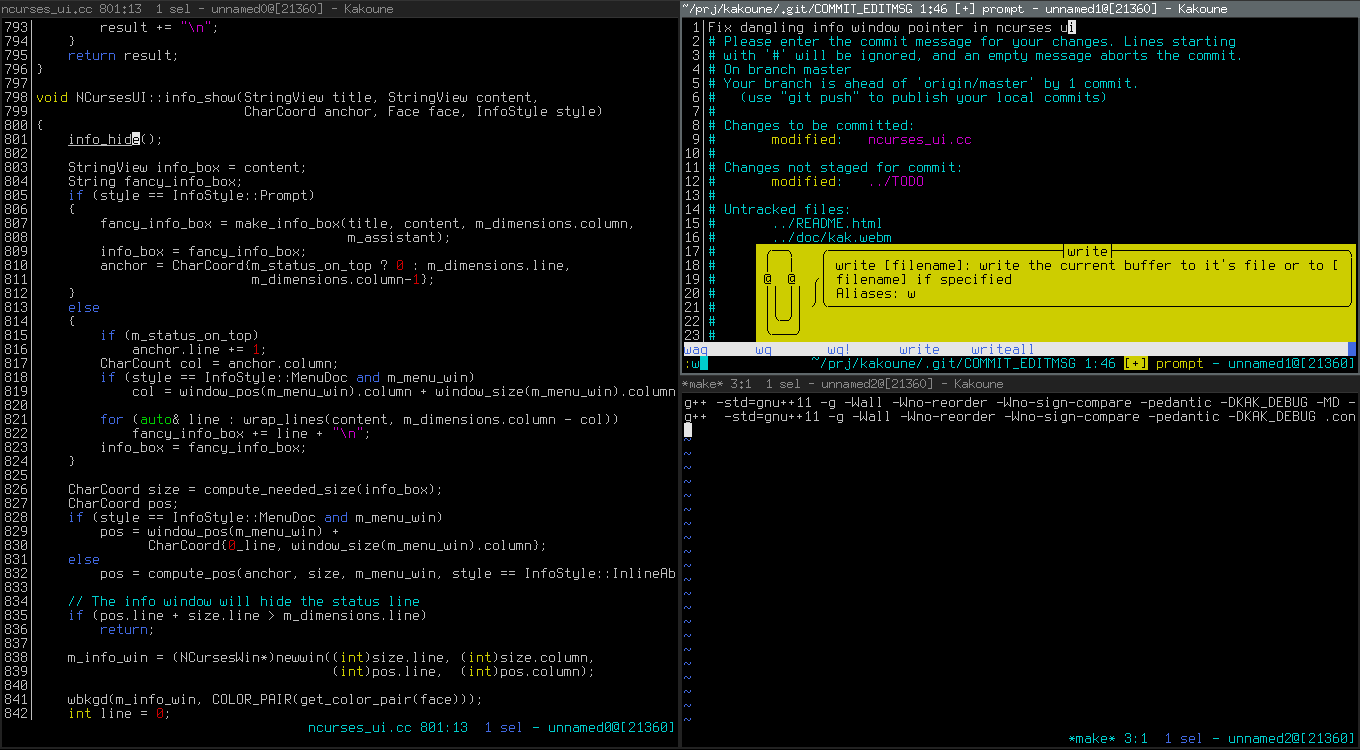
Clippy is reborn from its ashes into a cultural icon; it made you react, therefore it's a fun name to choose. Kakoune uses a clippy ASCII art for its immediate help, it's nice.
I think “kak” would be better translated as “poo”. Parents will routinely talk to their kids about “kak”, similar to the way US parents will use the word “poo”. The word “shit” generally has a much stronger meaning (and is therefore often obscured, as “s..t” or something similar.
I think "kak" still would be translated better as "shit", you wouldn't curse with "POO!". But in Dutch you can curse with "KAK!", just as 'SH*T!' in English.
Copyright doesn't apply to names, and the only US trademark for "clippy" is for medical equipment (and thus doesn't apply here) [1]. There doesn't seem to be any EU trademark for "clippy"