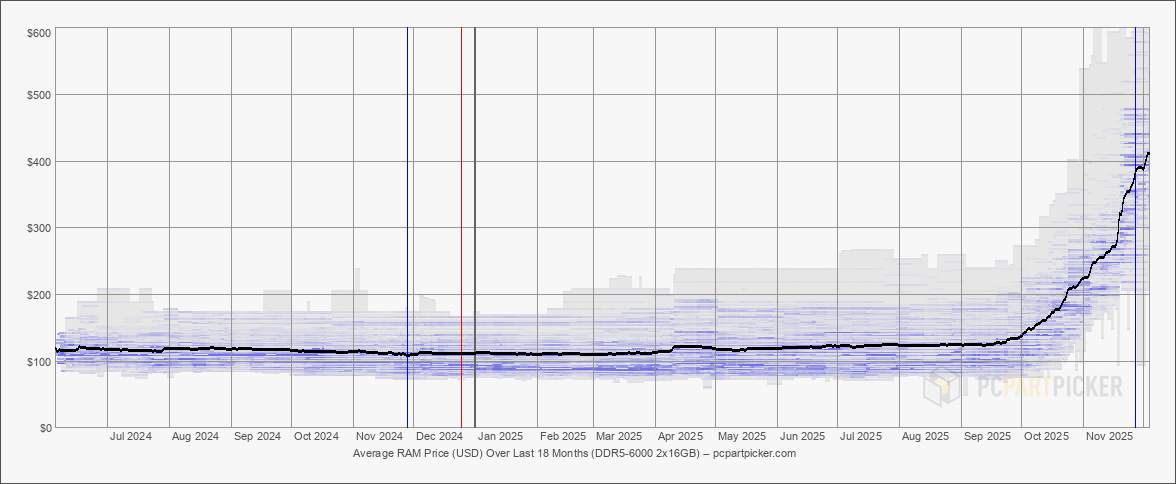
That is hilarious cope. The US benefits far far relatively more when the global economy is running smoothly than when able to sell oil higher, like some shithole petrostate. Appropriate I suppose.
There is an enormous amount of stuff that is only on archive.today, including stuff that is otherwise gone forever. A mix of stuff that somebody only ever did archive.today on and not archive.org, and stuff that could only be archived on archive.today because archive.org fails on it.
Anything on twitter post-login-wall for one. A million only-semi-paywalled news articles for others. But mainly an unfathomably long tail.
It was extremely distressing when the admin started(?) behaving badly for this reason. That others are starting to react this way to it is understandable. What a stupid tragedy.
If your argument is that value produced per-cpu will increase so significantly that the value produced by AGI/ASI per unit cost exceeds what humans can produce for their upkeep in food and shelter, then yes that seems to be one of the significant risks long term if governments don't intervene.
If the argument is that prices will skyrocket simply because of long-term AI demand, I think that ignores the fact that manufacturing vastly more products will stabilize prices up to the point that raw materials start to become significantly more expensive, and is strongly incentivized over the ~10-year timeframe for IC manufacturers.
I'm no economist, but if (when?) the AI bubble bursts and demand collapses at the price point memory and other related components are at, wouldn't price recover?
IF a theoretical AI bubble bursts sure. However the largest capitalized companies in the world and all the smartest people able to do cutting edge AI research are betting otherwise. This is also what the start of a takeoff looks like
Unbounded increases in complexity lead to diminishing returns on energy investment and increased system fragility which both contribute to an increased likelihood of collapse as solutions to old problems generate new problems faster than new solutions can be created since energy that should be dedicated to new solutions is needed to maintain the layers of complexity generated by the layers of previous solutions.
It should be noted that this has not revealed anywhere near as much as was being eagerly anticipated. So far nearly all the screenshots I've seen passed around are relatively low-follower barely-known accounts even in each one's own aligned political sphere.
I'm listening to ATC for education. I'm not confident in my ability to understand it correctly. That's why I qualified my level of certainty.
FWIW, the KBOS incident I saw didn't seem to be ATC either, if it was actually what I thought it was. It does seem like either of them may have been caught earlier if there had been more ATCs on staff or if they weren't as stressed or sleep deprived.
There is a dry pasta I use that, long story short, comes without a listed cooking time, whose correct cooking time I have experimentally determined to be ~18 minutes (though remarkably flexible, good at a much wider range than "normal"). I like it quite a lot (even though it seems to have the teflon-die surface rather than the bronze-die surface).
I think greater pasta thickness is underexplored, and the teflon-vs-bronze die thing as the highest determinant of pasta quality, while not nothing, is slightly-overstated r*dditry.
Bronze-die pasta has an obvious and substantial textural difference from teflon-die pasta. The stickiness of the bronze requires more force from the extruder, but results in a rougher surface on the pasta, because it literally sticks to the die.
Bronze-cut pasta holds sauce much better, especially for thinner sauces. It also makes your pasta water more starchy, since it loses more material during cooking. These things seem very obvious to me via my observations as a cook who uses both from time to time (but mostly the bronze stuff).
Both properties can be very useful (the first to everyone, the second just to those who use their pasta water in the sauce step).
It's good to question our assumptions from time to time, but there's no reason to just deny something like this with absolutely nothing to back it up.
I don't deny that it is beneficial (it clearly is, in my direct experience as well): I doubt that it is the highest determinant of quality, and suspect that even more basic properties like thickness have been systematically neglected and may be more consequential.
This sounded interesting, so I went and read a few articles. It seems, dies come in 5 categories: bronze, brass, steel, teflon coated (various bases) and plastic [0].
The bronze (and even brass) are uncoated and don't seem to lose material, on the contrary, they seem to get a patina with use. From what I read, bronze pasta is extruded at lower speed and temperature to account for the material (and the desired texture of the pasta). From an engineering point of view, this article give more insight [1].