There are no guarantees in life and I'm in technology because I like change...but when the announcement came across my email in October I was nervous for some of the same reasons.
But I always put more trust in my own interactions and I've had an opportunity now to work with quite a few of my new colleagues in IBM on both the engineering and business side. What I have seen from them is humility and curiosity about our business - there has been no arrogance. This has been true of their words and their actions so far. To me this is important because I think it's as a result of arrogance on the part of the acquirer that many deals go bad post-close.
Hope springs eternal in the hearts of men. Here's the thing: We have a LOT of evidence that those corporate promises mean nothing. There is a vast history inside and out of IBM of exactly this pattern of everyone saying nothing will change and then everything changes.
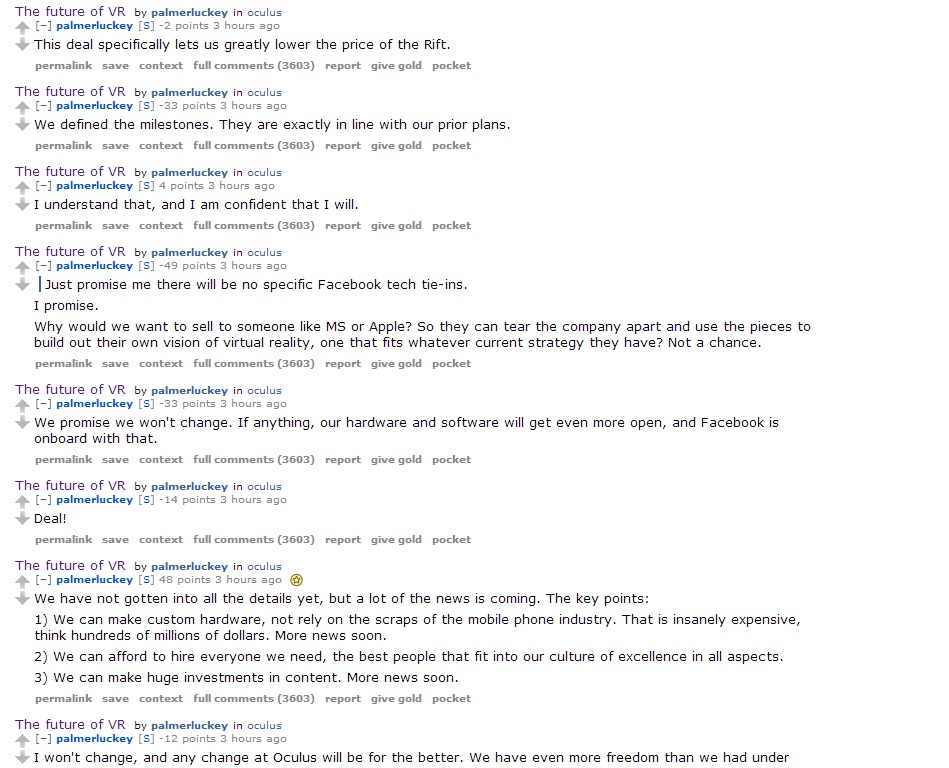
What you are saying to us is that the only reason you think nothing will change is that you really, really believe the IBM people. (Just like Palmer Luckey:https://thenextweb.com/wp-content/blogs.dir/1/files/2014/03/...) But that's even less than what other companies have been able to offer skeptics. But we know
"Seventy percent of U.S. acquisitions in the United States negatively impact the acquiring company’s results, sometimes immediately, and often continuing many years after purchase. Approximately 40 percent of the acquisitions of the last 10 years brought devastating business results. In about 80 percent of such cases, product or service, market share, and cultural impact are far below the goals anticipated in the beginning."
https://media.terry.uga.edu/socrates/publications/2011/07/bi...
YOU might be convinced, but you haven't given anyone a reason to believe it.
From my experience the only real proof that will convince people comes from the actions that are taken from now forward. I'd ask that if you believe these actions are harmful to developers or open source communities let me know @bradmicklea on Twitter.
Public statements are garbage and just sales pitches to reassure investors.
Unless Red Hat's deal legally mandated things stay a certain way in actual words written in a contract, then it's literally nothing and IBM can gut the place tomorrow if they wanted to.
This happens all the time with acquisitions. Most notable is TravisCI firing what, most of their senior staff 6 months after acquisition?
Proof will come in the actions that follow. If you see changes in how Red Hat behaves in the community feel free to let me know - @bradmicklea on Twitter.
I respectfully disagree - I'm a Red Hatter so you can take that for what it's worth. To me the 34B buys IBM the real estate in the open hybrid cloud market which Red Hat has built up in the last 5 years. That is part of a large and rapidly growing market. If IBM interferes with Red Hat they will likely squander the value of what we've built. If they foster what Red Hat did to win that critical ground then their 34B could stand to increase substantially.
Respectfully, I think you are being overly optimistic. I worked at a company acquired by HP several years ago. They bought us because we were beating them, and yet, they still thought they knew better, and intefered.
You can guess how things ended up.
I am certain IBM will think they know better than Red Hat, and will intefere. It is in their culture. The HPs and IBMs of the world no longer innovate. They acquire innovation and sqaunder it.
34billion is a lot of money to mess around with so hopefully they will at least thing twice before trying anything too dramatic, plus Jim Whitehurst (Red Hat CEO) is going to be reporting directly in to Ginni Rometty (IBM CEO) which should help provide some aircover. In the end it will probably depend on a) Red Hat continuing to grow and make money, because why would you kill a golden goose, and b) how good Jim Whitehurst is at the inevitable corporate politics
At that level of a company like IBM, everyone is purely political. The CEO can’t necessarily force specific changes, and has to work with other senior executives who have clauses in their contracts that allow them to exit with huge payoffs if certain job responsibilities are taken away from them. Those senior executives (esp at IBM) have immense power; and will easily be able to kill RedHat by a thousand cuts or just parcel out the talent at the company.
Just poach a few key folks internally from RedHat to lead “strategic initiatives” and backfill their roles with IBM lifers. The culture will degrade accordingly.
I certainly don't want to argue or appear confrontational, but wanted to ask you this:
Have there ever been any situations where the acquisition of a smaller company by a larger one has resulted in the smaller company remaining independent? Or has there been any positives for companies like Red Hat when they get bought?
Usually I hear or read the positive-yet-bland press release talking about how wonderful this is, and how big-corp won't destroy little-corp's culture. Yet a year or less afterwards, I read stories of how everyone in little-corp has been laid off, and now little-corps applications/services are now crap.
I'm a huge Fedora/CentOS/RHEL fan, and use it every opportunity I get. I'm very, very worried that Red Hat will be gutted and defiled until there's nothing left. Which is a very, very bad thing for open source because Red Hat is a huge cornerstone of OSS development and support.
I'm also not optimistic, but I do expect that IBM leadership can understand a balance sheet. Red Hat has almost no IP, given the nature of open source development. They have a few billion in assets [0], tack on a few more for existing client relationships, brand recognition, and future revenues. $34B is a massive premium over that, so what is IBM buying? IBM's people and processes have failed to develop successful cloud strategy, and not for lack of trying. Red Hat's people and processes have succeeded, so presumably that's what they're paying all that money for. I'm hoping it's obvious to IBM that they shouldn't meddle and squander what they've bought.
What you don't hear about are the dozens of companies Disney has acquired then shut down over the years. Playdom. Tapulous. Junction Point Studios. Fall line Studios. Wideload Games. Propaganda Games. Black Rock Studios.
Or the tragedy of LucasArts, which is one reason I left LucasFilm off the list.
Disney and gaming seem like a match made in heaven, but for some reason it seems like the mouse struggles to perform in that market compared to its unqualified successes in Movies, TV, and theme parks.
Are we talking about financial success, or making quality products? I get that shareholders care about the former, but as hackers we should care about the latter.
Pixar movies have become crappy sequels made to sell toys. Instagram has become an ad infested product that tries to have every feature, resulting in a confused mess. Exxon/Mobil is one of the worst things that could have happened to the planet.
eBay/PayPal is a good one that made product sense.
I’m not big enough of a Marvel fan to judge that one.
"Pixar movies have become crappy sequels made to sell toys."
Not really. Most of what they do isn't sequels, and the ones they do are great. I saw Toy Story in the cinema and loved it. My daughter just saw Toy Story 4 in the cinema and loved it. So...financially successful, and people love the movies - not sure how this is a good example, to be honest (unless the metric is "I don't like it", of course...).
I'm not entirely convinced Apple really wanted Steve Jobs back. They really needed an operating system after the failure of Copland though.
If IBM shareholders think that the future of IBM is the cloud, and that RedHat is the cloud at IBM, I would not be entirely surprised for Jim Whitehurst to replace Ginni Rometty a couple years down the road... 100% speculation from very very far away (I don't pay for anything from either IBM or RedHat).
Interesting theory. Based on history and company performance (I don't have sources for this) Rometty's run as CEO has outlasted most expectations. This is definitely an interesting thought
I doubt YouTube would have survived the lawsuits that were brewing before they were purchased. And then precedent would have been set against all video sharing sites, so the Internet would have been significantly worse off and streaming and independent content production would have been set back by a decade. I think the Google acquisition was a good thing, even if it means there are ads on videos unless you pay $5/month to remove them.
At the risk of opening up another debate I'd say that GitHub currently looks to be doing better (more releases, more enterprise sales) after Microsoft's purchase than before. I also see them as a model of how to keep a distinct culture alive and grow it inside a larger entity. If GitHub can do it I think Red Hat can too. But only time will tell. Everything at this stage is some form of speculation.
Indeed since in another thread recently, folks pointed out that RH had taken over core functions, such as systemd, pulseaudio, dbus, gnome, wayland, significant share of kernel, etc.
The agency I work at was bought up by the monolithic AKQA, which in turn was bought by the epic proportioned WPP.
At first, that meant our one to four person operation in SF (most are in London) moved from hanging around Google offices to getting a terrible fishbowl in AKQA. Then, right when I joined, they got approved for their own space in the financial district of SF. Since then, they've been expanding rapidly, with basically no input or oversight from AKQA or WPP.
So at least in this case it seems there was no issue.
IBM had a huge push about 20 years ago to spend their resources on Linux, I believe this played a part in Linux beating everything from SCO, Solaris and even AIX and BSD out of the market.
Microsoft seems to be doing the acquisition game right. All their recent purchases of indie video game studios have been well met, but that's most likely because of the leadership of Phil Spencer
They’re IBM, of course they will squander it. How do you think they went from king of the hill to grumbling behemoth that is constantly behind the times?
As someone who has worked at a company like that before I can foresee continual IBM management changes until you get the right combination of buiness minded leadership that will can everything at Redhat that isn’t directly related to developing what they consider obvious money makers.
Every company in the world is told they can keep their corporate culture after an acquisition. This never actually happens, or at least I've never seen it. Optimism that they shouldn't screw up Red Hat is just not how large corporatiols operate.
Red Hat's business model and open culture isn't changing. We will remain independent and I look at this as an opportunity for more people to engage with our stellar support and field teams.
I remember a very similar email from my company's CEO during a merger. Within months he had retired with millions and everything had changed. I sincerely wish Red Hat and your work doesn't fall victim to a similar fate, but IBM literally owns you as of today.
The CEO doesn't have full control over everything. Plenty can (and did) change even without a change in the CEO. Again - they are literally owned by IBM now. I'd be optimistic if Red Hat really were to be fully independent with respect to products. But unless IBM made this investment purely as a financial strategy, they will absolutely begin interfering.
Wish you luck, but strongly suggest you remain realistic about how this dance goes, simply for your own sake.
Thing is, IBM has been around for a long time and has a long history of acquisitions. They've done it enough that there's a process. My suggestion would be to go through this list and decide which one looks most like the situation in which you find yourself.
If you were feeling like a little research, you could probably even find the names of some folks in a job role like yours who were there at the time and see what happened to them post-acquisition.
"Red Hat's business model and open culture isn't changing. We will remain independent "
Oh, man, wouldn't it be pretty to think so?
In all seriousness, this is an INSANELY naive statement. It doesn't matter what IBM says, and it matters less what the Red Hat CEO says. You got bought. They can, and will, do whatever they want, regardless of what lip service they pay to independence or preserving culture or whatever.
They've just spent $34billion for what is essentially a culture and a customer base (all the software is open source, and the building are leased), so yes they absolutely can do whatever they want but burning it all to the ground is going to cause some interesting questions about exactly how that increased shareholder value. It could all fall apart but IBM management have a massive incentive to make it work.
Having worked for a company that got bought out for the "culture and employees", I can tell you that's a lie. You got bought out for the partnerships and technology, and everything else is a bonus. You will fall in line with the IBM culture, or you will be phased out. If you're not a salesperson, I'd suggest you spread your resume around.
No. Individual managers at IBM have strong incentives to meet their own comp plan incentives, and that's it.
Can you point to any acquisition EVER where the acquired company remained "independent" for a meaningful amount of time? Or where the smaller firm retained their own culture? It doesn't happen.
This seems like wishful thinking. These are exactly the same things that are always said. You may be fine for a few weeks, a few months, or even a few years, but IBM will inevitably interfere enough to cause a serious culture shift (or collapse).
Red Hat culture hasn't been anything to brag about. They basically maintain an outdated version of Linux that companies only pay for to get support and shift liability, but there is nothing innovative about Red Hat Linux.
I'd really suggest finding one of your colleagues that's seen IBM's track record with acquisitions and pick their brain a bit. They'll have much more relevant information for you than your old CEO.
I’m Brad Micklea and I lead Red Hat’s Developer Business Unit, which covers developer evangelism, our developer program at developers.redhat.com, and our developer tools. All these facets of our business, as with Red Hat more generally, will remain independent from IBM. This means that…
- You’ll still bump into our fantastic Red Hat developer relations team at events, meetups and keynotes.
- The Red Hat developer program—including the site, blog, and our social media channels—will remain independent and continue to focus on great open source software and culture.
- If you’re a member of the developer program, you’ll continue to enjoy free access to Red Hat software downloads, eBooks, events and great content.
I’m sure there is some nervousness in the developer community with this announcement. I welcome your questions and will be monitoring this thread and replying to as many as I can over the coming day or so.
Does IBM have any plan to move any of Red Hat's workers offshore?
What exactly, from your perspective, is IBM's expectation of this investment? Surely, IBM plans to have greater integration between IBM products/services and Red Hat products/services?
I can't really speak to business or HR questions. My role is focused on our relationship with developers. What I can say...We are a distinct entity in IBM and the only person reporting to an IBMer is Jim (our CEO) who now reports to Ginny (IBM CEO). We retain control over our associates. That said, the actions taken in the coming months and years will provide the real proof.
Speaking to integration. In terms of the Red Hat developer tools portfolio (which is ~15 tools and plugins), and a mix of Red Hat supported products and upstream open source projects - there is no change to our roadmap.
We are committed to continuing to invest deeply in open source as we have from Red Hat's inception.
We are going to continue to publish and support IDE plugins for VS Code [1], JetBrains [2] and Eclipse [3] - even if they compete with IBM plugins.
We will also continue to offer CodeReady Workspaces for the OpenShift Kubernetes platform [4]. I expect this will be of increasing interest to IBM customers as they adopt OpenShift more aggressively. The open source upstream project for this offering (Eclipse Che [5]) is also an area that has seen increasing IBM participation over the past year.
In open source communities there continues to be collaboration around the Eclipse Foundation's Cloud Development portfolio [6]. Be on the lookout for some announcements here in the coming months.
Similarly there's interest from IBM in continuing to create open source language servers that adhere to the Language Server Protocol [7] that the Red Hat tools could consume.
Unless those commitments are in the form of formal contracts, written down, then I would not place a great deal of faith in them. Unless they have legal obligations to abide by them, then IBM don't need to keep them.
I run Red Hat's Developer program, our developer tools portfolio and our developer relations team. When I first heard the news I had a similar reaction. But I've worked with IBM'ers in open source projects for years and they've always been great contributors. Perhaps more importantly both IBM and Red Hat are very committed to not changing our open culture and open source development model. That's been the source of our growth and why IBM felt we were worth 34B. Ultimately words are cheap, so if you see Red Hat's actions in the open source community changing please say something - I for one am committed to continuing to work the open source way.
Open source doesn't make money, you're at IBM now to save their failing cloud business. If you can't do that, expect your time on open source to dry up.
Open source creates market share, that's the foundation on which money can be made. Red Hat's business model wasn't charging for the open software, it was charging for the expertise we have in supporting that open software. The more market share the open source software has, the greater the monetary opportunity for us and the more we can put back into the communities. Red Hat has offices in ~40 countries and IBM is in ~175. That's a lot more touch points for us.
I'm the project lead for Che and can confirm that Red Hat will be contributing changes that will allow Che to run on OpenShift, but it will also roll in most of the enterprise features that were previously only available in the proprietary licensed Codenvy product. https://www.eclipse.org/che/
We're just starting to analyze Che for our coding school. Wouldn't all this just be possible with the Terminal? I'm not saying plugins aren't good, just trying to see if the terminal is a full featured one that would support something like, for example, installing the heroku toolbelt.
I haven't even started with a real test, just reading about it, so sorry for my lack of research, I'm just reading through the features (https://www.eclipse.org/che/features/) and saw the terminal, which is fundamental for us.
Eclipse Che is an open source developer workspace server and cloud IDE (https://www.eclipse.org/che/). It's got strong Java support as well as support for many other languages.
You can run it wherever Docker runs (and soon wherever you have OpenShift) and you can use it for free with 3GB RAM at codenvy.io.
Serious question: has Eclipse Che gotten easier to setup over the past year?
I tried it out in May/June 2016, and setting it up was very difficult -- the documentation was sparse and I ran into errors all over the place. When I finally had it setup correctly, a new version came out, and updating killed all my existing workspaces.
So, has there been a focus on documentation, stability, and clear upgrade paths in the last year?
The docker-based install is a little tricky because we need access to the docker socket and have to create a mount point so that workspaces can be stored locally (so they're not lost with upgrades). It's likely that when you last tried it we had not completed the local storage option.
If you have a chance try this: https://www.eclipse.org/che/docs/setup/getting-started/index... - we've added interactive help but we've also tried to clarify the syntax needed. I'd love to hear what you think. Of course if you hit issues please let us know on the eclipse/che GitHub repo.
OpenShift.io is pre-beta but we have begun onboarding in order to get early feedback. So far ~400 people and in and we are slowly adding more as we stabilize and build out the product and underlying SaaS infrastructure.
We will be communicating our progress more openly and consistently with those on the waitlist. We really do appreciate your patience and are working hard to get people onboard.
I don't mean to spout off in a public forum, don't think I don't understand how much work is involved in putting out something that we're not going to be disappointed with!
But I have been interested in OpenShift, and it is a good sign for me that so many people who obviously are involved in OpenShift are representing on this thread.
I will definitely give Openshift another look soon. We're building a group of experienced devs to help onboarding our new dev employees as they come on, and we're going to have some standard-setting capacity when it comes to showing off the tools we use.
(We are currently well behind in the K8S space imho, but getting better and I think making a more serious push for it is going to come soon. Our institution is large and like all large institutions Byzantine bureaucracy results in some extreme levels of inertia; well we haven't really dove into containers near the level I had at my last position, which was still only about token level – most core infrastructure still not containerized or even touching any containers.)
So, blank canvas!
I'm very much hoping to have an array of tools that I can share with new devs, so they can organically decide what works best for their own selves. I had kind of discounted oc based on not having used it much myself, but I do remember having some joy at reading the documentation that it was more centrally located and easier to "grok" as well as feeling more complete.
Anyway both things that will be super helpful to anyone who is new at Kubernetes or Dev stuff in general. There is just so much to learn and the ecosystem is ofc constantly evolving!
I will keep openshift origin in the toolbox and take another look at pro offering.